
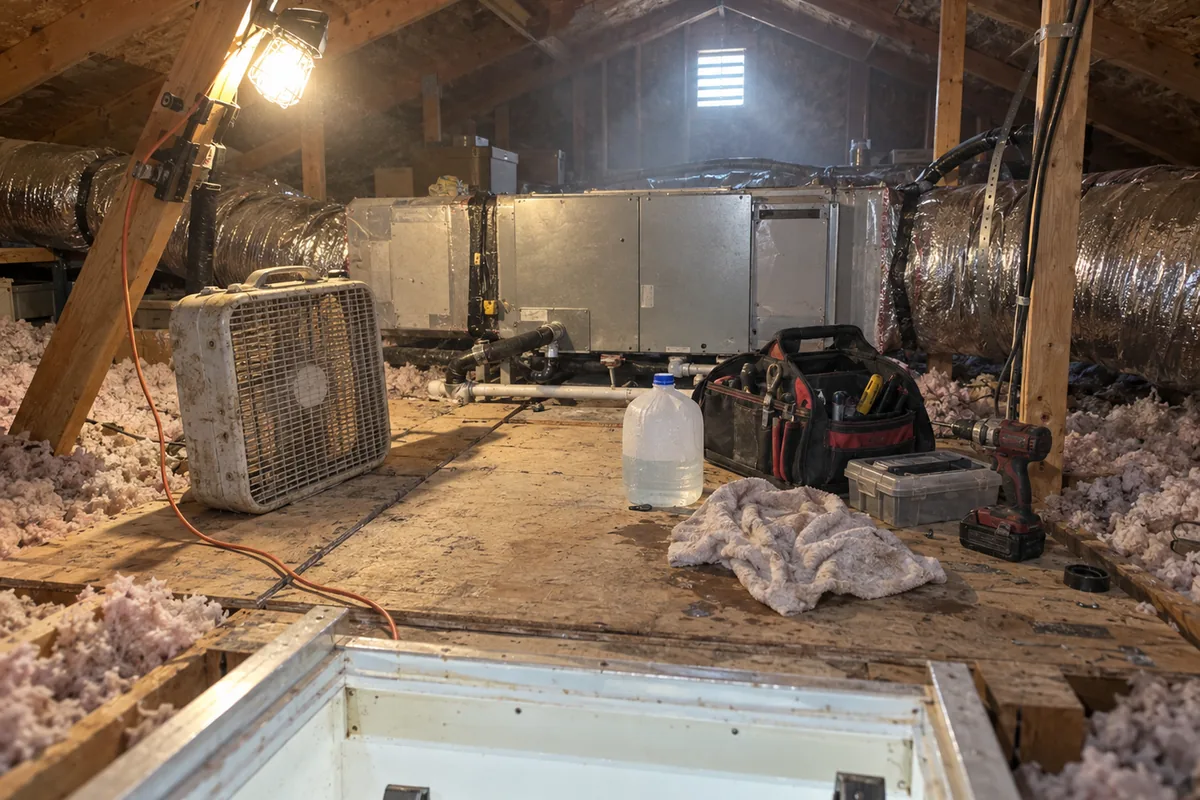
The install is a coil and a blower motor in a July attic, and the man doing it is four days into the job. He is twenty six, he is in better shape than anyone else on the truck, and he does not want to be the new guy who asks to come down. He comes down anyway, an hour later than he should have, and he is confused and not sweating. The lead tech gets him into the van with the air conditioning running and calls the office, and now there is a truck out of service, three afternoon calls with nobody assigned to them, and a phone that has started ringing because it is 97 degrees outside.
Every part of that is predictable, and the part that is easiest to miss is the fourth day. Not the heat, the fourth day.
There is still no federal heat standard, and that is not the same thing as no enforcement. OSHA’s proposed heat rule has been sitting since August 2024 with no target date for a final rule. Meanwhile the agency’s revised Heat National Emphasis Program took effect April 10, 2026 and runs for five years, heat gets cited today under the General Duty Clause, and in a growing number of states there is an actual enforceable standard with numbers in it. For a residential HVAC shop the awkward part is that the worst exposure on the schedule is indoors, in a customer’s attic, and almost every heat policy written for a trade assumes the crew is outside.
The rule that has not arrived
OSHA published the proposed rule, Heat Injury and Illness Prevention in Outdoor and Indoor Work Settings, on August 30, 2024. The informal public hearing concluded July 2, 2025, and the post hearing comment period for participants closed October 30, 2025. Since then the rulemaking has stayed on the Unified Agenda without moving. The Department of Labor’s 2026 regulatory plan says OSHA intends to finalize the standard while addressing the burdens commenters identified, and it sets no date for doing it.
So the honest read is that a final federal heat standard is not something to plan your next two summers around. Do not tell your crew a rule is coming, and do not tell them nothing applies.
What applies right now is Section 5(a)(1) of the OSH Act, the General Duty Clause. With no specific standard on the books, that is the tool OSHA uses on heat, and it is worth knowing what the agency has to prove, because the four elements tell you exactly what your defense looks like:
- The employer failed to keep the workplace free of a hazard to which its employees were exposed.
- The hazard was recognized.
- The hazard was causing or likely to cause death or serious physical harm.
- There was a feasible and useful method to correct it.
Element two is not a fight anyone wins in 2026. Heat is a recognized hazard in construction, and the agency has spent four years publishing on it. Element four is the one you control. If there is a feasible method of abatement, and you were using it, and you can show that you were using it, the citation gets much harder to write. If the feasible method is water, shade, and paid breaks, and you were not providing them, the citation writes itself.
The program that did arrive
The Heat National Emphasis Program, CPL 03-00-024, was reissued effective April 10, 2026 and runs five years, into 2031. It replaces the 2022 version, which had been extended once and would otherwise have lapsed that same week.
Two mechanics in it matter to a contractor.
Heat priority days. The NEP treats a day as a heat priority day when the heat index is expected to reach 80 degrees Fahrenheit or higher. On days when the National Weather Service has issued a heat advisory or warning for an area, OSHA can run programmed inspections in the targeted industries. In much of the southern half of the country, “heat index at or above 80” describes most of the working year, not an unusual afternoon.
The target list changed, and it got shorter. The revised Appendix A holds 55 industries. Compared with the 2022 program, 46 industries came off the list, 33 stayed, and 22 were added. Construction is represented on it, including residential and nonresidential building and specialty trade contractor categories.
Here is the part to handle carefully, and I am going to be straight about the limit of what I can tell you. The list is by NAICS code, and I could not confirm from OSHA’s published directive whether 238220, Plumbing, Heating, and Air-Conditioning Contractors, is one of the 55. Secondary write ups describe the construction categories in general terms and none of them reproduces the appendix. So open the directive and read Appendix A against your own NAICS code, and do not take a summary’s word for it, including this one. It is a ten minute job and it is the difference between “we might be on a programmed inspection list” and knowing.
Knowing also matters less than people assume, because of the third mechanic. Being off the target list does not put you out of reach. Unprogrammed inspections come from complaints, referrals, and severe injury reports, and they do not care about Appendix A. The NEP also directs compliance officers who are already on a site for something unrelated, on a heat priority day, to ask about heat and expand the inspection if hazards are apparent. An inspector who came for a fall protection referral can leave with a heat citation.
The exposure that HVAC gets wrong
Most heat guidance in the trades is written for people who work outside, and most shops adopt it that way. Water cooler on the truck, canopy at the jobsite, watch the guys on the roof in the afternoon. All correct, and all aimed at the wrong half of your risk.
Your techs’ worst thermal exposure is inside a building. It is a vented attic in the afternoon, in an unconditioned space with a radiant roof deck overhead, wearing long sleeves, kneeling on joists, working a horizontal air handler and its drain pan or pulling flex duct across truss chords. It is a crawlspace. It is a mechanical closet in a house where the air conditioning is the reason you were called, which means the house itself is the failure. That is not an edge case in residential HVAC. On a no cool call in August it is the job.
California’s indoor heat rule is instructive here even if you never work in California, because it is the most developed indoor standard in the country and it shows how the drafters thought about this. Section 3396 of Title 8 applies to indoor work areas at or above 82 degrees Fahrenheit when employees are present, and all of its provisions kick in at 87 degrees, or at 87 heat index, or at 82 degrees where employees wear clothing that restricts heat removal or work in a high radiant heat area. An attic under a summer roof deck is a textbook high radiant heat area.
Look at what it exempts and the picture gets sharper. Incidental exposure is exempt: 82 to 95 degrees for less than fifteen minutes in any sixty minute period. A tech who ducks into an attic to read a model number is incidental. A tech doing a coil changeout is not, and no amount of calling it a quick job changes the arithmetic. Vehicles are exempt too, but only where the air conditioning is functioning. A van with a dead compressor is not a cool down area, it is another indoor work area, and everyone in the shop already knows which van that is.
The rule also requires cool down areas kept below 82 degrees where feasible, blocked from direct sunlight and shielded from other radiant heat sources. On a residential jobsite that is a real question with a real answer, and the answer is usually the conditioned part of the house, the van with working air conditioning, or shade with a fan. It is not the garage.
What the state you work in already requires
If you are in a state that runs its own OSHA plan with a heat standard, none of the federal stalling matters. You have numbers today.
California is the one I can quote precisely, from the regulations themselves. Section 3395, outdoor, requires shade when the temperature exceeds 80 degrees, high heat procedures at or above 95 degrees, drinking water at one quart per employee per hour for the entire shift, and a preventative cool down rest of at least five minutes beyond the time needed to reach shade. Newly assigned employees must be closely observed by a supervisor for their first fourteen days. During a heat wave, defined as 80 degrees or more and at least 10 degrees above the average high of the preceding five days, everyone gets closely observed. The written plan has to exist in English and in the language understood by the majority of employees.
Several other states have their own enforceable heat rules, including Oregon, Washington, Maryland, Nevada, and Colorado, with varying triggers and varying indoor coverage. If you are in one, the state plan’s text governs and you should be reading it rather than a national summary. If you are in a federal OSHA state, you are in General Duty Clause territory, which means no numbers and no safe harbor, just the four elements.
Build to the proposal, because it costs you nothing to be early
The proposed federal rule may or may not land. Its contents are still the most useful blueprint available, because they line up closely with what the states that already regulate this decided independently, and because meeting them is precisely the evidence that kills element four of a General Duty Clause case.
The proposal is built on two triggers. At an initial heat trigger of 80 degrees heat index: cool drinking water in sufficient quantity, described as one quart per employee per hour, break areas with cooling, paid rest breaks as needed, acclimatization for new and returning employees, and indoor controls such as ventilation or air conditioning where feasible. At a high heat trigger of 90 degrees heat index: a paid rest break of at least fifteen minutes in the break area at least every two hours, and a system for observing employees for signs and symptoms. Time spent walking to the break area or removing gear does not count toward the break. Underneath both sits a written Heat Injury and Illness Prevention Plan and training.
Notice how little of that is expensive. Water, a shaded or conditioned place to sit, a clock, a written page, and a supervisor who looks at people. The costly part is the one shops skip.
Acclimatization is the part shops skip
Go back to the fourth day.
Both the California rule and the federal proposal single out new employees for close observation, fourteen days in California’s case, a graduated first week in the proposal’s. Every serious heat standard in the country contains some version of that provision, and it is the one that gets dropped first, because it is the only requirement that costs production rather than money. Water is cheap. Slowing a new hire’s first week down is not, and it is the requirement with the clearest logic behind it. The body’s adaptation to heat work takes days it has not had yet.
In residential HVAC the exposure is worse than the calendar suggests, because a new tech’s first week is often the week they are handed the attic work. It is unglamorous, it does not require much diagnostic skill, and it is what you give the person who is still learning. That is how the least acclimatized body on the payroll ends up in the hottest space on the jobsite, alone, wanting to prove something.
A returning tech counts too. Someone back from a week of vacation, or off the schedule with an injury, or a seasonal hire coming back for the summer, has lost the adaptation. So has everyone, on the first serious heat of the year, which is the argument for treating the first heat wave of the season as a distinct operational event rather than a busy week.
What to actually change on Monday
- Read Appendix A of CPL 03-00-024 against your NAICS code. Ten minutes, and it settles whether you are a programmed inspection candidate on heat advisory days. Then stop treating that as the whole question, because complaints and referrals reach everyone.
- Write the plan, and make it name attics. A one page plan that says water, cool down location, breaks, who watches, and what happens if someone goes down. If it only describes outdoor work, it does not describe your job. Attics, crawlspaces, and no cool houses belong in the text.
- Put a real acclimatization rule on new hires. Fourteen days of a named person checking on them, lighter attic assignments in week one, and the same treatment for anyone returning after time off. Write down that you did it.
- Check the van air conditioning before the season, not during it. Your cool down area is frequently the van. A van with a dead compressor quietly removes the control your plan is relying on.
- Buy a heat index reading, do not estimate one. The NEP and the proposal are both written in heat index, not temperature. The OSHA-NIOSH Heat Safety Tool app gives you the outdoor number for free. For an attic you need to actually measure, because the ambient forecast tells you nothing about the space your tech is in.
- Train the crew on symptoms, and specifically on confusion. Cramps and heavy sweating are the warnings people know. Confusion, and skin that has stopped sweating, are the emergency, and by then the affected person is the last one who will recognize it.
- Decide in advance what you cancel. The hardest call is turning down revenue on the hottest day of the year. Making that decision at 6 a.m. against a written trigger is much easier than making it at 2 p.m. against a schedule.
The version of this that reaches your phone
Heat waves are the cruelest scheduling problem your business has, because the two pressures arrive together and point in opposite directions. The phone volume spikes exactly when the crew needs to work slower, take breaks that are not optional, and be pulled off attic work in the afternoon. Every heat safety decision you make correctly costs you capacity on the day capacity is worth the most.
That is a triage problem before it is a staffing problem. When a tech goes down and the calls have to be redistributed, or when you have decided the attics stop at 2 p.m. and the callbacks do not, someone has to answer the phone, get the address and the equipment and whether anyone in the house is elderly or medically vulnerable, and get it in front of a human who can make the call about tonight versus tomorrow morning. That work does not stop while your office manager is on the line with a customer or you are driving to meet an ambulance.
That is the job Dial 72 does, on the days when everybody available is already busy. See how it works, or pricing if the answer right now is voicemail.
Quick answers
Is there a federal OSHA heat standard? No. The proposed rule, Heat Injury and Illness Prevention in Outdoor and Indoor Work Settings, was published August 30, 2024 and has not been finalized. The hearing concluded July 2, 2025 and post hearing comments closed October 30, 2025. The 2026 regulatory plan states an intent to finalize it and sets no target date.
Then how does OSHA cite heat? Under Section 5(a)(1) of the OSH Act, the General Duty Clause. The agency must show a recognized hazard causing or likely to cause death or serious physical harm, employee exposure, and a feasible method of correction. Documented water, rest, shade, and acclimatization practices are what undercut the last element.
What is the Heat NEP and is it still running? CPL 03-00-024, the National Emphasis Program for outdoor and indoor heat related hazards. The revised version took effect April 10, 2026 and runs five years, through 2031. It replaced the 2022 program, which was set to lapse.
Is my shop on the target list? Check Appendix A of the directive against your NAICS code. The revised list holds 55 industries, with 46 removed, 33 retained, and 22 added compared with 2022, and construction categories are represented. Verify your own code rather than relying on a summary.
Does being off the list mean I will not be inspected for heat? No. The target list drives programmed inspections. Complaints, referrals, and severe injury reports produce unprogrammed inspections regardless, and an inspector on site for another reason on a heat priority day can ask about heat and expand the scope.
What counts as a heat priority day? A day when the heat index is expected to reach 80 degrees Fahrenheit or higher. Programmed inspection activity is tied to National Weather Service heat advisories and warnings for the area.
Does any of this cover indoor work like attics? The proposed federal rule covers indoor and outdoor settings, and the NEP is titled for both. California’s Section 3396 is the developed indoor standard: it applies at 82 degrees, with all provisions at 87 degrees, or at 82 degrees in high radiant heat areas or where clothing restricts heat removal. Brief exposure of under fifteen minutes per hour between 82 and 95 degrees is exempt, which does not describe attic installation work.
What would the proposed rule require if it passes? At 80 degrees heat index: water at one quart per employee per hour, break areas with cooling, paid breaks as needed, acclimatization for new and returning employees. At 90 degrees heat index: a paid fifteen minute break at least every two hours plus observation for symptoms. Plus a written prevention plan and training.
Which states already have their own heat rules? California, Oregon, Washington, Maryland, Nevada, and Colorado have adopted enforceable heat standards, with different triggers and different indoor coverage. Read your own state plan’s text, because the requirements are not interchangeable.
Does the equipment going into that attic affect the job itself? The heat exposure is the same regardless of what’s in the coil, but the R-410A installation deadline that was set to force a refrigerant switch just got lifted, which is worth knowing before you plan crew time around a changeout that turns out to be a different scope than expected.
