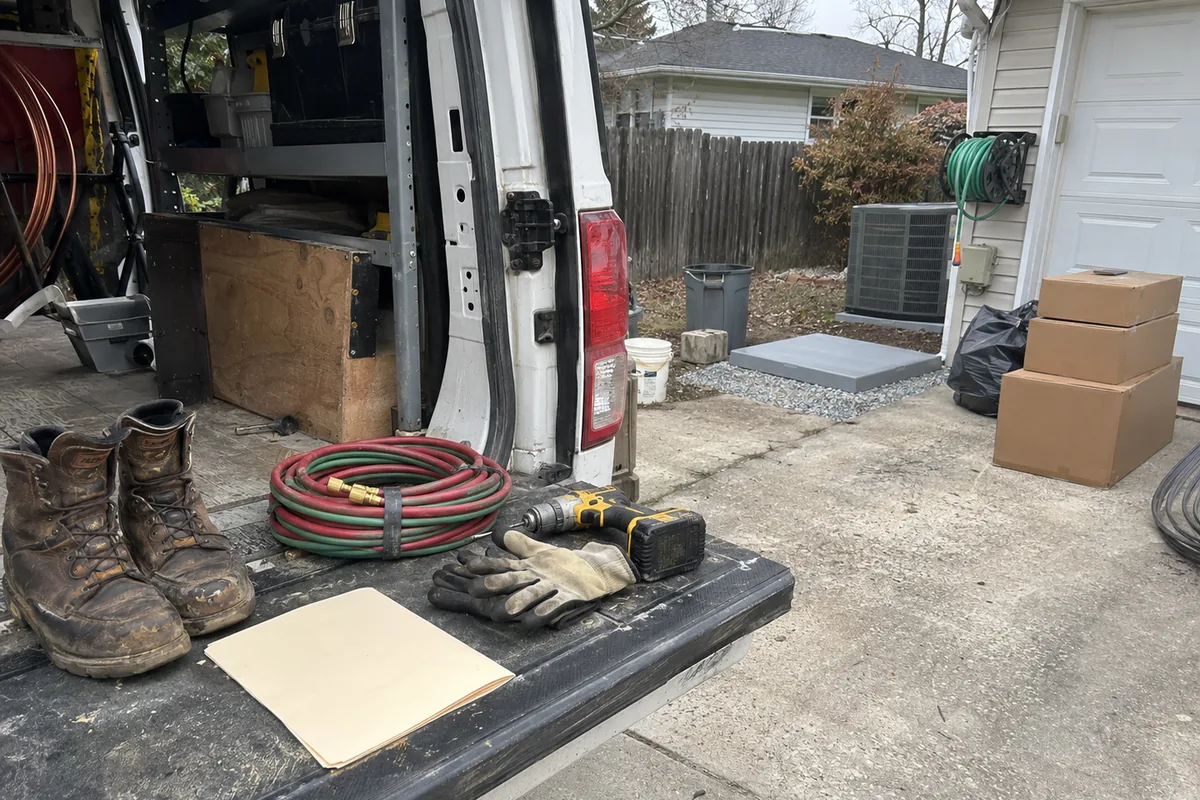
TL;DR: An HVAC van and trailer can fall under federal commercial motor vehicle rules when their combined rating or actual weight reaches 10,001 pounds or more and the job involves interstate commerce. Check the van and trailer labels this week, then flag every job that crosses a state line.
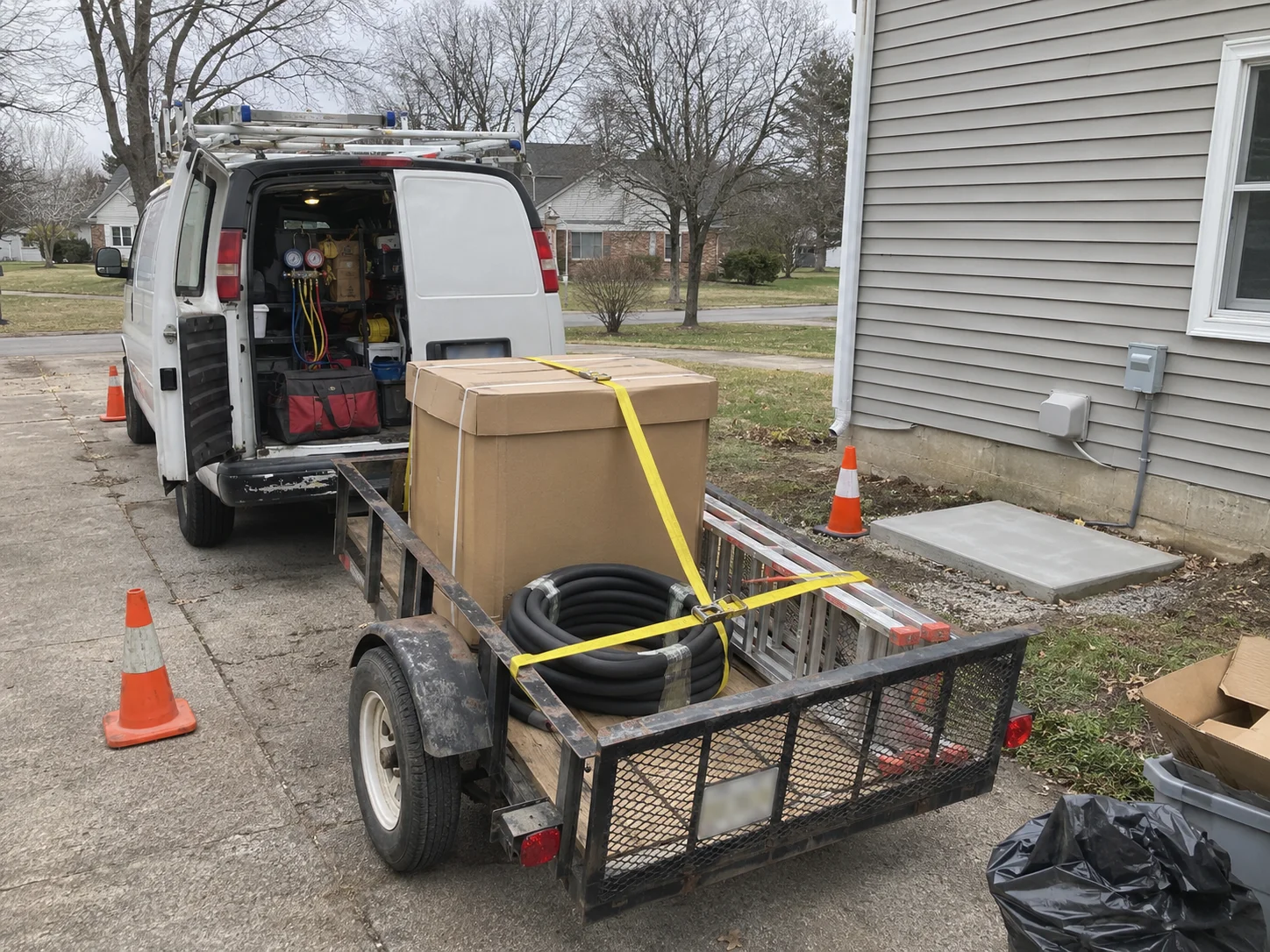
A common pattern in shops near a state border: the replacement install crew rolls out with a service van and an equipment trailer, and nobody checks the trailer’s label, because the van alone looked fine for years.
That trailer can change the answer. Federal rules measure the combination, not just the van.
The trailer can push your van over the federal line
Under 49 CFR 390.5, a commercial motor vehicle includes a self-propelled or towed vehicle used on a highway in interstate commerce when its gross vehicle weight rating, gross combination weight rating, gross vehicle weight, or gross combination weight reaches 10,001 pounds or more, whichever is greater.
A van rated well under 10,001 pounds can still cross the line when it pulls a trailer.
The gross combination weight rating uses the greater value from the manufacturer’s certification label or the combined ratings or actual weights of the power unit and towed unit.
Find the van’s GVWR on the certification label in the door jamb. Find the trailer’s rating on its own label. Add the two ratings for a first check. The actual loaded weight can matter too.
This is where your van loadout and weight deserves a closer look. The tools, parts, ladders, and trailer contents all affect what the combination is carrying, even though the federal test also uses the manufacturer’s ratings.
A job across the state line counts as interstate commerce
The weight test is only half of the question. The other half is where the work takes place.
The federal definition of interstate commerce includes transportation between a place in one state and a place outside it. A job across the state line fits that plain example. It also includes certain trips between two places in the same state when the transportation passes through another state or is part of transportation that began or ends outside the state.
For a small HVAC shop, start with the simple question: will this van and trailer cross a state line for the job?
Mark those jobs before dispatch. Shops near a border should pay close attention because a normal service area can include two states even when every customer is local.
Intrastate-only operations are different, and state rules vary. If the route or job does not fit the simple examples, ask your state motor carrier office or FMCSA about the specific situation. Do not make a broad assumption from the word “local.”
Dial 72 answers calls 24/7, texts the owner a call summary that includes the job address the caller gave, and books onto the shop calendar. That text lets a dispatcher see at a glance that a booked job sits on the other side of a state line before the truck is assigned.
There is no HVAC contractor exception
The federal safety rules in 49 CFR 390.3(a) apply to employers, employees, and commercial motor vehicles that transport property in interstate commerce.
The listed exceptions do not create a trades-contractor or HVAC exception. A shop hauling its own tools and equipment is moving property in furtherance of a commercial enterprise. The personal-property exception is for occasional transportation by individuals, not for compensation and not in furtherance of a commercial enterprise.
The general exceptions in 49 CFR 391.2 cover limited categories such as farm custom operations, apiarian industries, certain farm vehicle drivers, covered farm vehicles, and pipeline welding trucks. None covers HVAC work.
That means the shop should test the combination and the route. It should not rely on the fact that the truck carries company tools instead of customer freight.
Your commercial auto insurance and COI requests are a separate issue, but the same vehicle decision matters there too. Ask your insurance agent how the commercial auto policy is written for the van and trailer combination.
Medical certification and time records still matter
A person subject to Part 391 must not operate a commercial motor vehicle unless medically certified as physically qualified under 49 CFR 391.41. The driver must carry the certificate. A CDL or CLP holder no longer needs to carry that certificate beginning June 23, 2025.
This rule does not say that every HVAC driver needs a CDL. Do not turn the 10,001-pound test into a claim that a CDL is required.
Hours of service have a short-haul exception. Under 49 CFR 395.1(e)(1), a driver within a 150 air-mile radius of the normal work reporting location can avoid the logging requirement in 395.8 if the driver returns and is released within 14 consecutive hours and receives at least 10 consecutive hours off duty between 14-hour duty periods.
The carrier still must keep accurate time records for six months. Those records must show the driver’s start time, total on-duty hours, and release time. Section 395.1(e)(2) provides a similar exception for vehicles that do not require a CDL.
Keep a short written record of driver start and release times anyway. It supports the short-haul exception and gives you something concrete to review.
Your OSHA recordkeeping duties are another reason to assign one person to keep records current. Also check who is driving the truck, especially when new hires or apprentices begin taking service or install vehicles across the border.
Check the combination before assigning the job
Federal registration with FMCSA and vehicle marking requirements appear in Part 390 Subpart E and 390.21. If your combination reaches the federal weight threshold and the work involves interstate commerce, talk to FMCSA or your state motor carrier office before filing. Confirm current requirements at fmcsa.dot.gov.
The penalty rules in 49 CFR Part 386 Appendix B, amended in 2026, list maximums of up to $1,584 per day for recordkeeping violations, capped at $15,846, up to $19,246 per non-recordkeeping violation, and up to $4,812 for non-recordkeeping violations by drivers. Those are maximums, not a statement of what a shop typically pays.
This week, read both rating labels, add the van and trailer ratings, mark every job that crosses a state line, and ask FMCSA, your state motor carrier office, and your insurance agent what applies before the next truck rolls.