
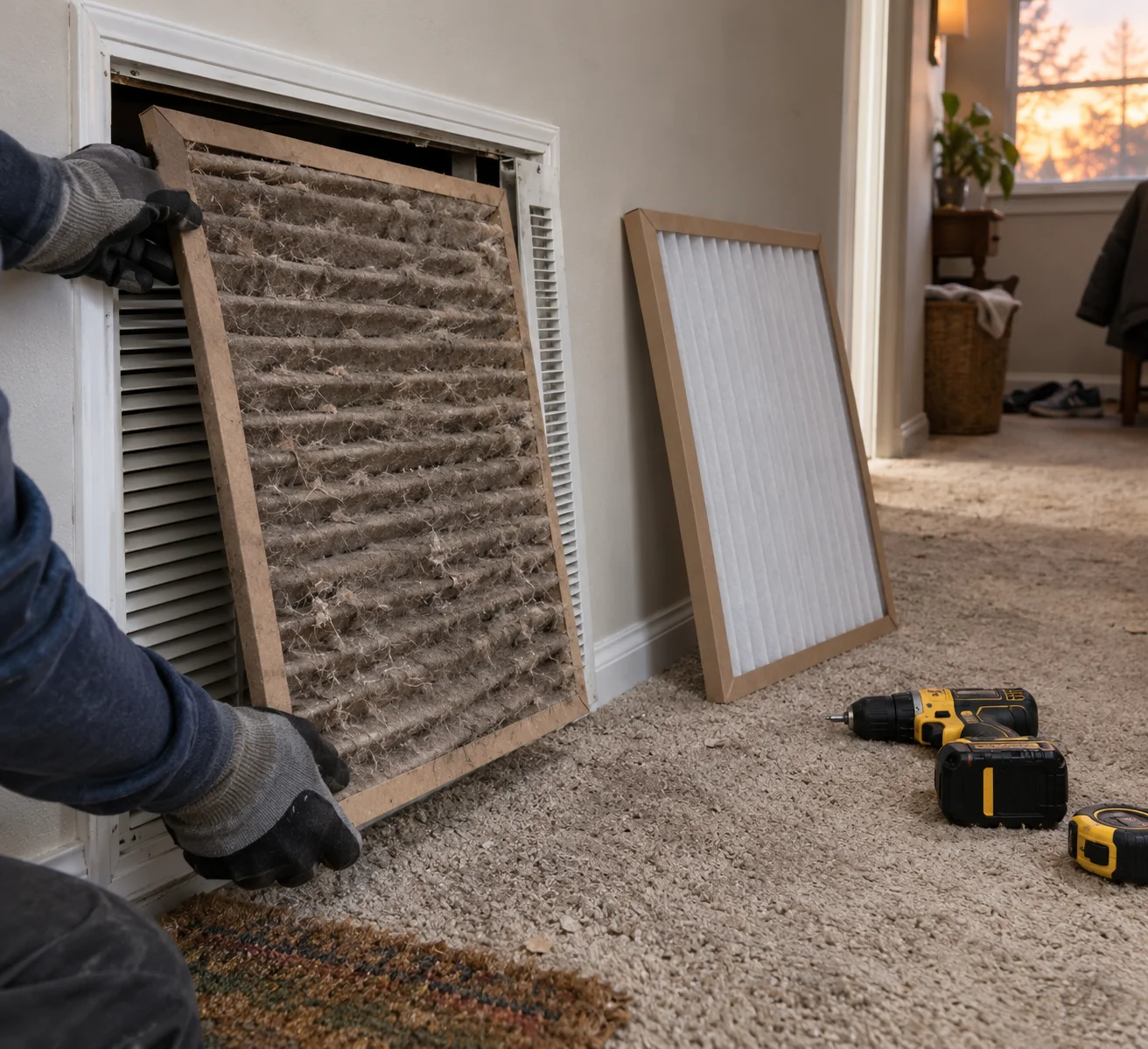
TL;DR: EPA recommends MERV 13, or the highest filter rating the HVAC system’s fan and filter slot can handle. Do not promise clean air, and do not tell a customer to run the fan continuously unless a high-efficiency filter is installed.
Smoke-day calls are short, but they bury urgent service calls
A dispatcher sees the same pattern when wildfire smoke or Santa Ana season hits. The calls are not repair calls. They are short questions.
“What size filter should I buy?”
“Will a better filter hurt my system?”
“Should I run the fan?”
Each question is easy to answer in under a minute with a prepared script. Together, they flood the line. A real no-cool or no-heat call can sit behind them while the customer with a smoke question waits.
This is familiar territory for inland Southern California shops dealing with fire weather. The call bunching looks like the first heat wave. That pattern is covered in surviving the first heat wave, along with the cost of letting calls go unanswered. The same call volume problem applies here. See also HVAC call surge cost math.
The technical answer has two parts. The filter needs to capture more particles, and the system still needs to move air.
EPA’s recommendation depends on what the system can handle
The EPA says to choose a high-efficiency HVAC filter, such as MERV 13, or use the highest rating the system fan and filter slot can accommodate. That last phrase is the part that belongs in your phone script.
The answer is not automatically MERV 13 for every home.
The EPA also says to use recirculate mode if the system has a fresh air intake. The outdoor intake damper can be closed instead. This keeps the system from bringing smoky outdoor air into the home through that intake.
With a high-efficiency filter installed, the EPA says to run the fan as often as possible by setting it to On instead of Auto. That runs the fan more often than a normal heating or cooling cycle. Tell the customer it uses more electricity. It is EPA guidance for a system with a high-efficiency filter installed, not a blanket instruction for every system.
In heavy smoke, the EPA says to keep extra filters available and replace the filter more often than the manufacturer’s schedule. The EPA also says a homeowner may need an HVAC technician to determine the highest-efficiency filter the system can accommodate.
The source is the EPA’s Wildfires and Indoor Air Quality page.
A MERV 13 filter can be the wrong answer for the return
A MERV 13 filter in a return designed for a thin MERV 6 filter can restrict airflow. The system may not have the fan capacity, filter surface area, or filter slot depth to handle the higher resistance. The result is not a better answer simply because the MERV number is higher.
That is where shops get burned. A caller asks for the strongest filter. The person answering gives the number without asking what the equipment can accommodate. The customer installs it, the system struggles to move air, and your shop gets the callback.
Use the phrase “highest rating your system can accommodate.” Do not turn “MERV 13” into a universal installation order.
Filter pressure drop is the reason, and it is covered in our piece on the MERV 11 floor. If the homeowner does not know the equipment or filter setup, offer a technician visit rather than guessing over the phone.
The phone script should set a limit on the promise
A short script can give the customer a useful answer without making a claim the equipment cannot support.
Try this:
“The EPA recommends MERV 13, or the highest-efficiency filter your system’s fan and filter slot can handle. We need to confirm your system before telling you which filter to install. If your system has a fresh air intake, set it to recirculate or close the outdoor intake damper. If a high-efficiency filter is installed, you can set the fan to On instead of Auto, but that uses more electricity. A filter can help reduce particles moving through the HVAC system. It does not make smoke harmless or promise clean air.”
That script handles the main questions in one call. It gives the customer an action for the fresh air intake. It explains the fan setting. It identifies the equipment limit. It also keeps the shop from promising that a filter will make the indoor air clean.
Do not tell a caller to install a filter that the system cannot accommodate. Do not tell the caller that MERV 13 is safe for every return. Do not promise that running the fan will solve the smoke problem.
A receptionist can sort filter questions from no-heat calls
Dial 72 answers 24/7 in <1s. It answers in English and Spanish. It texts the shop a triage summary of each call, so a filter question can be separated from an emergency. An emergency is escalated immediately.
That distinction matters on smoke days. The shop decides what to tell callers about filters. The receptionist follows the shop’s instructions and does not invent technical advice. Your team can provide the approved script, the questions needed to identify a filter or system issue, and the point where the call should become a technician visit.
The triage summary also gives the shop a quick view of why people are calling. A homeowner asking about a filter belongs in a different queue from someone reporting no heat, no cooling, or another emergency.
Give callers one safe answer and one clear next step
Tell callers to check the existing filter size and equipment information, but do not approve a higher MERV rating without confirming what the fan and filter slot can accommodate. Recommend MERV 13 when the system can handle it, or the highest rating the system can handle.
Tell them to use recirculate mode or close the outdoor intake damper if the system has a fresh air intake. Tell them to use Fan On only with a high-efficiency filter installed, and explain the added electricity use. Tell them to keep spare filters available and replace them more often than the manufacturer’s schedule during heavy smoke.
Put that wording in your Dial 72 instructions before smoke calls start. Have the receptionist sort filter questions from emergencies, and send the uncertain cases to a technician instead of guessing.
