
TL;DR: The 2024 IRC requires suction-line insulation to be at least R-3, with an external surface permeance of no more than 0.05 perm. It also requires weather protection, and adhesive tape cannot serve as that protection.
The insulation rule has an R-value half and a weather-protection half
The 2024 IRC Section M1411.12, “Insulation of Refrigerant Piping,” covers the insulation itself. Refrigerant vapor lines, meaning suction lines, and their fittings must have insulation rated at not less than R-3. The insulation must also have an external surface permeance of no more than 0.05 perm when tested to ASTM E96.
That permeance limit is about vapor resistance. The insulation must resist moisture reaching the cold copper. Closed-cell insulation is what this requirement points toward.
The next section adds a separate requirement. Section M1411.12.1, “Refrigerant Line Insulation Protection,” sends you to Section N1103.4.1 in the energy chapter. That section matches IECC R403.4.1, “Protection of Piping Insulation.”
You need both parts. The insulation needs the required R-value and permeance. The exposed insulation also needs protection from the conditions around the condenser and line set.
The R-value changes when the adopted code changes
Do not assume the number from memory. Older IRC editions set the suction-line requirement at R-4. The 2018-based Seattle Residential Code text used R-4. A published Building Officials Association of Florida interpretation also stated that the IRC R-4 requirement governed over the energy code’s general R-3 requirement for mechanical piping.
The section number moved as well. Older editions placed the rule in M1411.5 or M1411.6. The 2024 IRC uses M1411.12.
States can amend the number. South Carolina’s adopted amendment to the IRC refrigerant piping insulation section sets the minimum at R-2.5 instead.
That gives you three reasons to look up the title, not just the section number. The R-value can change. The section number can change. Your state or local jurisdiction can amend the rule in either direction. Check the adopted code edition for the town where the work is being done.
This also matters on change-outs. If the job keeps the old line set, do not treat the existing insulation as automatically acceptable. The insulation still has to meet the rule that applies to the work, including the protection requirement. See the guidance on reusing the line set before you leave old insulation in place.
Electrical tape is not the weather protection
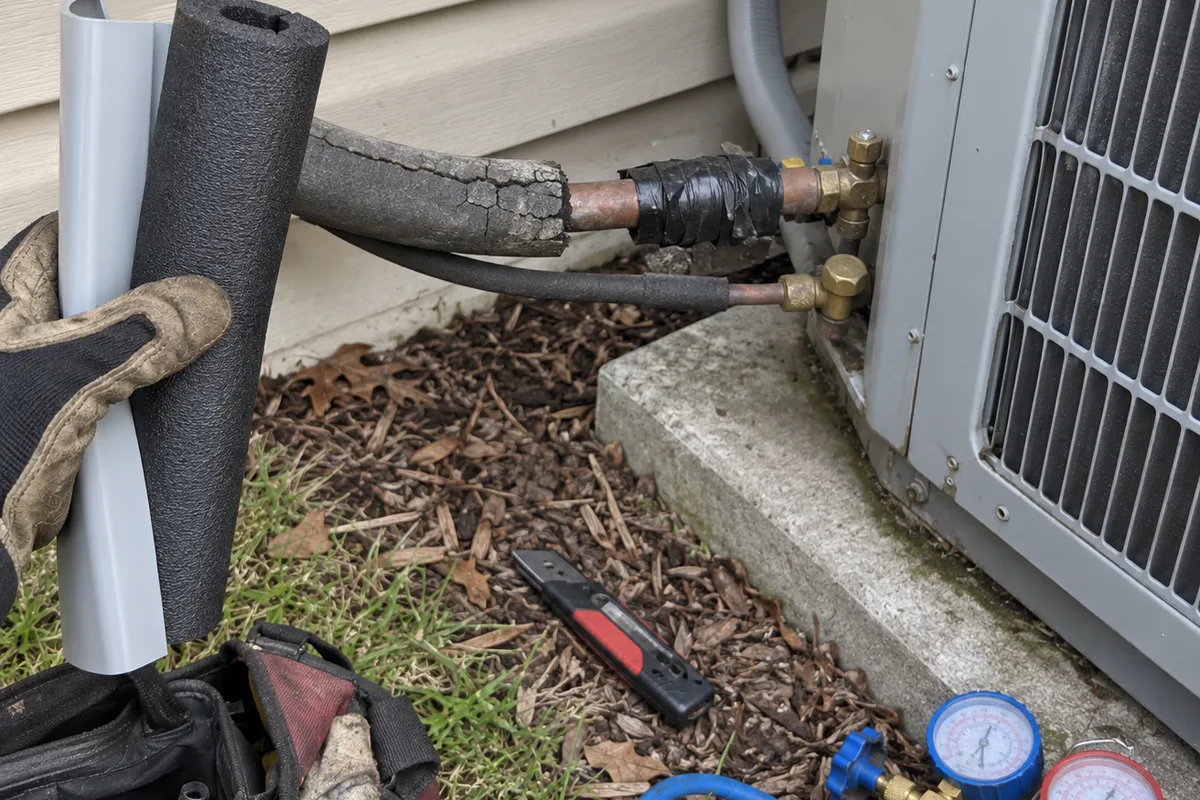
Section N1103.4.1 requires piping insulation exposed to weather to be protected from damage. The listed exposures include sunlight, moisture, physical contact and wind. The protection must shield the insulation from solar radiation that degrades the material.
The protection must also be removable for maintenance for not less than 6 feet from the equipment. Adhesive tape is prohibited as the protection.
That last sentence rules out the common electrical-tape wrap. A spiral of black electrical tape over a joint is still adhesive tape. It does not become an acceptable UV cover because it is wrapped neatly or because it has held together through one season.
Fall maintenance calls show the usual failure point. It is often the first few feet of suction line at the condenser. The foam has gone chalky and cracked from sun. There are gaps where the insulation was pulled back to braze and never closed. A black electrical-tape spiral is covering the joint.
The tape is doing the job of a UV cover, but the 2024 text prohibits adhesive tape as the protection. Install protection that shields the insulation from sunlight and can be removed for service.
The removable distance can also change locally. Washington State’s energy code version requires the protection to be removable for at least 6 inches from the equipment. Read the adopted text instead of assuming every jurisdiction uses 6 feet.
A ceiling stain can start with an exposed suction line
A bare or degraded suction line picks up heat before the refrigerant gets back to the compressor. The line can also sweat where it runs through humid, unconditioned space such as an attic or crawlspace. That moisture can drip onto drywall.
A homeowner may call about a water stain on the ceiling. Nobody connects it to the line set above the ceiling until the technician is on site. The phone detail matters because it can change what you bring and what you inspect first.
Dial 72’s AI receptionist, Bella, answers 24/7, triages calls by the shop’s own rules, and texts the shop a call summary after every call. She recognizes maintenance members when they call. If a caller mentions a ceiling stain or water dripping near the refrigerant lines, that detail appears in the text summary, so the technician can bring insulation and a UV cover instead of finding out on site.
The condenser visit is the right time to document the condition
A tune-up opens the service valves at the condenser. That is where the outdoor insulation is most exposed, and it is also where the insulation is often pulled back during service.
Check the exposed suction line from the condenser toward the building. Confirm that the insulation is present and continuous. Look for chalking, cracks, gaps and open joints. After service, close any gap at the valves. Use a cover that protects the insulation from sunlight and comes off for maintenance. Do not use adhesive tape as the protection.
The service valves have another code item that tune-ups disturb. Review locking refrigerant caps as part of the same visit.
Document the insulation condition and take a photo for the maintenance record. Use ACCA’s maintenance standard when setting the shop’s documentation process. Record the adopted code edition or local amendment used for the job.
On every condenser visit, check the suction-line insulation before leaving the property. Verify the R-value rule for the adopted edition. Verify the removable protection distance. Replace broken or missing protection with a proper cover, not electrical tape. Then put the condition and photo in the record.
