
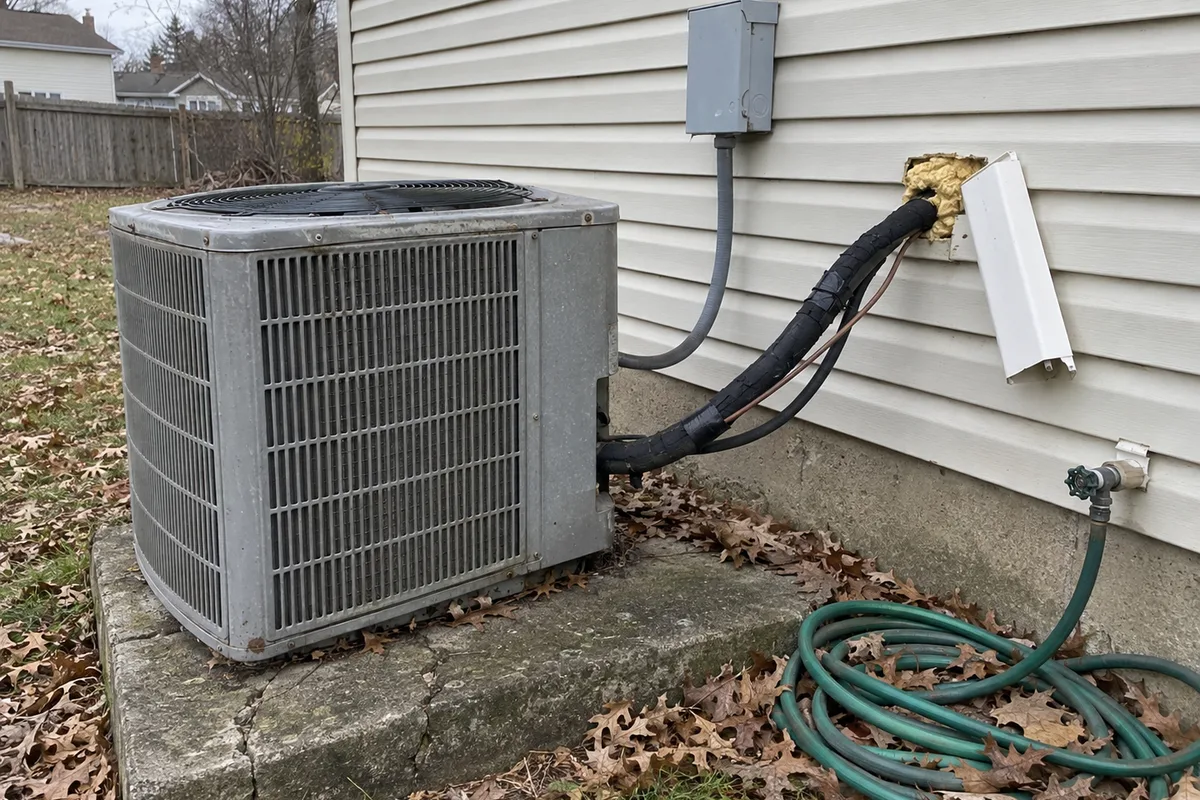
The changeout went in on a Tuesday. New condenser, new coil, new pad, new disconnect. The existing copper was in good shape and already run through the wall, so it stayed. Three weeks later the system is running long, the house is not holding on the hot afternoons, and the tech who goes back finds subcooling low, superheat high, and nothing obviously wrong with the equipment.
The equipment is fine. The line set is 5/16 inch liquid line, the system was factory charged for 3/8, nobody adjusted it, and the run to the far corner of the house is longer than anyone measured.
The existing line set is not a neutral leftover from the old job. It is a component with a specification, the manufacturer wrote that specification into the installation instructions, and the mechanical code makes those instructions part of the installation. Reusing copper is usually allowed. Reusing it without opening the manual is a different thing, and it is where a clean install quietly turns into a callback.
The code section that turns the manual into a requirement
This is the part shops underuse, because it sounds like a formality and it is not.
The International Mechanical Code puts it in Section 304.1: “Equipment and appliances shall be installed as required by the terms of their approval, in accordance with the conditions of the listing, the manufacturer’s installation instructions and this code.” The same section requires the manufacturer’s installation instructions to be available on the job site at the time of inspection.
The International Residential Code says the same thing in Section M1307.1: “Installation of appliances shall conform to the conditions of their listing and label and the manufacturer’s instructions. The manufacturer’s operating and installation instructions shall remain attached to the appliance.”
Read that plainly. The line set limits in the manual are not manufacturer preferences you can weigh against field convenience. In a jurisdiction that has adopted these codes, they are the installation requirement, and an inspector can ask to see the document that contains them. That also cuts the other direction in your favor: when you do it right, the manual is the thing that proves you did.
Which edition your jurisdiction has adopted varies, and adopted code is what gets enforced rather than the newest published edition. The substance of these two sections has been stable across editions, but confirm your local adoption rather than quoting an edition year at an inspector.
Reuse is usually allowed, which is not the same as reuse without checking
Take the most common version of this question right now, an R-410A system being replaced with R-454B equipment. Carrier’s published FAQ on the transition addresses it directly: from a system standpoint you do not need to replace line sets when moving to R-454B, because it uses the same POE oil as R-410A, as long as the line set meets the current building code. Their guidance is that local building codes regulate what is required for refrigerant runs.
That is a real answer and it is worth knowing, because a lot of field folklore says otherwise. It is also narrower than it sounds. It says the oil chemistry does not force replacement. It says nothing about whether that particular line set is the right diameter, the right length, in serviceable condition, or correctly charged for the new equipment. Those are four separate questions and the manual answers each one.
It is also one manufacturer speaking about their own equipment. Your manufacturer’s instructions govern your job. The numbers below come from Carrier’s published R-454B residential piping and long line guideline, and they are here to show the shape of the arithmetic, not to be copied onto a different brand’s install.
Question one: is the diameter right
Liquid line diameter is not a detail. It sets the maximum allowable length, it determines the charge adjustment, and on smaller diameters it can rule out the application entirely.
In that guideline, liquid lines of 1/4 and 5/16 inch are permitted within published limits with a TXV metering device only, and the tables show how fast the allowance shrinks. On a 2.5 ton air conditioner with units on the same level, a 3/8 inch liquid line allows up to 250 feet of total equivalent length. The same system on 5/16 inch drops to 175 feet. On 1/4 inch it drops to 30 feet. Same equipment, same house, three very different answers depending on what copper is already in the wall.
Suction line diameter is handled per model in the product data rather than by one universal chart, because acceptable vapor line diameters have to return oil to the compressor while avoiding excessive capacity loss. The capacity loss is published for each acceptable diameter. That is the number to look at when someone argues that an undersized suction line is “close enough.” The manufacturer has already quantified what it costs you.
Question two: how long is it really
Actual length and equivalent length are two different measurements and the tables use equivalent length.
Fittings add pressure drop, and the guideline converts them to equivalent feet. On 7/8 inch tube, a standard 90 degree elbow counts as 2.0 feet, a long radius 90 as 1.4 feet, and a 45 as 1.0 feet. A liquid line solenoid counts as 12 feet. A filter drier counts as 6 feet.
Their worked example: a 4 ton system with 165 feet of 7/8 inch straight tubing, four standard 90 degree elbows and two long radius 90s comes to 165 + 8 + 2.8, or 175.8 feet total equivalent length. Ten and a half feet of that never existed as copper. It came from the fittings.
This matters most on the reused set, because you did not run it and you may not know what is behind the drywall. A line set that was pulled through a joist bay with a couple of extra bends in it is longer, in the way the table cares about, than the tape measure says.
Question three: which way does it run, and how far
Vertical separation between the indoor and outdoor units changes the allowable length and can change the parts list.
In the same guideline, a 3 ton air conditioner on 5/16 inch liquid line allows 175 feet total equivalent length with the units on the same level. Put the outdoor unit 21 to 30 feet below the indoor unit and that drops to 100 feet. Go further and the table stops offering an acceptable value at all.
Once an application crosses into long line, accessories are not optional. For these units the guideline calls for a TXV indoor metering device on all long line applications, a hard start kit on single stage units, a crankcase heater if one is not factory supplied, and on heat pumps a bi-flow liquid line solenoid installed within 2 feet of the outdoor unit with the arrow pointing toward it. Where the outdoor unit sits below the indoor unit, an inverted vapor line trap is required at the indoor unit, with the top of the trap higher than the top of the indoor coil.
Those are the parts that get skipped when a reused line set turns out to be longer than anyone assumed, because nobody priced them.
Question four: did anyone adjust the charge
This is the one that produces the callback in the opening paragraph, and it is arithmetic.
Outdoor units in that guideline are precharged for 15 feet of 3/8 inch liquid line, and the factory charge attributable to that line set is 9 ounces. The charge adjustment per foot depends on liquid line diameter: 0.60 ounces per foot for 3/8, 0.40 for 5/16, and 0.27 for 1/4.
The formula they publish is straightforward:
(ounces per foot × total line length) minus (factory charge for the line set) = charge adjustment
Two of their examples, both of which are reuse scenarios:
- 15 feet of existing 1/4 inch liquid line. (0.27 × 15) minus 9 = negative 4.95 ounces. You remove about 5 ounces from the system.
- 45 feet of existing 5/16 inch liquid line. (0.40 × 45) minus 9 = positive 9 ounces. You add 9 ounces.
Neither of those is a large number in isolation. Both are enough to move subcooling out of range on a residential system, and both are invisible to a tech who assumes the factory charge covers it because the equipment is new.
For long line applications the guideline requires a minimum of 10 degrees of subcooling on all liquid line diameters, charged to 10 degrees or the rating plate subcooling, whichever is greater, so that refrigerant does not flash before the metering device. Charging by subcooling also has conditions: indoor between 70 and 80 degrees, outdoor between 70 and 100. Outside those conditions, they direct you to the weigh-in method instead. On a 45 degree morning in October, that is the method you are using.
Where reuse actually stops: the metering device and the coil
The line set can often stay. The rest of the old refrigerant circuit usually cannot, and this is the boundary that gets crossed most often.
The same guideline is explicit on the R-454B transition: do not use an R-410A TXV, because TXVs are not cross compatible between R-410A and R-454B. Do not convert a coil with a piston or an R-410A metering device. Coils must come from the factory with an R-454B TXV and an A2L dissipation board already installed. Carrier’s transition FAQ says the same thing about matching, that full furnace coils are not interchangeable and the refrigerant designed for the indoor coil must match the outdoor unit.
So “we reused the line set” and “we reused the indoor coil” are not the same sentence, and only one of them is generally defensible. This is also the point where a matched system stops being paperwork and starts being the physical install, which is the same argument as the AHRI certified reference number on the estimate.
Condition, and what disqualifies a reused set outright
None of the above matters if the copper itself is not serviceable. The judgment calls that come up on a driveway:
- Kinks, pitting, visible corrosion, or a previously repaired leak. Replace it. You are about to warranty a system through it.
- A previous compressor burnout. Acid and contaminants in the line are a system-killer for the new compressor, and cleanup requirements come from the manufacturer, not from habit.
- Buried, encased, or otherwise inaccessible runs. You cannot inspect what you cannot see, and you cannot service it later either. Price accordingly and say so in the proposal.
- Degraded suction line insulation. Cheap to replace and a real capacity and condensation problem if you do not.
- Wrong diameter for the new equipment. Covered above. This is the failure that looks like a bad system for the life of the install.
The handling requirements around opening and closing the system come from the manual too. That guideline calls for a factory approved liquid line filter drier on every unit, liquid line filter driers rated at 600 psig or higher, no suction line filter drier left in the line longer than 72 hours, and evacuation to 500 microns before recharging, breaking the vacuum with dry nitrogen. It also says plainly never to open the system to atmosphere while it is under vacuum. Recovery before you cut anything is the federal requirement, and the difference between the legal floor and a vacuum that actually removes moisture is covered in our piece on EPA 608 evacuation minimums.
The standard that ties it back to the rest of the job
ACCA’s quality installation specification, ANSI/ACCA 5 QI, exists precisely because equipment does not deliver its rated performance on its own. It specifies physical measurement of airflow and refrigerant charge so the system actually produces its AHRI certified performance, with measured airflow through the indoor blower required to be within 15 percent of the design value.
That is the same logic as the line set. The certificate on the estimate describes a system tested under specific conditions. The refrigerant circuit you built in the field either reproduces those conditions or it does not. A Manual J load, a Manual S selection, and a Manual D duct design all get quietly undone by 45 feet of the wrong copper and nine missing ounces of refrigerant.
What to actually change on Monday
- Look at the line set before the quote goes out, not on install day. Diameter, approximate run, vertical separation, and condition. Four things, five minutes, and they belong in the proposal either as “existing line set reused” or as a priced replacement.
- Print the piping section of the instructions for the model you are selling. Not the model you sold last year. The tables change between refrigerants and between product lines.
- Make the charge adjustment a checklist item with a written number. Not “we topped it off.” The ounces added or removed, and the measured subcooling, on the work order.
- Photograph the existing set before you touch it. Insulation condition, the wall penetration, any visible damage. This is the cheapest documentation you will ever collect and it settles arguments later.
- When you replace it, say why in one line the homeowner can understand. “The existing liquid line is 5/16 and this system needs 3/8” beats “we always replace them,” and it is the difference between looking thorough and looking expensive.
The version of this that reaches your phone
The homeowner does not call and say the liquid line is undersized. They call in the middle of August and say the new system you just installed is not keeping up, and they are unhappy because they just spent real money with you.
That call is the one you cannot afford to miss, because it is a warranty visit on a job you already invoiced, and every hour it sits in voicemail it gets more expensive and the customer gets angrier. Whoever answers needs to get down that it is recent install, what the complaint is, and that it goes to the tech who did the work, not to whoever is free. That is the job Dial 72 does when your office is already on another line or the crew is on a roof. See how it works, or pricing if that call is currently going to a machine.
Quick answers
Can I reuse an R-410A line set for R-454B equipment? Generally yes from an oil standpoint, because R-454B uses the same POE oil, provided the line set meets your local building code and the manufacturer’s requirements for diameter, length, and condition. Carrier states this directly in its transition FAQ. Confirm against the instructions for the equipment you are installing rather than assuming it generalizes.
Are the line set limits in the installation manual actually enforceable? Yes, where the mechanical code is adopted. IMC 304.1 requires installation in accordance with the manufacturer’s installation instructions and requires those instructions to be on the job site at inspection. IRC M1307.1 requires installation to conform to the listing, label, and manufacturer’s instructions.
What is total equivalent length? Actual straight tubing length plus the equivalent length of every fitting and accessory. Elbows, filter driers, and liquid line solenoids all add feet. In one published guideline a standard 90 on 7/8 inch tube counts as 2.0 feet, a filter drier as 6, and a liquid line solenoid as 12. The tables are written in equivalent length, not tape measure length.
Do I need to adjust the charge when I reuse a line set? Almost always. Units are typically factory charged for a specific length and diameter. In that guideline it is 15 feet of 3/8 inch liquid line, worth 9 ounces, with adjustments of 0.60, 0.40, and 0.27 ounces per foot for 3/8, 5/16, and 1/4 inch respectively. An existing set that is a different length or diameter needs refrigerant added or removed.
Can I keep the existing indoor coil and just change the condenser? Not across a refrigerant change. TXVs are not cross compatible between R-410A and R-454B, piston or R-410A metering devices are not to be converted, and coils are required to come from the factory with the correct TXV and dissipation board. Full coils are not interchangeable, and the indoor refrigerant has to match the outdoor unit.
What if the existing line set is buried or inaccessible? You cannot inspect it, you cannot easily service it, and you are about to warranty a compressor through it. Treat it as a known risk, price it honestly, and put the limitation in writing in the proposal instead of discovering it during a leak search two summers from now.
Does any of this apply if the run is short and straight? The length tables probably will not bite you, but diameter and charge adjustment still will. A 15 foot run on the wrong diameter liquid line is exactly the case in the manufacturer’s own worked example, and it still required pulling about 5 ounces out of the system.
