
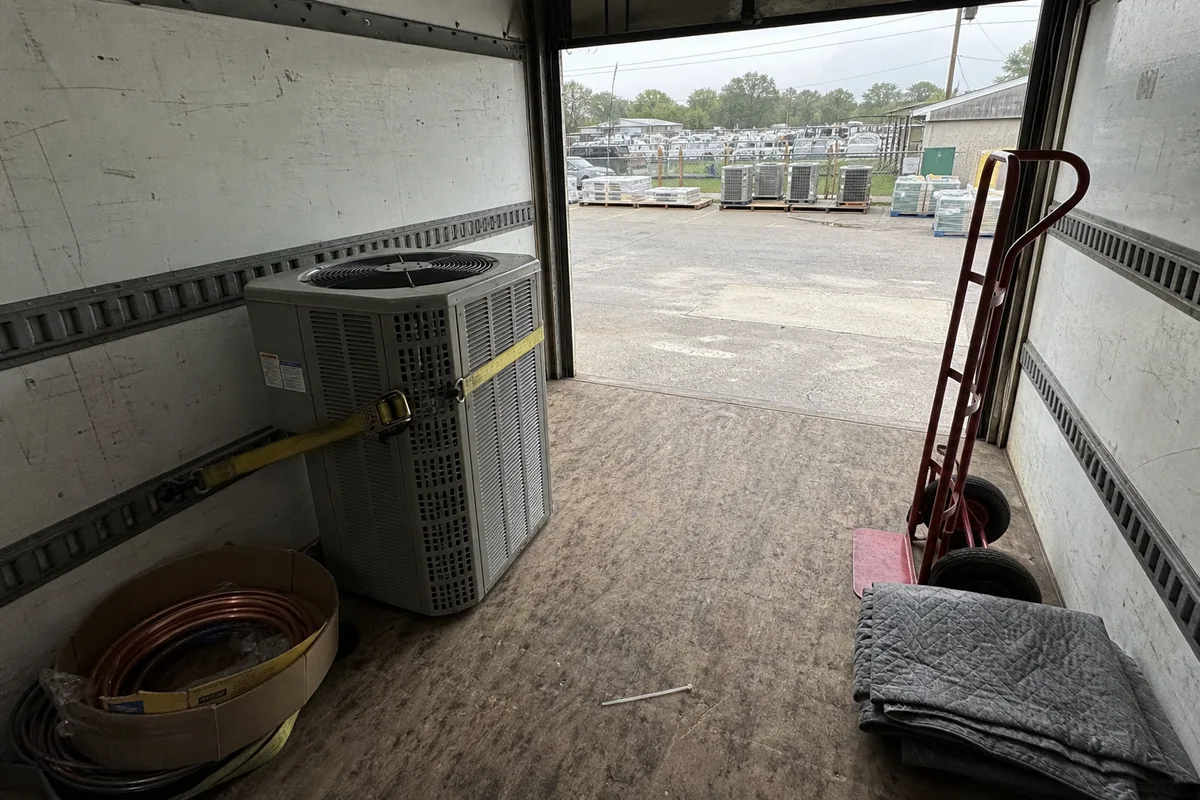
A condenser can be legal to build, legal to sell, and legal to keep on your shelf, then become illegal to install when the job is in the Southeast or Southwest.
The unit did not change. The installation address did.
That is the current federal rule for central air conditioners. In two of the three DOE regions, compliance is decided on the day you install the system, and the date that matters is not printed on the equipment label.
Southeast and Southwest installations use the installation date
The Department of Energy divides the country into three regions for central air conditioner efficiency standards. In the North, compliance is determined by the product’s date of manufacture. In the Southeast and Southwest, compliance is determined by the date of installation. DOE states this on its Regional Standards Enforcement page.
The Southeast includes Alabama, Arkansas, Delaware, Florida, Georgia, Hawaii, Kentucky, Louisiana, Maryland, Mississippi, North Carolina, Oklahoma, South Carolina, Tennessee, Texas, Virginia, the District of Columbia, Puerto Rico, and the U.S. Territories. The Southwest includes Arizona, California, Nevada, and New Mexico. The North is the remainder of the United States.
That makes the installation address the first check on every central air conditioner job in those regions. Your shop location does not decide the rule.
For products manufactured on or after January 1, 2023, the national base standard for a split-system air conditioner is 13.4 SEER2. The Southeast standard is 14.3 SEER2 for systems under 45,000 Btu/h and 13.8 SEER2 for systems rated at 45,000 Btu/h and above.
The Southwest has an extra requirement. Systems under 45,000 Btu/h must meet 14.3 SEER2 and 11.7 EER2. Systems rated at 45,000 Btu/h and above must meet 13.8 SEER2 and 11.2 EER2.
These regional standards apply to air conditioners only. Heat pumps are not subject to the regional standards. A split-system heat pump has a national standard of 14.3 SEER2 and 7.5 HSPF2.
A 13.4 SEER2 unit can be legal inventory and an illegal installation
Beginning January 1, 2023, basic models that meet the national SEER2 standard but do not meet the amended regional SEER2 and EER2 standards may still be manufactured. They may not be installed in the Southeast or Southwest. A 13.4 SEER2 split system is legal to build, ship, stock, and sell, and nothing about the box tells you whether the installation is allowed. The region of the installation address does.
DOE lists three outcomes for a basic model that does not meet the amended regional standards. It must have been installed in the Southeast or Southwest before January 1, 2023, moved outside those regions for installation, or recertified under DOE regulations with at least one compliant coil-only combination.
This is why aging regional shelf stock carries a real risk. A unit that is legal to own is not automatically legal to install.
An install-date rule is exactly the kind of rule that strands legal inventory, and the trade has already seen one of them walked back for that reason when the R-410A installation deadline got lifted. The DOE regional rule for central air conditioners is not one of those. It remains in effect.
The certified combination, not the condenser alone, decides compliance
DOE’s guidance states that, to be installed in the Southeast or Southwest, the outdoor unit must have at least one coil-only combination compliant with the regional standard applicable at the time of installation.
The basic model may be certified as regionally compliant only when every individual combination within that basic model meets the regional standard. The combination list must include a coil-only combination representing the least-efficient combination in which that outdoor unit is distributed in commerce.
That is different from checking the condenser model and the matched pairing shown on your proposal. Before you quote or stock equipment for a Southeast or Southwest job, verify the certified combination behind the quoted rating the same way you would confirm the AHRI number that belongs on the estimate.
DOE’s first example shows how one pairing can disqualify the whole basic model. Model A with coil-only indoor unit A is certified at 13.4 SEER2. The same outdoor unit with coil-only indoor unit B is certified at 14.3 SEER2 and 11.7 EER2. Beginning January 1, 2023, Model A cannot be certified as regionally compliant or installed in the Southeast or Southwest, because not all of its individual combinations comply.
The 13.4 SEER2 pairing controls the result. Model A can be installed only outside the Southeast and Southwest.
A blower coil does not provide a workaround. In DOE’s second example, Model B has a coil-only pairing rated at 13.4 SEER2 and a blower-coil pairing rated at 14.3 SEER2 and 11.7 EER2. Model B still cannot be installed in the Southeast or Southwest because the required coil-only combination is not compliant.
That makes certified combination data part of equipment selection rather than paperwork after the sale. It lands in the same step where a load calculation becomes a specific selected system.
There is one narrow provision for existing stock of discontinued basic model combinations. Under 10 CFR 429.102(c)(4)(i), those combinations may be installed in the Southeast or Southwest if they were previously validly certified as compliant with the regional standards applicable at the time of installation, which means every combination in the basic model showed compliance, including the representative coil-only combination. It does not turn every old condenser into installable regional inventory.
The installer carries the DOE liability
DOE’s Regional Standards Enforcement material states that contractors and installers bear liability for noncompliant installations. DOE also states that a homeowner is not liable to DOE for a contractor’s installation of a noncompliant central air conditioner system.
DOE may request records from installers, dealers, distributors, or manufacturers. Those records must be provided within 30 days of the request.
Homeowners who believe an installer put in a noncompliant air conditioner can report it to DOE at [email protected] or 202-287-6997, and DOE can assess civil penalties.
The contrast with other equipment standards is direct. The 95% AFUE furnace rule attaches compliance to manufacture rather than installation. ACCA states that HVAC equipment standards are the only DOE energy efficiency standards using the date of installation as the compliance deadline.
S. 4892 would change the date, but it has not changed the rule
S. 4892 is the “Strengthening Manufactured Appliance Requirements towards Thoughtful Energy Efficiency Standards Act,” known as the SMART Energy Efficiency Standards Act.
Its official long title is: “To amend the Energy Policy and Conservation Act with respect to regional standards for furnaces, central air conditioners, and heat pumps.”
Senator Joni Ernst of Iowa introduced the bill on June 24, 2026, in the 119th Congress, 2nd Session. It has been read twice and referred to the Senate Committee on Energy and Natural Resources. It has not passed.
The bill would move the compliance date to the date of manufacture. Its stated purpose is to place compliance responsibility with the manufacturer and have every product entering the distribution chain comply with applicable DOE requirements.
ACCA, AHRI, HARDI, and PHCC support the change. ACCA describes the current problem this way: “Contractors feel the same squeeze when a job slips past the deadline, and the equipment already on the truck becomes a compliance problem.”
ACCA also points to the 2023 transition, when businesses in the South and Southwest raced to install compliant inventory before the deadline or risked being stuck with equipment they could no longer legally install.
Nothing in S. 4892 changes your current obligations.
Check the address and the coil-only certification before you sell
For every air conditioner quote in the Southeast or Southwest, identify the installation address first, then confirm the basic model is certified to the applicable regional standard, including the required coil-only combination. The condenser label and the matched pairing on the proposal do not answer that question on their own.
Treat aging shelf stock in those regions as an exposure. If a unit does not meet the current regional rule, the options are the ones DOE lists, which means moving it outside those regions for installation or confirming it qualifies under the install-through provision.
Plan around the rule in effect today. S. 4892 is still in committee.
