
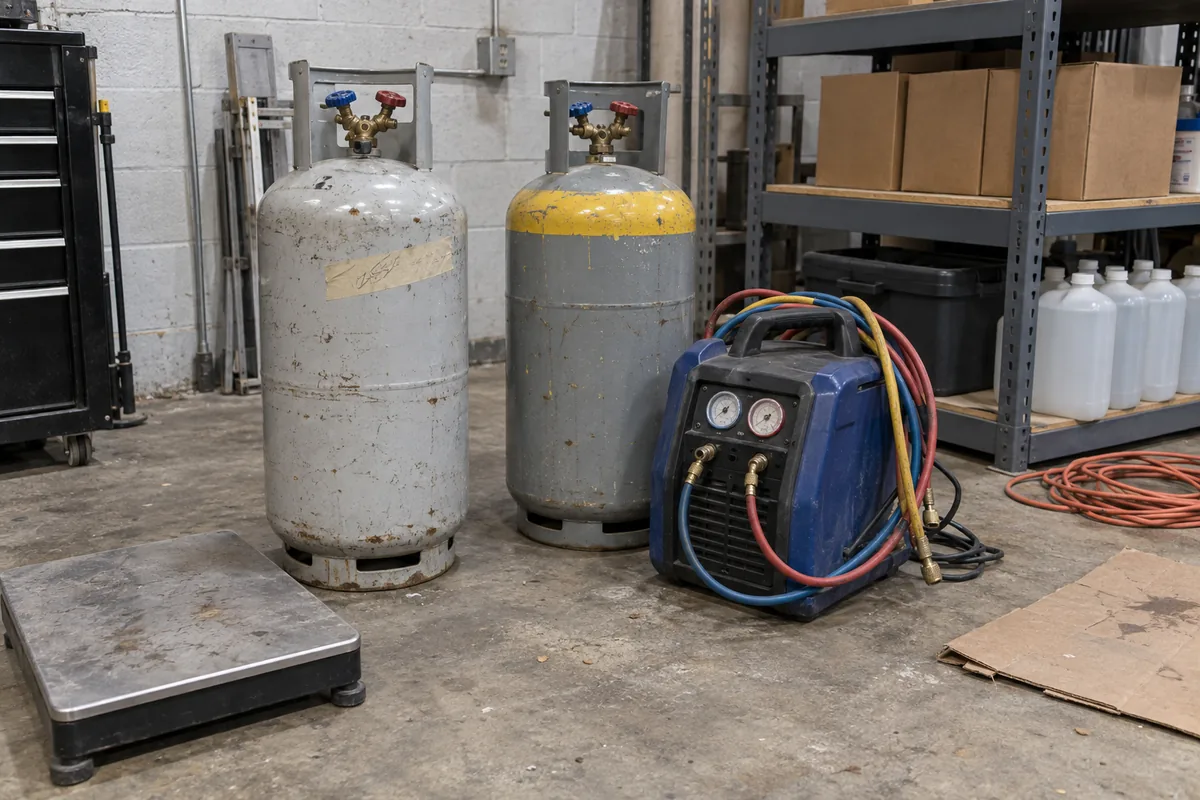
The changeout goes fine. The tech recovers the charge off the old R-410A condenser, gets the new equipment in, and hauls the recovery cylinder back to the shop. It ends up in the corner next to the parts shelf with a strip of tape on it and someone’s handwriting.
Two days later a different call comes in. A system that is low on charge, an owner who does not want to spend much, and a tech standing in the shop looking at that cylinder thinking the obvious thought.
He calls the office and asks whether he can just use it.
The answer is no, and it is worth knowing exactly why, because the reason is not a manufacturer preference or a shop policy. It is a definition in federal regulation, and the same definition explains what that cylinder is actually worth and what you are supposed to do with it instead.
Under EPA’s Section 608 rules, refrigerant you recover can go back into equipment owned by the same owner without further processing. It cannot go into a different owner’s equipment unless it has first been reclaimed by an EPA-certified reclaimer to the purity specified in AHRI Standard 700-2016. Two different customers are two different owners, so the cylinder from Monday’s changeout is not legally available for Wednesday’s service call. That is the whole rule in two sentences, and almost every practical question about a recovery cylinder falls out of it.
The three words are not synonyms
Most techs use recover, recycle, and reclaim interchangeably in conversation. EPA does not. Each one is a defined term with its own consequences, and the gap between them is where shops get into trouble.
Recover, per EPA, means “to remove refrigerant in any condition from an appliance and store it in an external container without necessarily testing or processing it in any way.” That is what happens on every changeout. It is a physical act and nothing more. Recovered refrigerant has no established purity, because nothing has been done to establish one.
Recycle means to “extract refrigerant from an appliance (except MVACs) and clean refrigerant for reuse in equipment of the same owner without meeting all of the requirements for reclamation.” Note the two conditions bolted onto that definition. The refrigerant gets cleaned, and it goes back to equipment of the same owner. Both halves matter.
Reclaim means “to reprocess recovered refrigerant to at least the purity specified in the Air-Conditioning, Heating, and Refrigeration Institute (AHRI) Standard 700-2016 and to verify this purity using the analytical methodology prescribed in the standard.” Reprocess and verify. Not one or the other.
EPA states the resale restriction plainly: its regulations “restrict the resale of used ozone-depleting and substitute refrigerant to a new owner unless it has been reclaimed by an EPA-certified refrigerant reclaimer.” And the reclaimer side is not something a contractor can self-declare. EPA is direct about it: “Refrigerant reclaimers must be certified by EPA.”
So the cylinder in the corner of your shop is recovered refrigerant. It is not recycled refrigerant and it is definitely not reclaimed refrigerant, and the difference is a lab test you did not perform.
Who counts as the owner, and why it is not you
This is the part that decides the common cases, and it is worth being blunt about.
The owner of the equipment is the person who owns the equipment. On a residential service call that is the homeowner. It is not your shop, and it does not become your shop because the refrigerant is sitting in a cylinder with your company name on it. Possession of the cylinder is not ownership of the equipment the refrigerant came out of or is going into.
Run that through the everyday scenarios and the answers get clean:
- Recover the charge, repair the leak, put it back in the same system. Same owner, same equipment. This is the case the recycling provision exists for, and it is the one every shop does constantly without thinking about it.
- Recover from one system in a house and use it in a second system in the same house. Same owner, different equipment. Still inside the provision.
- Recover on a property manager’s building and use it across that owner’s other units. Same owner. Fine, and worth knowing if you do multifamily.
- Recover from Monday’s changeout and top off Wednesday’s unrelated customer. Different owner. This is the one people talk themselves into, and it is outside the rule.
- Sell the drum to a supply house or another contractor for use in servicing. Different owner, and now it is a sale of used refrigerant. It has to be reclaimed first, by a certified reclaimer.
The awkward case in the middle is the changeout itself, because after a changeout the old equipment is gone and nobody is going to put that charge back. That refrigerant has exactly two legitimate destinations: another system belonging to that same owner, or a certified reclaimer. In residential work the first almost never applies, which means in practice the answer for changeout refrigerant is nearly always the reclaimer.
What recycling actually requires, and why most residential shops skip it
The same-owner path is real, but it comes with the word “clean” in the definition, and cleaning is not the same as storing.
On-site recycling means running the refrigerant through equipment designed to reduce moisture, acidity, and particulates, typically oil separation plus filter driers with replaceable cores. It is a real process with real consumables, and the machine has to be up to it.
EPA’s equipment rules matter here. The agency’s certification standards for recovery and recycling equipment “are based on the Air-Conditioning, Heating, and Refrigeration Institute (AHRI) 740 test protocol,” and EPA “has approved the Air-Conditioning, Heating, and Refrigeration Institute (AHRI) and Underwriters Laboratories (UL) to certify recycling and recovery equipment.” For units manufactured or imported after January 1, 2017, the requirements sit in Appendix B3 for non-flammable refrigerants or Appendix B4 for flammable refrigerants.
Hold onto that last split. EPA wrote separate appendices for flammable refrigerants, which is the regulatory version of the thing every A2L class has been telling you: an A1-only recovery machine is not the tool for R-32 or R-454B. Check the nameplate and check the manual for the specific refrigerants listed, rather than assuming the machine on the truck covers everything you now install. The rest of the A2L equipment picture is in our earlier piece on shop readiness.
Most residential shops never build out a recycling capability, and that is a defensible call. The volumes on a residential service board rarely justify the equipment, the consumables, or the risk of putting questionable refrigerant into a customer’s new compressor. The practical residential answer is the reclaimer, and the shops that treat that as a routine, scheduled part of operations do better than the shops that let cylinders pile up.
What changed on January 1, 2026
The recover-recycle-reclaim structure above is long-standing. The new part is on the buying side, and it is worth understanding because it changes what the word “reclaimed” guarantees when you purchase it.
EPA’s Emissions Reduction and Reclamation program, established under the American Innovation and Manufacturing Act, created the first national purity floor for what may be marketed as reclaimed. As of January 1, 2026, no person may sell, identify, or report refrigerant as being reclaimed for use in installation, servicing, or repair if the regulated substance component contains more than 15 percent, by weight, of virgin regulated substance.
Two mechanics enforce it. Certified reclaimers must generate a record certifying that the material filling a container being sold does not exceed that limit, and they must affix a label to the container saying so. The label language EPA specifies states that the contents do not exceed the limit of 15 percent, by weight, on virgin regulated substance per 40 CFR 84.112(a).
The practical consequence for a contractor is small but real: when you buy reclaimed refrigerant, there is now a label on the cylinder that means something specific, and there is a paper trail behind it. Before this, “reclaimed” on an invoice could describe material that had been heavily rebalanced with new production. Now at least 85 percent of the HFC content has to be material that was previously in equipment, recovered, and reprocessed.
The part of that rule that does not apply to you
Being honest about scope is part of being useful, and there is a lot of loose talk about the ER&R rule aimed at residential contractors who are not actually covered by most of it.
The ER&R leak repair provisions attach to equipment with a full charge of 15 pounds or more using HFCs or substitutes above a GWP threshold. Automatic leak detection requirements attach to commercial and industrial process refrigeration at much larger charges. Residential and light commercial air conditioning and heat pumps are not in scope for those provisions.
The 2029 requirement to service with reclaimed refrigerant, similarly, lands on supermarket systems, refrigerated transport, and automatic commercial ice makers. Not residential split systems.
So if a vendor is selling your shop a leak-repair compliance package on the strength of the ER&R rule and your work is residential changeouts and service, ask specifically which provision applies to your equipment. The reclamation standard and the resale restriction do reach you. The leak repair and automatic leak detection mandates, as written, do not. The broader regulatory picture, including where the industry is pushing back, is in our piece on the refrigerant rule ACCA challenged.
Why the cylinder is worth more than it was three years ago
There is a reason your techs are suddenly eyeing the recovery drum, and it is not that they got more environmentally conscious.
The AIM Act directs EPA to phase down production and consumption of HFCs in steps. EPA’s published schedule sets allowances at 90 percent of baseline for 2022 and 2023, 60 percent for 2024 through 2028, 30 percent for 2029 through 2033, 20 percent for 2034 and 2035, and 15 percent from 2036 onward. That is a shrinking pool of newly produced material chasing an installed base of R-410A equipment that is going to need service for another fifteen years.
Here is the piece that makes recovery economically interesting rather than merely mandatory. The phasedown caps production and import of new HFCs. Reclaimed refrigerant is not newly produced, so it does not draw on that shrinking allowance pool. As virgin supply tightens on schedule, reclaimed material is the part of the supply that is not capped, and the only source for it is refrigerant that somebody bothered to recover properly.
That reframes the recovery cylinder. It is not waste you have to deal with. It is feedstock for the only uncapped supply of the refrigerant your service board is going to keep needing. Reclaimers pay for clean material, and a shop that recovers carefully and keeps its cylinders segregated is producing something worth more each year rather than accumulating a disposal problem. We covered the demand side of this when the R-410A installation deadline was lifted.
The fastest way to turn an asset into a bill
All of that value evaporates on contamination, and contamination is almost always a labeling and discipline failure rather than a technical one.
Mixed refrigerant generally cannot be reclaimed to AHRI 700 purity. When a reclaimer determines that a cylinder cannot be brought to specification, the material does not become worthless in a neutral way, it becomes destruction-only, and destruction is a service you pay for. The cylinder that was going to be a small credit becomes a line item going the other direction, plus identification and transport charges on top.
The prevention is unglamorous and completely within your control:
- One cylinder per refrigerant, no exceptions. If you recover R-410A into a drum, that drum is an R-410A drum. R-22 gets its own, R-454B gets its own. The moment somebody makes an exception “just this once” to finish a job, you have created a destruction fee nobody will discover for months.
- Label at the truck, not at the shop. A cylinder labeled from memory three days later is a cylinder of unknown contents.
- Keep A2L recovery physically separate. A2L recovery cylinders are marked and threaded differently from A1 cylinders specifically so they do not get cross-connected, and there are fill limits to respect. Treat that hardware difference as the safety feature it is rather than an annoyance to adapt around. Transport rules for this equipment have their own wrinkles, covered in our piece on hauling A2L equipment.
- Ask your reclaimer their terms before you need them. Minimum quantities, whether they accept mixed material at all, what identification costs, and what destruction costs. Some reclaimers will not take small quantities of questionable material. Finding that out with six drums stacked up is worse than finding it out now.
Verify the reclaimer, and verify it recently
EPA publishes a list of EPA-certified refrigerant reclaimers with contact information, service territories, and whether each one accepts refrigerant from outside companies. It also publishes a separate list of organizations that are no longer EPA-certified reclaimers.
That second list is the one worth caring about. Certification is not permanent, and a company you used two years ago on a colleague’s recommendation may not be on the current list. EPA’s reclaimer page was last updated September 1, 2026, so the current version is genuinely current.
Handing used refrigerant to an uncertified operation does not transfer your problem to them. Check the list, check the delisted list, and keep the paperwork from every transfer. The record that you sent material to a certified reclaimer on a specific date is the same kind of documentation as a commissioning test or an evacuation record, worth nothing until the day it is worth a great deal.
Venting is still the one that ends careers
Worth stating plainly, because the temptation increases as recovery gets more inconvenient.
EPA regulations prohibit individuals from intentionally venting ozone-depleting substances or their substitutes while maintaining, servicing, repairing, or disposing of air conditioning or refrigeration equipment. That prohibition reaches HFC substitutes, and it reaches the A2L refrigerants now going into residential systems. It survived the 2020 rescission of certain other Section 608 requirements for substitutes.
The exceptions are narrow and none of them is a loophole for a busy afternoon. De minimis quantities released while making a good faith attempt to recapture and recycle or safely dispose. Refrigerant emitted during normal operation, such as mechanical purging and leaks. And a small set of specifically exempted substitutes, which EPA limited to isobutane and R-441A in household refrigerators and freezers and propane in retail food refrigeration. R-410A is not on that list, and neither is R-454B or R-32.
The related question of how far down you have to pull before you open or charge a system is a different rule with different numbers, and we covered it in our piece on EPA evacuation minimums.
What to actually change on Monday
- Answer the cylinder question once, in writing, for the whole crew. Recovered refrigerant goes back to the same owner’s equipment or it goes to a certified reclaimer. It does not go into a different customer’s system. Put it on the shop wall so no tech has to make the call alone at 4pm.
- Set up a reclaimer relationship before you need one. Pick from EPA’s current certified list, confirm they take outside material and what their minimums are, and put pickups on a schedule instead of waiting until the corner of the shop fills up.
- Audit the cylinders you already have. Anything unlabeled or ambiguous is a candidate for identification charges. Find out now, while it is a small number of drums.
- Buy one cylinder per refrigerant you handle and stop rationalizing. The cost of the extra drum is trivially less than one destruction fee.
- Check your recovery machine against what you actually install now. EPA’s own rules split flammable and non-flammable equipment requirements. If you are installing A2L systems, confirm the machine on the truck is listed for them.
- Look at the label when you buy reclaimed. Since January 1, 2026, a container sold as reclaimed carries a specific certification about virgin content. That label is now information rather than marketing.
- Treat recovery as revenue-adjacent, not as cleanup. Reclaimed refrigerant sits outside the production cap that is tightening on schedule through 2036. Careful recovery is how you participate in that.
The version of this that reaches your phone
None of the above is what the customer says when they call.
They say the AC is not cooling and the last company told them it needs freon and they want to know what you charge to add some. Or they say they are getting a new system and they want to know what happens to the old stuff. Or, increasingly, they read something about refrigerant being phased out and they want to know if their system is about to become illegal, which it is not, and they would like somebody to tell them that.
Those calls come in during the same window as everything else, which is to say during a heat wave, while your techs are on roofs and your office is already on another line. The ones that go to voicemail do not leave a message. They call the next shop.
That is the job Dial 72 does, answering in under a second, around the clock, and getting the details to the right person instead of to a machine. See how it works, or pricing if those calls are currently going somewhere you cannot see.
Quick answers
Can I put refrigerant I recovered from one customer into another customer’s system? No. EPA’s recycling provision allows reuse of cleaned refrigerant only in equipment of the same owner. Two customers are two owners. To go to a different owner it must first be reclaimed by an EPA-certified reclaimer to AHRI Standard 700-2016 purity.
Can I recover a charge, fix a leak, and put the same refrigerant back? Yes. That is the same owner and the same equipment, and it is the ordinary case the provision was written for.
What is the difference between recycled and reclaimed? Recycled means cleaned for reuse in equipment of the same owner without meeting all reclamation requirements. Reclaimed means reprocessed to at least AHRI 700-2016 purity with that purity verified using the analytical methodology in that standard, done by a reclaimer EPA has certified.
Can my shop become a reclaimer? Only by getting certified. EPA states that refrigerant reclaimers must be certified by EPA, and certification involves committing that each batch will be reprocessed to and verified against AHRI 700-2016. It is not a self-declaration.
What changed for reclaimed refrigerant in 2026? As of January 1, 2026, refrigerant cannot be sold or identified as reclaimed if the regulated substance component exceeds 15 percent by weight of virgin material. Certified reclaimers must label containers and keep records certifying compliance.
Does the ER&R leak repair rule apply to residential air conditioning? Not as written. Those leak repair provisions attach at a 15 pound full charge, and automatic leak detection attaches to much larger commercial and industrial systems. Residential and light commercial AC and heat pumps are outside those particular requirements. The reclamation and resale rules still reach you.
What happens if I mix refrigerants in one recovery cylinder? Mixed material generally cannot be brought to AHRI 700 purity, which makes it destruction-only. You pay for identification, transport, and destruction rather than receiving value for clean material. Use a dedicated cylinder per refrigerant.
Is venting R-410A actually illegal, or just discouraged? Illegal. EPA prohibits intentionally venting ozone-depleting substances or their substitutes while servicing, maintaining, repairing, or disposing of AC and refrigeration equipment. The narrow exceptions cover de minimis releases during good faith recovery attempts, emissions during normal operation, and a short list of specifically exempted hydrocarbon substitutes that does not include R-410A, R-32, or R-454B.
Why is recovered refrigerant worth more than it used to be? The AIM Act phasedown caps production and import of new HFCs on a published schedule, stepping to 30 percent of baseline in 2029 and 15 percent by 2036. Reclaimed refrigerant is not newly produced and does not draw on those allowances, so it is the part of the supply that is not capped, and it can only come from refrigerant somebody recovered properly.
