
TL;DR: Under the 2024 IRC, a range hood capable of exhausting more than 400 cfm needs makeup air only when the house contains a fuel burning appliance that is neither direct vent nor mechanically drafted. A condensing furnace may not trigger the rule, but an atmospheric water heater venting up a chimney still can.
The 400 cfm number is only half the rule
Section M1503.6 requires makeup air for each exhaust system capable of exhausting more than 400 cfm. The rule does not stop there. It also requires one or more gas, liquid or solid fuel burning appliances inside the dwelling unit’s air barrier that are neither direct vent nor served by a mechanical draft venting system.
That means the hood’s rated capacity controls. Use the number the hood can exhaust, not the speed the homeowner says they usually select.
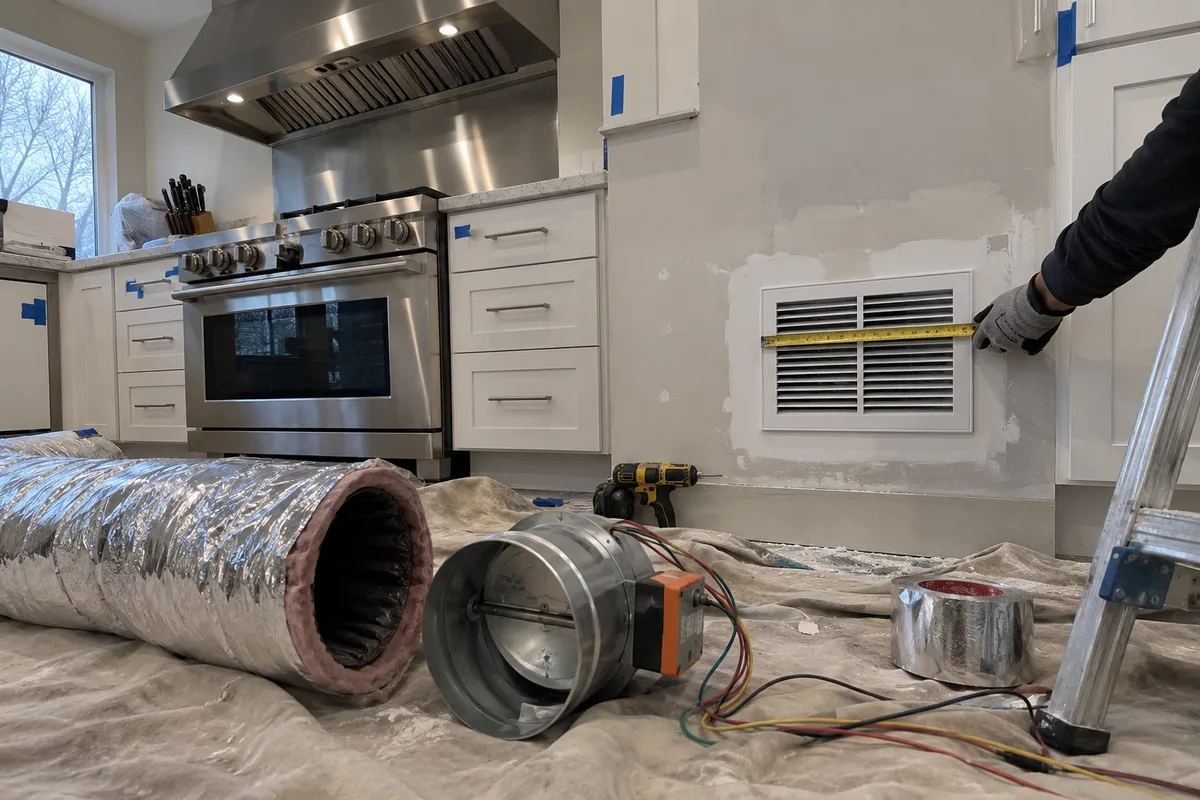
The makeup air must be supplied mechanically or passively at a rate approximately equal to the exhaust rate. The system must have at least one outdoor air duct and a damper that meets M1503.6.2.
The exception for an exhaust system used only for space cooling, and intended to run only when windows or other air inlets are open, does not fit a range hood. That exception is for equipment such as a whole house fan, not domestic cooking exhaust.
A furnace change out does not settle the water heater question
A sealed combustion, two pipe condensing furnace is direct vent. It draws combustion air from outdoors and sends its flue gases outdoors. That furnace does not trigger M1503.6.
The water heater may produce a different answer. An atmospheric water heater with a draft hood venting up a chimney uses natural draft. Natural draft comes from chimney height and the temperature difference of the flue gases. If that appliance is inside the air barrier, it triggers the makeup air requirement even after the old furnace is replaced with a condensing unit.
When the furnace leaves the chimney, the water heater is often left alone on it. That orphaned water heater can be the appliance that changes the range hood answer.
Fan assisted 80% furnaces venting into a Category I vent require a direct answer from the local building official. Whether that arrangement counts as a mechanical draft venting system is not something to assume either way. Confirm it before you tell the homeowner that makeup air is or is not required.
This matters because a large hood pulls the house negative. A natural draft appliance depends on weak buoyant draft. Strong exhaust can reverse that draft and spill flue gases, including carbon monoxide, into the home.
That is why a call about a range hood can become a water heater safety call. The shop doing the furnace work often already knows which appliances remain in the house. You may be the contractor best positioned to identify the condition that controls the code question.
The makeup air duct must serve the kitchen correctly
Under M1503.6.1, outdoor makeup air ducted for a kitchen must discharge into the same room as the exhaust system. It can also discharge into a room or duct system connected to that room through permanent openings.
Those permanent openings must have a net free area at least equal to the required makeup air supply opening area. Putting an outdoor duct somewhere else in the house does not automatically satisfy the kitchen location rule.
The damper has its own requirements. Each damper must be a gravity damper or an electrically operated damper that automatically opens when the exhaust runs. The damper must remain accessible for inspection, service, repair and replacement. Permanent construction or unrelated ducts cannot block that access.
A gravity or barometric damper cannot be used in a passive makeup air system unless it is rated to deliver the design makeup airflow at a pressure difference of 0.01 inch water column, or 3 Pa, or less.
Settle this before the duct is covered. A visible grille alone does not answer whether the installation meets M1503.6.
The makeup air question usually reaches the shop sideways
The call often comes in around dinnertime after a kitchen remodel. The CO alarm chirped while the family was cooking. The water heater smells funny when the new hood is on high. The call gets filed as a water heater problem or a furnace problem, and the new hood is not mentioned unless someone asks what changed in the house recently.
That question can expose the real issue. Ask about the hood when a combustion appliance behaves differently after a remodel. Ask about the water heater when a homeowner says the furnace was recently replaced. The hood rating and the appliance venting arrangement belong in the same conversation.
Dial 72’s receptionist, Bella, answers 24/7, triages by the shop’s own rules, and escalates emergencies straight to the on call tech with the full call context. You can make “CO alarm going off” an escalate immediately rule. Bella also texts a call summary after every call, so the tech already knows the caller mentioned a new range hood before arriving.
Ask these questions before you quote the work
Ask for the hood’s rated cfm. Do not use the homeowner’s usual operating speed.
List every gas, liquid or solid fuel burning appliance inside the dwelling unit’s air barrier. For each one, identify how it vents. Is it direct vent, natural draft or mechanical draft?
Confirm which code edition the jurisdiction has adopted. Some jurisdictions still enforce an older IRC edition that ties the requirement to hood size alone, without the appliance condition. This adopted code edition issue can change the result.
Then identify the makeup air arrangement. Where will the outdoor duct discharge? What is the damper type, and does it meet M1503.6.2? Can someone reach it without removing permanent construction or unrelated ducts?
If the equipment is operating normally, document the hood rating, the appliance venting and the adopted code edition before you price the work. A combustion test during a tune up can add useful information, as covered in combustion analysis for a gas furnace. Keep CO alarm guidance available for the customer conversation.
