
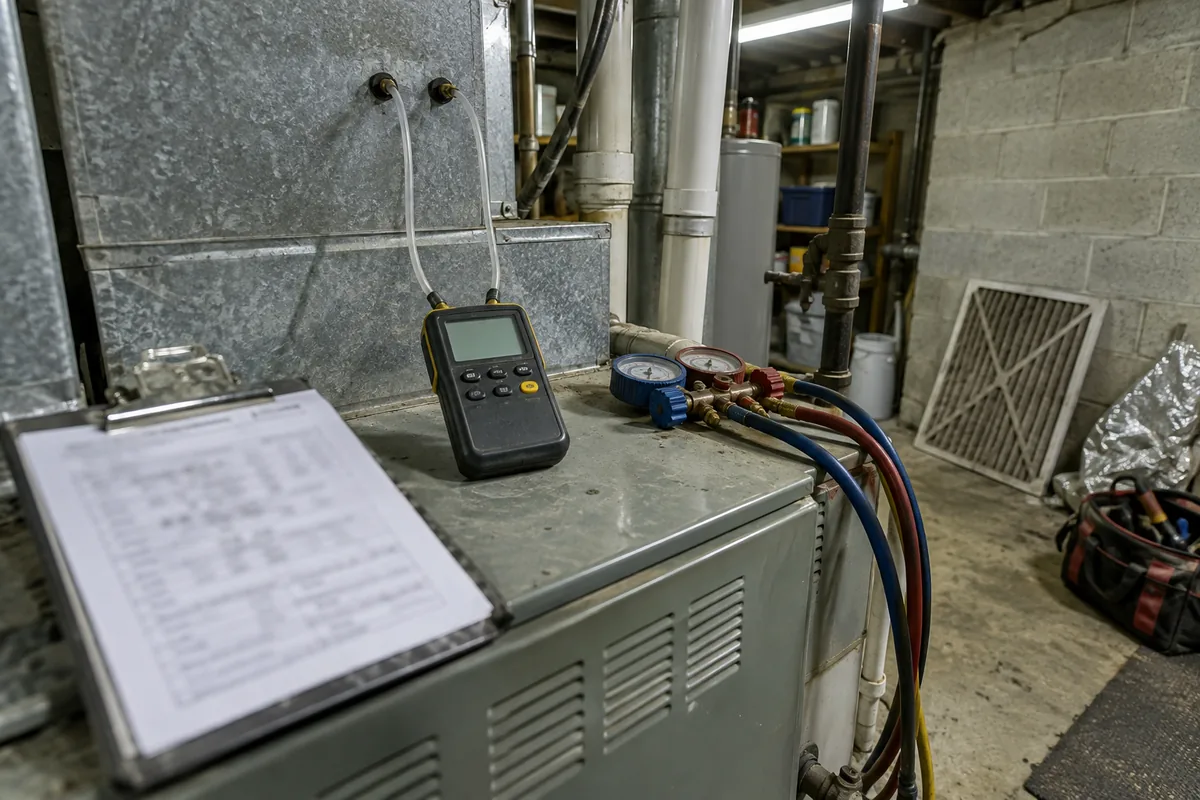
The callback that turns into an argument is rarely about whether the work was done. It is about whether anyone can prove what the numbers were on the day of the install.
Two years later a system is underperforming, the homeowner believes it was never right, and the shop is arguing from memory. A recorded superheat reading, a measured static pressure and a duct leakage result produce a completely different conversation, because you can show what the system did when it left your hands.
That is the point of ANSI/ACCA 5 QI-2015, the HVAC Quality Installation Specification. It does not treat “quality installation” as a slogan. It puts every requirement into three parts: Requirements, Acceptable Procedures, and Acceptable Documentation.
The third part is the one shops skip.
The installation file is part of the installation
For nearly every requirement, the documentation language ends the same way, with the contractor providing written job documentation or a checklist in the installation file. A number measured on the truck and never written down does not meet the requirement.
Section 6.1 requires that an installation file be created and handed to the client or building owner, and that your shop keep copies along with the model and serial numbers of every piece of equipment installed.
This is not new construction paperwork. The scope covers equipment installed in new and existing buildings, so a changeout is in scope, and it applies to unitary air conditioners, heat pumps, furnaces and boilers. There is no reason not to read it either. ACCA publishes its quality standards as free downloads, in its own words “as a service to the industry and our broader community.” It is the install-side sibling of ANSI/ACCA 4 QM, the standard that defines a maintenance visit, and it has a companion, ANSI/ACCA 9 QIvp, which sets the minimum requirements for verifying that a system actually meets QI. That second document is the protocol a third party uses to check your work, which means the file is not just for you.
The design records prove why that equipment belongs there
Section 3 starts before the equipment arrives, with ventilation calculations performed to a recognized methodology such as ASHRAE 62.1 or 62.2.
The load calculation rule then changes with the job. New construction, or any job that modifies the existing duct system or hydronic piping, requires room-by-room heat gain and heat loss calculations. Existing construction with no duct or piping modification can use a block load. Acceptable procedures are ACCA Manual J, ACCA Manual N, or an equivalent approved by the authority having jurisdiction, documented on Form J1 or N1 with Worksheet A. Calculations are not required if the original ones are on hand and accurately reflect the building’s current construction and use, but that is a narrow exception, not a reason for skipping the sizing question entirely.
Capacity then has to land inside recognized sizing limits at design conditions. Residential work uses Manual S, and the QI standard reprints the under-sizing and over-sizing limits from ANSI/ACCA 3 Manual S-2014 in an appendix, which is the same discipline as turning a load into the right equipment. Indoor and outdoor units also have to be verified as a match against the AHRI Product Certification directory or the CEE directory, with a copy of the certificate and its reference number in the file. That makes the AHRI number a job record, not a sales document.
The numbers the standard actually puts a tolerance on
Section 4 is where the standard gets specific. Airflow through the indoor heat exchanger has to be within 15% of the design airflow at the design fan speed, and inside the CFM range in the OEM product data. Measured external static pressure has to sit within the OEM range, and no more than 25% or 0.10 IWC, whichever is greater, over the calculated ESP used to design the duct system. On a changeout with no modification to the pre-existing ductwork, that second comparison is not required, because there is no design ESP to compare against.
Two details in the fine print catch people out. Temperature rise is a heating-only method at steady state, and the standard says plainly it is not acceptable for determining cooling airflow over the indoor coil. Static pressure also has to be measured with clean filters, coils and fans.
The re-test rule catches more. If the crew seals ducts or balances airflow after the first reading, the airflow and static pressure requirements have to be performed again and recorded on updated documentation. The common field mistake is exactly that sequence: measure airflow, seal ducts, go home. The recorded number no longer describes the system that is actually installed.
Refrigerant charge has an order too. Airflow or water flow must be within OEM tolerances before the charge is measured or adjusted, and the system has to be at steady state. Then superheat charging has to land within plus or minus 5 degrees F of the OEM value, or subcooling within plus or minus 3 degrees F.
Fuel-fired equipment needs a firing rate within plus or minus 5% of nameplate input and a temperature rise within nameplate limits, verified by clocking the meter or by a combustion analysis, with airflow confirmed first.
Duct leakage has a number for existing homes
Section 5 sets separate limits. New construction allows no more than 10% total duct leakage with ducts entirely inside the thermal envelope, or 6% if any portion sits outside it. Existing construction allows no more than 20% total leakage, or a 50% improvement on the existing rate. Local code or the AHJ can set the requirement instead.
Total leakage is supply plus return, measured against the air handler fan flow at design conditions using the higher of the heating or cooling airflow. Sealing materials have to be listed and labeled to UL 181A or UL 181B, and duct pressurization testing at 25 Pascal is an acceptable procedure, which is the same test code is already asking for in many jurisdictions.
This is not a small line item. NIST Technical Note 1848, by P.A. Domanski, H.I. Henderson and W. Payne, identified leaky ducts as the dominant installation problem, followed by refrigerant undercharge and improper airflow, and found that simultaneous faults generally add up rather than cancel out. NIST researcher Piotr Domanski put the combined effect this way: improper installation could increase household energy use for space heating and cooling “on the order of 30 percent over what it should be.”
Section 6 makes your phone number part of the deliverable
Owner education is a requirement here, not a courtesy, and it has four parts that are all required together. The customer has to be instructed on system operation, on maintenance requirements, and on warranty procedures and responsibilities, and has to be given contact information for warranty, maintenance and service. Acceptable documentation can include signed confirmation with the date and the names of the trainer and the person instructed, which is the same habit that protects the warranty registration window.
So the standard makes your shop the contact. It says nothing about what happens when the customer uses that number on a January night, or calls two years later because the paperwork is gone and they want to know what was installed. Dial 72 answers in under a second, 24/7, triages by your shop’s own rules so no heat in extreme weather or a vulnerable occupant reaches your on-call tech, books ordinary work into the calendar while the caller is still on the line, and sends the summary by text in English or Spanish. It recognizes maintenance members, which is the other half of what section 6.2 asks you to promote. Pricing is flat at $95, $295 and $495 a month, and how it works walks the call flow end to end.
Add the third column to your start-up sheet this week
Download the standard, it costs nothing. Then look at your own start-up sheet and ask whether it captures a measured value for every item the standard puts a tolerance on: airflow, external static pressure, superheat or subcooling, firing rate, duct leakage. Add a line for the re-test after sealing and balancing. Keep a copy at the shop with the model and serial numbers, and hand the file to the customer.
Your techs are probably already doing most of this work. The thing worth changing is what they leave behind.
