
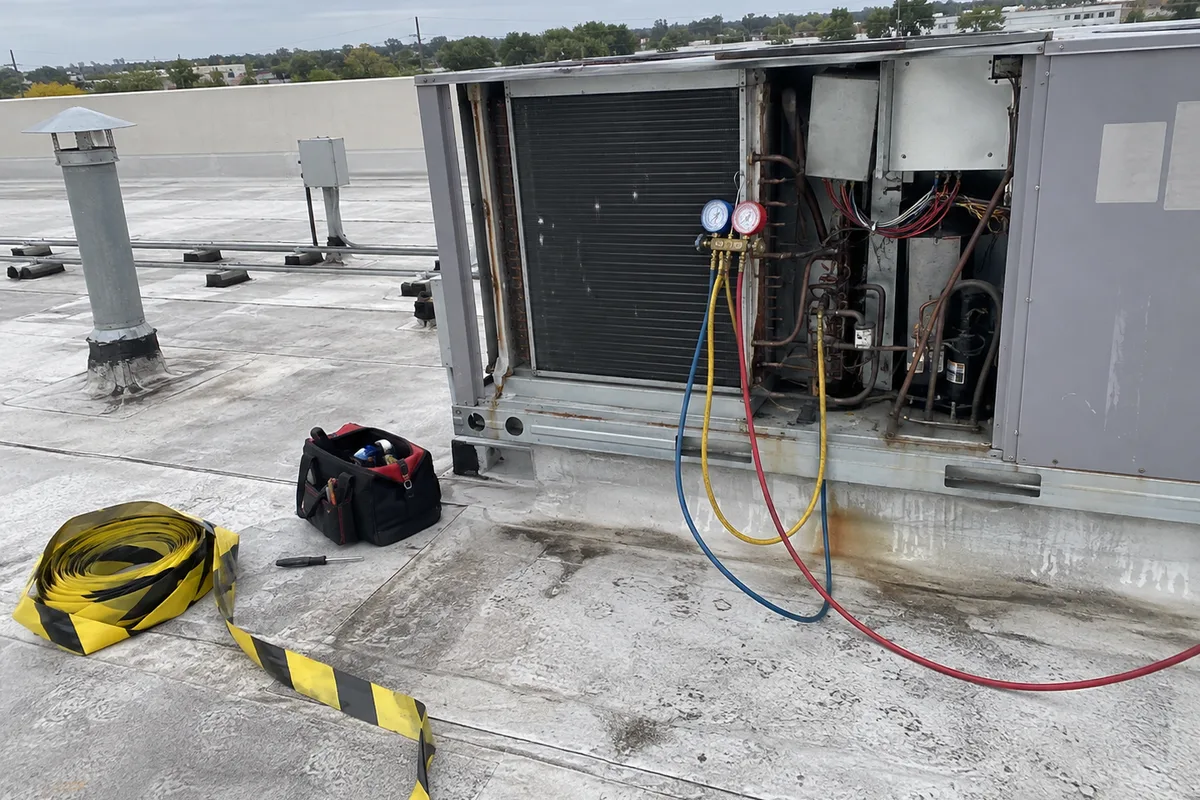
No, not automatically, and getting this wrong is a real citation and liability exposure, not a technicality. OSHA’s 2016 preamble and a 2020 standard interpretation letter define “infrequent” as roughly monthly or less and “temporary” as one trip lasting an hour or two. A shop running quarterly or biannual PM contracts on the same RTU can still qualify, but a shop that gets called back to the same unit repeatedly through a season can cross into workaround-required territory without anyone deciding that on purpose.
What OSHA 1910.28 actually requires near a roof edge
OSHA 29 CFR 1910.28, Subpart D, sets the fall protection rule for work on low-slope roofs. When work is performed less than 6 feet from the roof edge, the employer must protect the employee with a guardrail system, safety net system, travel restraint system, or personal fall arrest system.
There is no designated-area exception inside 6 feet. A rope or warning line does not replace the required protection at that distance. The rule is direct in 1910.28(b)(13)(i).
That makes the roof edge part of your dispatch decision, not just a technician’s judgment after arrival. If the RTU access panel, disconnect, or service path puts the technician inside that distance, the applicable protection has to be in place.
This is separate from the electrical access question covered in where the HVAC disconnect must be located. That article deals with NEC access requirements. This rule deals with fall exposure under OSHA.
The three distance bands change what you can use
The first band is less than 6 feet from the edge. Guardrails, safety nets, travel restraint, or personal fall arrest are required. A designated area is not available, regardless of how short the task is.
The second band is 6 feet to less than 15 feet from the edge. The same protection systems are required, but the employer may use a designated area instead when the work is both infrequent and temporary. OSHA describes that area as a distinct, physically delineated portion of the roof. A rope, wire, tape, or chain can serve as a warning line.
The third band is 15 feet or more from the edge. Fall protection may be omitted for infrequent and temporary work if the employer enforces a work rule prohibiting employees from going within 15 feet of the edge without fall protection. That is not permission to let a technician drift toward the edge while carrying tools or parts.
The fixed distance matters in the same way that other code dimensions matter for equipment access. Attic and crawlspace equipment access is a parallel example of a code setting a physical limit instead of leaving the question to habit.
What “infrequent” and “temporary” actually mean in OSHA’s own words
OSHA’s 2016 preamble, as discussed in its June 12, 2020 standard interpretation letter, defines “temporary” as a task lasting no more than an hour or two and requiring only one trip to the roof. “Infrequent” means work that arises only on occasion, such as monthly or less.
OSHA’s named examples include changing a filter in a rooftop HVAC unit, replacing a part, or responding to an equipment outage. A single filter change once a year fits the example OSHA itself gives. That does not turn every filter route, PM contract, or return visit into infrequent and temporary work.
Each trip has to be evaluated on its own. A breakdown call, a warranty return visit, and a full seasonal PM are separate trips. The fact that one filter change is short and rare does not give every later visit the same treatment.
The other major OSHA rule affecting routine HVAC service is electrical, not fall related. OSHA’s energized electrical work requirements address that different hazard category.
The repeat-visit problem is where shops get this wrong
The pattern that trips shops up is usually not the annual PM visit. It is the unplanned return work between scheduled visits.
A shop books one seasonal PM on a rooftop package unit in spring. The same unit then generates a breakdown call in July, a warranty part replacement in August, and a second breakdown in September. Counted individually, each visit looks short and occasional. Counted together on that roof, it is four separate trips inside five months, which is well past OSHA’s monthly-or-less framing for “infrequent.”
Nobody sat down and decided the job stopped qualifying for the designated-area exception. It accumulated past the line while everyone kept doing what worked the first three times.
A quarterly PM contract can still arguably fit OSHA’s monthly-or-less framing because the visits occur less often than monthly. A biannual PM schedule also presents a different record than repeated seasonal callbacks. But you should track the actual visit history for the specific rooftop unit. Do not decide from the contract frequency alone.
A designated area does not replace every fall protection method
A designated area is not a general substitute for guardrails or a harness. It is a physically delineated roof section used only for infrequent, temporary work between 6 feet and 15 feet from the edge.
That means the area must be established as a distinct zone with a rope, wire, tape, or chain used as a warning line. The task must also meet both parts of the exception. It must be infrequent, and it must be temporary.
Inside 6 feet, the designated-area option is unavailable. At 15 feet or more, the designated-area option is not the rule being used. Instead, fall protection may be omitted only for qualifying work when the employer enforces a rule barring employees from entering the area within 15 feet of the edge without fall protection.
OSHA does not pre-approve your decision that a particular rooftop visit qualifies. The employer makes that call and must be able to defend it using the facts of the work and the visit history.
Track every rooftop visit against the specific RTU
Your dispatch record should show the address, the specific unit, the reason for the visit, and the date. Include PM work, breakdown calls, warranty callbacks, part replacements, and filter changes. The question is not just how long today’s task should take. It is how often your shop has sent someone to that roof and unit.
Dial 72 books every call directly into the shop’s calendar while the caller is still on the line and syncs with ServiceTitan, Housecall Pro, Jobber, and Google Calendar. That puts follow-up breakdown calls into the same job history as the original PM instead of leaving the dispatcher to reconstruct the pattern from memory.
Use that history before sending the next technician up. Check the distance from the edge, identify the protection method, and decide whether the work is still both infrequent and temporary. If the record shows repeated trips through the season, stop treating the first designated-area setup as permanent permission.
Does a harness replace a guardrail requirement inside 6 feet? No. Guardrail, net, restraint, or personal fall arrest protection is required inside 6 feet, and a designated area is not an option there.
Does one filter change a year count as infrequent? Yes. OSHA names changing a rooftop HVAC filter as an example of infrequent, temporary work when it is short and requires one trip.
Does a quarterly PM contract on the same unit still qualify? Arguably yes under OSHA’s monthly-or-less framing, but track the visits and do not assume the contract alone settles the question.
Who decides if work is infrequent and temporary? The employer makes the call and must be able to defend it. OSHA does not pre-approve the decision.
Can a designated area be used within 6 feet of the edge? No. It is available only between 6 feet and 15 feet, and only for infrequent, temporary work.
