
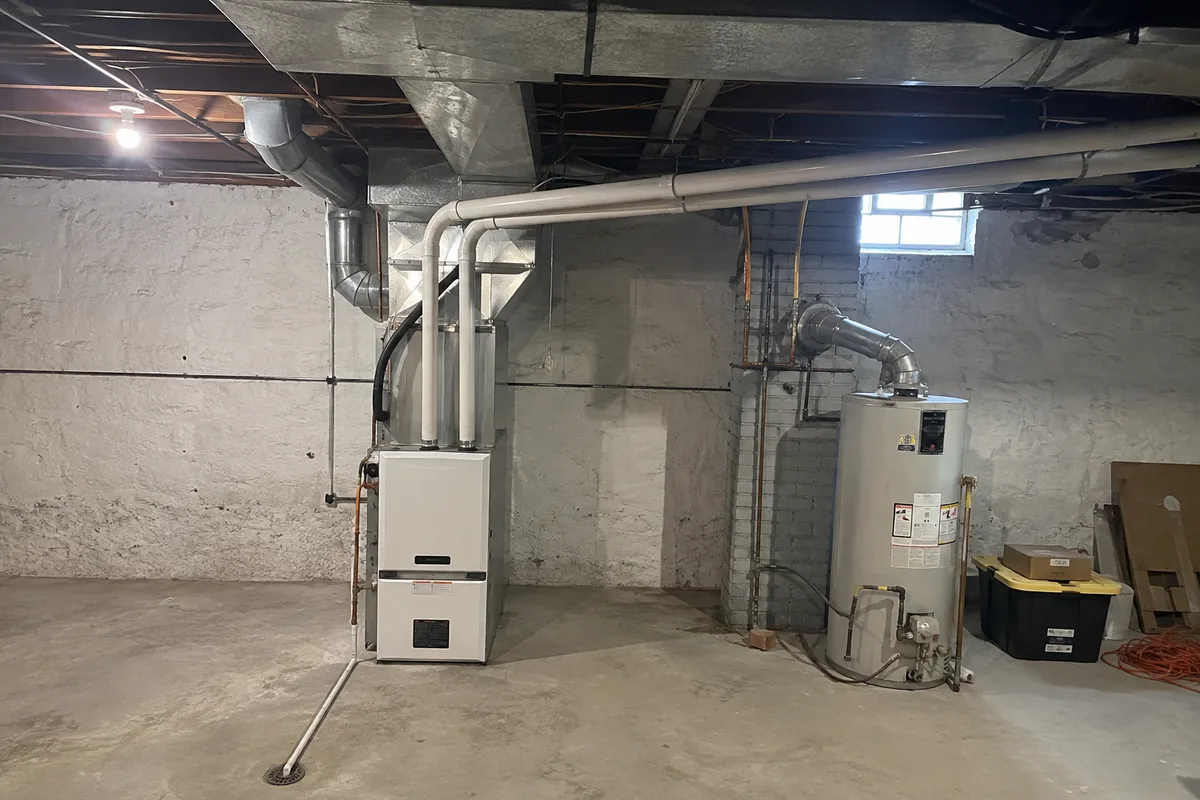
The furnace is in, the PVC is terminated, the condensate pump is wired, and the homeowner is happy. Six weeks later they call about a smell in the basement and rust streaks on the water heater jacket. The water heater was never touched. That is the point.
When you disconnect an appliance from a shared chimney, the fuel gas code does not treat the remaining appliance as untouched work. It treats the chimney as a new installation that has to be resized. That is one short section, it applies on the day you pull the old furnace, and it is the difference between a liner that was a line item and a liner that is a warranty call.
Shops mostly know the orphaned water heater exists. What tends to be missing is the ability to prove it on the driveway, in front of a homeowner comparing three quotes, with a number instead of a feeling.
What “orphaned” actually means
The common older configuration is an 80% furnace and an atmospheric gas water heater, both draft hood or draft diverter equipped, both connectored into one masonry chimney. The chimney was sized, correctly or otherwise, for their combined input. Together they produced enough hot flue gas to warm the masonry, establish draft, and keep the flue above the dew point of the combustion products for most of the run cycle.
Take the furnace off that chimney and you remove most of the heat. What remains is often a 30,000 to 40,000 Btu per hour water heater firing in short bursts into a flue built for four or five times that. The chimney does not get hot fast enough, draft is slow to establish, and on a cold morning with the wrong wind the products of combustion take the easy path out of the draft hood into the basement instead of up. Meanwhile the flue gas that does go up cools below its dew point inside the masonry and condenses, which is what puts moisture into the tile and mortar and eventually the water heater jacket.
Oak Ridge National Laboratory documented this behavior in its condensing furnace venting work. It is not a theory about older housing stock. It is the predictable result of removing the appliance that was doing the heating.
That is a combustion safety issue and a building durability issue at the same time. It is also entirely foreseeable at the point of sale, which is why the code puts it on the person doing the changeout.
The section that makes it your job
The International Fuel Gas Code handles this in Chapter 5, under existing chimneys and vents. The trigger language is broad on purpose:
Where an appliance is permanently disconnected from an existing chimney or vent, or where an appliance is connected to an existing chimney or vent during the process of a new installation, the chimney or vent shall comply with Sections 501.15.1 through 501.15.4.
Read the first clause slowly. It is not about the appliance you installed. It is about the appliance you removed. Pulling the furnace off the chimney is itself the event that brings the chimney into scope, even though your new equipment never touches it.
Four subsections follow, and all four are billable work:
Size (501.15.1). The chimney or vent “shall be resized as necessary to control flue gas condensation in the interior of the chimney or vent and to provide the appliance or appliances served with the required draft.” Condensation control is named first. This is the code writing down the exact failure mode above.
Flue passageways (501.15.2). The passageway has to be free of obstructions and combustible deposits, and has to be cleaned if it previously vented a solid or liquid fuel appliance or a fireplace. In housing stock old enough to have a shared masonry chimney, that history is common and worth asking about.
Cleanout (501.15.3). Masonry chimney flues need a cleanout opening with a minimum height of 6 inches. Plenty of older chimneys do not have one.
Clearances (501.15.4). Airspace clearance to combustibles per the building code and the manufacturer’s instructions.
Section numbers move between editions and jurisdictions amend them. The enforceable text is the edition your jurisdiction actually adopted, and the parallel language lives in NFPA 54, the National Fuel Gas Code, also published as ANSI Z223.1. Verify in the adopted code rather than trusting a number quoted in an article, the same discipline that applies to standards versus adopted code generally.
The arithmetic you can do on the driveway
You do not need a full table exercise to know whether you have a problem. The masonry chimney tables for a single appliance carry a cap in the column heading itself. The maximum internal area of the chimney is seven times the appliance’s categorized vent area, flue collar area, or draft hood outlet area. The same seven times limit appears in the chimney sizing methods for a single draft hood equipped appliance.
That turns into two numbers most techs can carry in their head.
A 3 inch draft hood outlet has an area of about 7.1 square inches. Seven times that is roughly 49 square inches of maximum internal chimney area.
A 4 inch draft hood outlet has an area of about 12.6 square inches. Seven times that is roughly 88 square inches.
Now measure the inside of the flue, not the outside of the masonry. A chimney that comfortably carried a furnace plus a water heater is frequently well past the number for the water heater alone once the furnace is gone. When it is, the chimney is oversized for the remaining appliance as a matter of code text, not judgment, and you have your answer before anybody argues about it.
Confirm the water heater’s actual draft hood outlet size on the rating plate or in the manufacturer’s instructions rather than assuming, and remember the cap is a maximum. Clearing it does not by itself finish the sizing exercise.
Why the table you were using no longer applies
There is a second thing that changes at the moment of disconnection, and it gets missed because both situations look like “look it up in the vent tables.”
While the furnace and water heater shared the chimney, the sizing lived in the common vent tables for two or more appliances connected to a vertical vent or chimney. With the furnace gone there is one appliance on that chimney, so the governing tables are the single appliance tables. Different tables, different capacities, different pass and fail.
Which single appliance table depends on what the chimney is and where it runs. There are separate masonry chimney tables depending on whether the vent connector is Type B double wall or single wall metal. Exterior masonry chimneys, meaning a chimney with one or more sides exposed to outdoor air, are treated more restrictively still, because the masonry is being cooled from outside while it is trying to stay above the flue gas dew point.
For a clay tile lined exterior masonry chimney the code requires a specific table pairing and attaches conditions to it, including that the vent connector be Type B double wall and that connector length be limited to one and a half feet for each inch of connector diameter. The code then says the quiet part directly. Where those conditions cannot be met, an alternative venting design shall be used, such as a listed chimney lining system.
That is the code naming the fix.
The fixes, in the order worth quoting them
Reline the chimney. The usual answer. A listed corrugated metallic chimney liner system in a masonry chimney is sized off the Type B vent tables, with the maximum capacity reduced by 20 percent. That 20 percent reduction is the detail shops skip, and skipping it is how a liner gets installed that still does not carry the load on paper. Masonry chimneys generally must be lined with an approved clay flue lining, a chimney lining system listed and labeled to UL 1777, or another approved material that resists corrosion, erosion, softening, and cracking from vent gases, and masonry chimneys are built and installed per NFPA 211. Size the liner for the water heater that is staying, not for the pair that used to be there.
Take the water heater off the chimney entirely. A power vented or condensing gas water heater, or a heat pump water heater, ends the venting problem instead of managing it. It is a bigger number on the proposal and it is often the better recommendation, especially when the water heater is already past ten years, when the chimney is exterior, or when relining is awkward enough that the cost difference narrows. If the chimney ends up with no gas appliance on it, it still needs to be dealt with as an abandoned flue rather than left open.
Do nothing, on purpose, with documentation. Occasionally the numbers work. Interior chimney, correctly sized liner already in place, water heater draft hood outlet large enough that the seven times cap is not exceeded, table capacity satisfied. If that is the case, write down what you measured and what table you used. An unremarkable finding you can produce later is worth more than a memory.
What is not on this list is leaving it and hoping. The failure is slow, it looks like a water heater problem rather than a furnace problem, and it comes back to the last person who worked on the system.
Verify after, not just before
The sizing exercise is a paper result. The confirmation is at the appliance.
After the changeout, with the water heater firing, check for spillage at the draft hood once the burner has had a chance to establish draft. Do it under worst case conditions rather than ideal ones, which means with the house set up the way it actually gets used: exhaust fans running, dryer on, any other combustion appliance operating, doors in the position that puts the mechanical space under the most negative pressure. A water heater that drafts fine in a still basement with the door open can spill with the bath fan and dryer going.
Measure rather than infer. Combustion products are invisible until they are not, and a mirror at the draft hood tells you about moisture, not about carbon monoxide. This is the same measurement discipline that turns a furnace visit into a defensible safety check, applied to the appliance you did not sell.
Also remember that the condensing furnace you just installed changed the space itself. It is pulling its combustion air from outdoors through its own intake instead of from the room, so the mechanical space no longer has that appliance’s draft to help it, and the total input on the chimney has dropped. Both of those cut the same direction for the water heater.
What to do this month
- Add the chimney to the survey sheet. On any changeout coming off a shared vent, record the flue’s internal dimensions, whether the chimney is interior or exterior, whether it is lined and with what, whether there is a cleanout, and the water heater’s draft hood outlet size and input. That is a two minute addition that decides a several hundred dollar line item.
- Teach the seven times number to everyone who quotes. Roughly 49 square inches for a 3 inch draft hood outlet, roughly 88 for a 4 inch. It is enough to know on site whether a liner is in the conversation.
- Price the liner in the proposal, not after. A shop that includes it looks more expensive next to a shop that did not, right up until the inspection or the callback. Explain the line rather than hiding it.
- Ask about the water heater’s age while you are already there. If it is close to replacement, the power vent conversation is a better one to have now than after a new liner is installed around it.
- Photograph the flue and the cleanout. Existing conditions you documented before you started are the cheapest thing you will ever own.
The version of this that reaches your phone
The homeowner in this story does not call and say their water heater is orphaned. They call and say the basement smells funny, or that the water heater they never had trouble with is suddenly rusty, and they are annoyed because you were just there. That call is going to a shop whose techs are booked into heating season.
Whoever answers needs to get two things down before anyone dispatches: that the complaint involves a combustion appliance and possible spillage, and that this address had recent work. Those two facts turn a vague callback into a correctly prioritized visit with the right tech and the right parts. A voicemail box gets you neither, and on a cold week the callback happens after the customer has already called somebody else. That is the job Dial 72 does when your office cannot pick up. See how it works, or pricing if this call is currently going to voicemail.
Quick answers
Is the orphaned water heater really our responsibility if we never touched it? Under the fuel gas code, permanently disconnecting an appliance from an existing chimney is itself the trigger that brings the chimney into scope. The remaining appliance’s vent has to be resized as necessary to control flue gas condensation and provide required draft. The work you did to the furnace is what created the obligation.
How do I know quickly whether the chimney is oversized? Compare the flue’s internal area against seven times the water heater’s draft hood outlet area, which is the maximum internal chimney area named in the single appliance masonry chimney tables. About 49 square inches for a 3 inch outlet, about 88 for a 4 inch. Measure the inside of the flue, not the outside of the chimney.
Can I size the liner straight off the Type B vent tables? Listed corrugated metallic chimney liner systems in masonry chimneys are sized using the Type B vent tables with the maximum capacity reduced by 20 percent. Using the unreduced capacity is a common and consequential mistake.
Does it matter that the chimney runs up an outside wall? Yes. Exterior masonry chimneys are handled more restrictively, with their own table pairing and conditions, including a Type B double wall connector and a connector length limit of one and a half feet for each inch of connector diameter. Where the conditions cannot be met, the code directs you to an alternative venting design such as a listed lining system.
Is a liner always the answer? No. Moving the water heater to a power vented, condensing, or heat pump unit ends the venting problem rather than managing it, and on an old water heater or an awkward exterior chimney it is often the better recommendation once you compare total cost.
Does this only come up on 95% furnace installs? It comes up any time an appliance leaves a shared chimney, including boiler replacements and cases where a homeowner switches to a ductless or heat pump system and abandons gas heat. Condensing furnace changeouts are simply the most common path to it, which is why it will keep getting more common as the 95% AFUE standard pushes more of the market that direction.
What about combustion air in the mechanical space? Removing the furnace lowers the total input in the space, so the combustion air requirement for what remains generally goes down, not up. The new furnace draws its combustion air through its own intake. Confirm the space still meets the requirement for the appliances that are actually left in it rather than assuming the old calculation carries over.
