
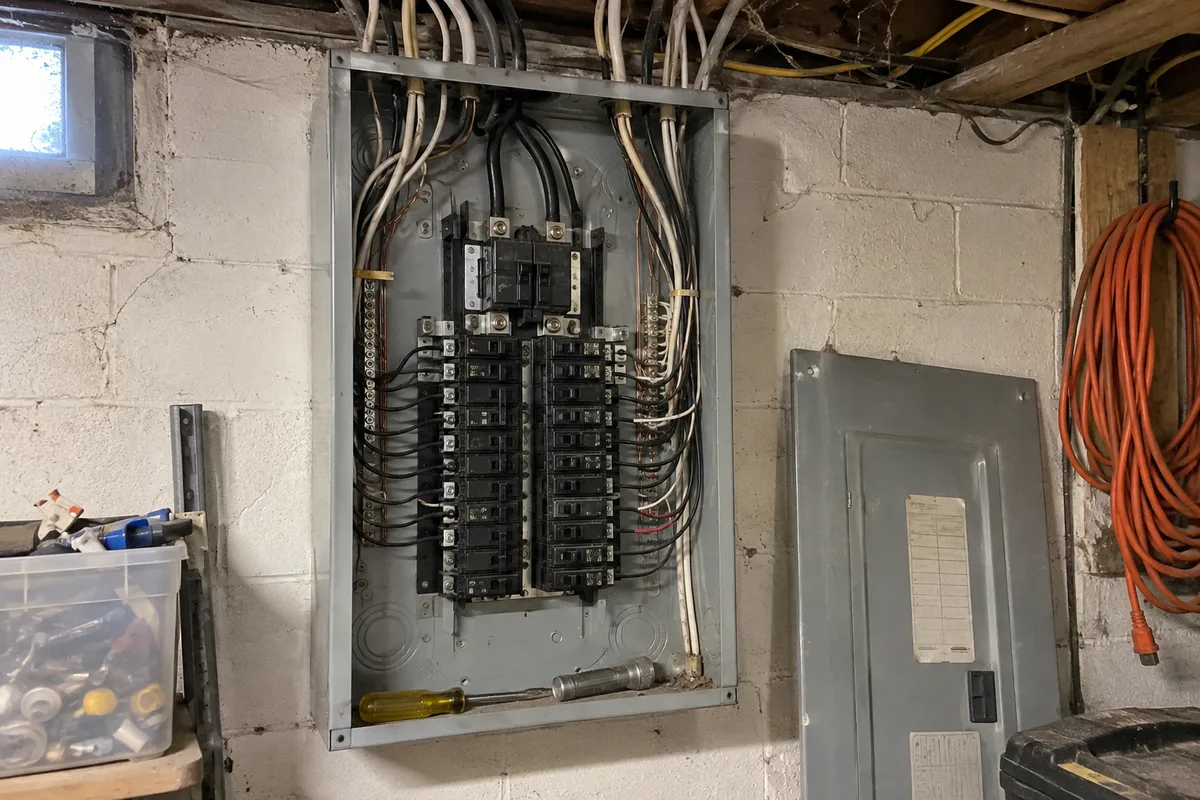
On an air conditioning circuit the breaker is legally allowed to be bigger than the wire it feeds. That is not a mistake somebody made in the field. It is how NEC Article 440 works. What is not allowed is a breaker bigger than the number printed on the equipment nameplate.
MCA sizes the conductor, MOCP caps the breaker
MCA means minimum circuit ampacity, the floor for the branch circuit conductors. MOCP means maximum overcurrent protection, the ceiling for the breaker or fuse. Both are on the plate because a residential condenser is multimotor and combination load equipment, and NEC 440.4(B) requires that equipment to carry a visible nameplate marked with the minimum supply circuit conductor ampacity and the maximum rating of the branch circuit short circuit and ground fault protective device.
Those numbers are not the manufacturer’s preference. NEC 110.3(B) says listed, labeled, or identified equipment shall be installed and used in accordance with any instructions included in that listing, labeling, or identification. The word is “shall.” That one sentence turns a printed plate into an enforceable installation requirement.
The marked MCA already carries the 125 percent factor
NEC 440.35 requires branch circuit conductors to be not less than the MCA marked on the nameplate. The manufacturer already did the arithmetic. NEC 440.33 sets it at the compressor’s nameplate current rating, plus the other motor’s nameplate current rating, plus 25 percent of the compressor current. You do not recalculate that in the field. You confirm the installed conductor meets or exceeds the printed number.
The temperature column is where careful work still fails. Nearly all residential HVAC equipment is rated 100 amperes or less, and under NEC 110.14(C)(1)(a) the terminations on equipment that size are used for 60 degree C conductors, or for higher rated conductors whose ampacity is taken from the 60 degree C column, unless the equipment is listed and identified for the higher rating. Reading 10 AWG THHN out of the 90 degree C column and calling it 40 amps does not satisfy an MCA the 60 degree C column only supports at 30.
MOCP is the largest breaker allowed, not the breaker you have to buy
The marked value cannot be exceeded. The device you install may be smaller. Shops read MOCP as a spec line telling them what to order, and it is not one. The plate may call it “maximum fuse size” or “maximum fuse or circuit breaker,” and some equipment prints one number for a fuse and a different one for a breaker. Those are not interchangeable.
NEC 440.22(A) is the rule behind the marked number. For an individual motor compressor the protective device must carry the starting current at a rating not exceeding 175 percent of the rated load current or branch circuit selection current, whichever is greater, and where a device at 175 percent will not carry starting current, the next higher standard size is permitted up to 225 percent. The manufacturer applied all of that before printing MOCP. A nameplate reading MOCP 40 does not become MOCP 50 because a calculation might otherwise have allowed it.
This is where Article 440 leaves ordinary branch circuit logic, in which the overcurrent device protects the conductor. Here the marked device works together with the equipment’s own internal overload protection, which is why a conductor can look undersized against the breaker and still comply. A unit marked MCA 24.3 and MOCP 40 is correctly wired with 10 AWG on a 40 amp breaker: the wire satisfies the MCA at 30 amps in the 60 degree C column, and the breaker sits at the permitted ceiling. Techs who learned residential branch circuits before they learned Article 440 see that pairing and want to fix it.
The changeout problem now runs in the other direction
Everyone plans for the upgrade case, where the new equipment needs more wire than the old circuit has. The common failure now is the reverse. A more efficient replacement usually draws less, so the 40 or 45 amp breaker already in the panel can sit above the new unit’s MOCP of 25 or 30. The conductor is normally fine, because it already exceeded a smaller MCA. It is the breaker that is out of compliance, and nobody touched it. That is exactly the problem.
Structure Tech, a home inspection company, names the oversized circuit breaker as the most common defect it finds at the air conditioner circuit, and says it typically happens when a unit is replaced with a more efficient one and the breaker in the panel is not replaced with a smaller one. That is one firm’s field observation rather than an industry statistic, but it matches the direction of the problem. A replacement is what pulls an old installation into current requirements generally, the same logic behind efficiency compliance turning on the day you install the equipment and behind the changeout trigger in NEC 210.8(F) and the GFCI exception that expired.
There is a documentation habit underneath it. In changeout files the nameplate photograph is nearly always there and the panel photograph nearly never is, because crews are trained to document the equipment rather than the circuit feeding it. That gap is what produces an oversized breaker finding a year later, when a home inspector pulls the deadfront during a sale and the homeowner calls the shop that did the install. Put the panel photo in the survey beside the nameplate photo and both directions get ruled out before the truck leaves.
The disconnect has its own number, and it is 115 percent
The disconnect is sized from neither MCA nor MOCP. NEC 440.12(A)(1) requires its ampere rating to be at least 115 percent of the nameplate rated load current or branch circuit selection current, whichever is greater, and 440.12(B)(2) requires 115 percent of the sum of all individual loads at rated load conditions for combination loads. That is three numbers off one plate, and reusing the existing disconnect on a changeout is a decision rather than a default, separate from the location and working space in front of it.
One last plate-versus-memory trap. The NEC no longer requires a breaker to carry an HACR marking, since standard UL 489 breakers are treated as suitable for the application. Older nameplates still say “HACR type circuit breaker,” and where the plate says it, 110.3(B) still makes it binding on that install. The NEC is a model code either way, binding you in the edition your jurisdiction adopted.
The version that reaches your phone
None of this arrives as a code question. It arrives as a homeowner saying the AC trips the breaker, while the crew is in an attic and nobody is at the desk. “It trips the breaker” and “it is dead” point at different problems and different truck stock, and getting that detail on the first call instead of a voicemail is the difference between one visit and three, before you even reach what a missed no-heat call actually costs.
Dial 72 answers 24/7, triages so a breaker complaint and a dead system do not arrive looking identical, flags a replacement inquiry as its own category, and texts you the summary while you are still on the roof. See how it works, or pricing if that call currently goes to voicemail.
