
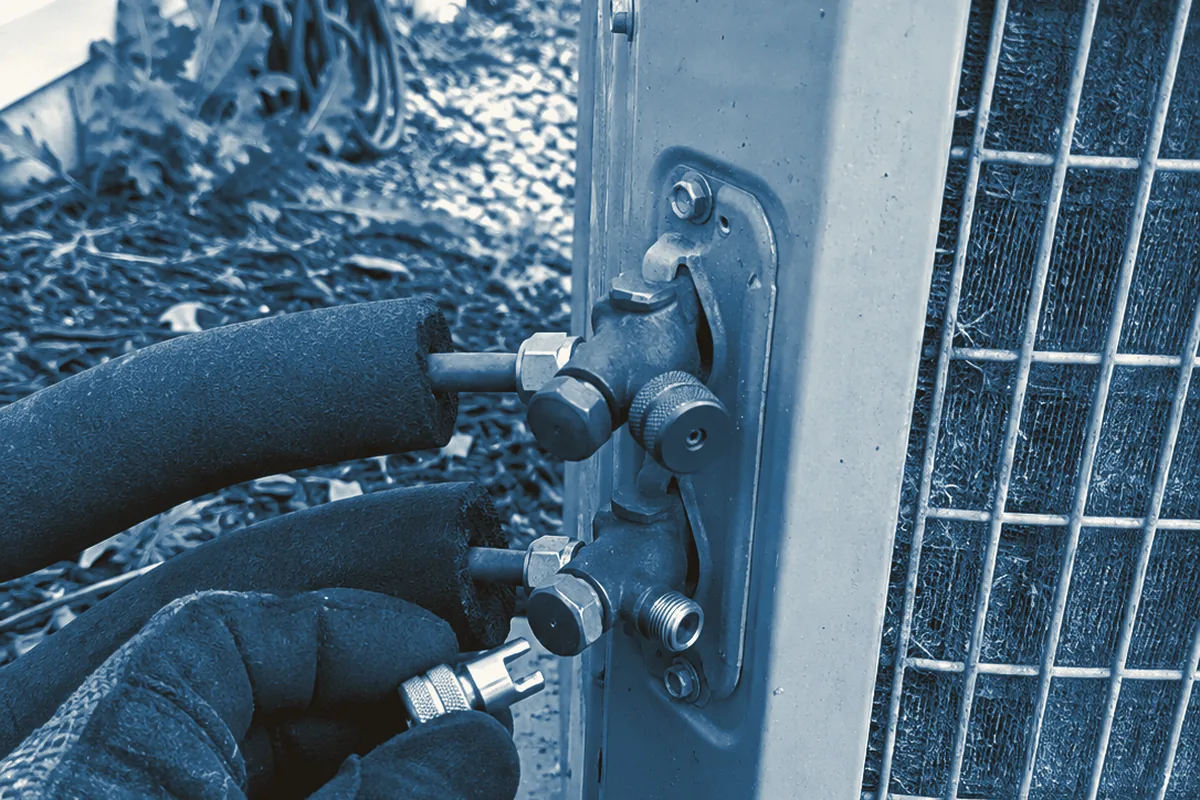
The locking cap rule has been in both I-Codes since 2009
The current code language states: “Refrigerant circuit access ports located outdoors shall be fitted with locking-type tamper-resistant caps or shall be otherwise secured to prevent unauthorized access.”
That requirement has been in the International Residential Code and International Mechanical Code since the 2009 editions. The ICC publishes both codes. In the 2009 IRC, it appeared as section M1411.6. In the 2024-based IRC, it is section M1411.15, titled “Locking Access Port Caps.”
In the IMC, the requirement was section 1101.10 in the 2015 and 2018 editions. It is section 1101.9 in the 2021 edition. Look it up by its title, “Locking access port caps,” instead of relying on a number you remember from a previous code edition.
The install passes, but the tune-up is where the violation starts
Installers mostly put the right caps on a new condenser. The trouble shows up later.
A code requirement on installed equipment is not a one-time checkbox at final inspection. Outdoor access ports have removable caps because technicians need to connect gauges and service equipment. Every visit that opens those ports decides what the equipment is wearing when the technician leaves.
The locking caps come off. The key gets set on top of the unit, dropped in a pocket, or left in the truck. A plain cap goes back on because it is already within reach. The shop that last touched the ports owns what is on them when the visit is complete.
A plain cap does not meet either path in the rule
The code gives you two ways to comply. Use locking-type tamper-resistant caps, or secure the ports by another method that prevents unauthorized access.
A plain brass or plastic cap that anyone can spin off by hand is neither. It is not a locking-type tamper-resistant cap, and it does not otherwise secure the port.
Equipment behind a locked enclosure can fit the second path. The enclosure has to prevent unauthorized access.
Your state may be on a different model code, but the rule is still there. Nevada Mechanical Code 2018 section 1105.11, “Refrigerant Port Protection,” requires outdoor air conditioning refrigerant access ports to have locking-type tamper-resistant caps or protection approved by the authority having jurisdiction. It also provides an exception for ports in secure locations protected by walls or fencing that require key access.
The rule protects people and the refrigerant charge
The direct safety concern is unauthorized access to refrigerant. People, often teenagers, may inhale refrigerant directly from outdoor units. That can kill.
The caps also deter tampering and venting of the charge. Refrigerant in the circuit has real value, as discussed in refrigerant recovery, recycling, and reclaim.
The rule applies in a particular town based on the IRC or IMC edition that jurisdiction adopted and any local amendments. Any jurisdiction using the 2009 edition or a later edition has had this requirement. Check which code edition your jurisdiction adopted before deciding which section applies locally.
Service managers see the same cap problem on older equipment
A common field pattern appears when a service manager pulls up an older system for maintenance or a replacement quote. The condenser was installed with locking caps. Later, the ports have plain caps, one locking cap and one plain cap, or no cap at all with only the valve core showing.
Nobody decided to remove the protection permanently. A technician on an earlier visit used the key, removed the locking caps, and put back whatever cap was handy. It is the same drift that affects any small part that has to come off to do the job.
The fix is procedural. Stock locking caps and the key on every truck. Add “caps back on, locked” to the maintenance checklist and the technician’s closeout. The ANSI/ACCA maintenance standard and what a maintenance visit should include gives you the place to add that check to the rest of the visit.
Every truck needs the right caps and the key
The cap check belongs on every service call, not only new installations. Check both outdoor access ports on equipment you installed and equipment you did not install. If the protection is missing or wrong, fix it before you leave.
A missing cap call should reach the schedule
A homeowner who calls because the caps are missing, or because someone was messing with the outdoor unit, may not have a true emergency. The call still should not disappear into voicemail.
Dial 72 remembers returning customers, including equipment history, so the caller does not have to re-explain the system. It books directly into the shop’s calendar while the caller is on the line and texts a call summary to the shop after every call. It triages by your rules. True emergencies escalate to the on-call technician immediately. Everything else books a slot.
That gives the shop a scheduled visit and a summary with the customer’s equipment history attached. The technician can show up with locking caps and the key instead of discovering the problem at the unit. Preparing your AI receptionist before she answers helps set that process up.
Change the closeout before the next service visit
Stock locking caps and the key on every truck, sized for the service ports you actually see. Put “caps replaced and locked” on the maintenance checklist and technician closeout. Then look up “Locking access port caps” by title in the code edition your jurisdiction adopted. The install may have passed years ago. Your service visit is what determines whether the protection is still there.
Three questions about outdoor refrigerant port caps
Is a plain brass cap enough?
No. A plain cap that anyone can remove by hand is not a locking-type tamper-resistant cap and does not otherwise secure the port.
Does it apply if the unit is inside a locked fence?
The code provides an “otherwise secured” path. A secure location protected by walls or fencing that requires key access is the type of arrangement covered by parallel code language.
Is this a new rule?
No. The requirement first appeared in the 2009 editions of the IRC and IMC.
