
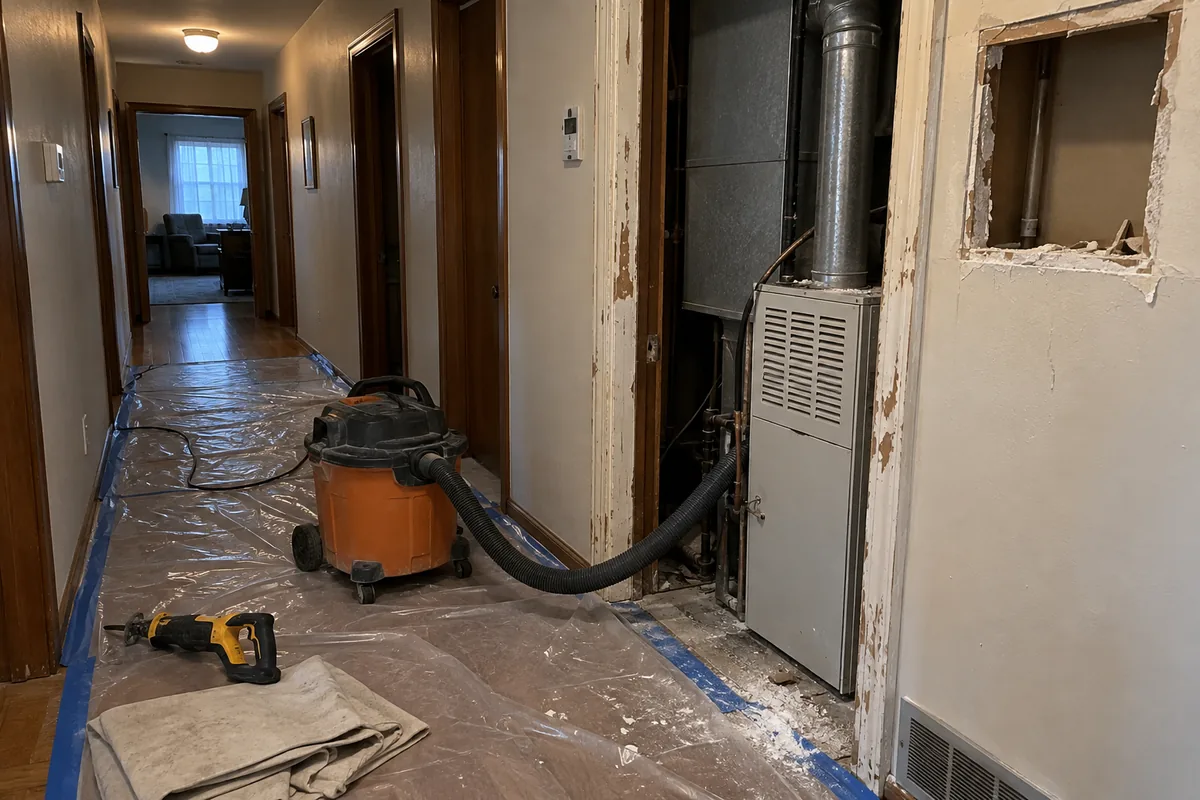
You are changing a furnace in a house built before 1978. The closet fails the volume test, so you are cutting permanent combustion air openings into a furnace closet wall. Once the saw touches that painted wall, the job may fall under EPA’s Lead Renovation, Repair and Painting rule.
The same question shows up when you enlarge painted trim to meet attic and crawlspace access requirements, add a return grille, or open exterior siding for a line set. The mechanical work has not changed. What changed is that it now disturbs paint.
The regulation names HVAC work directly
The RRP rule sits at 40 CFR Part 745, Subpart E. It applies to paid work that disturbs painted surfaces in houses, apartments, and child-occupied facilities built before 1978. Compensation is the trigger. Homeowners working on their own homes are not covered.
EPA’s March 2026 compliance guide lists painters, plumbers, carpenters and electricians as covered trades, and lists remodeling, repair and maintenance, electrical work, plumbing, painting preparation, carpentry and window replacement as covered activities. HVAC appears in neither list. That omission does not exclude you, because both lists are expressly non-exhaustive.
The regulation itself names the trade. The definition of minor repair and maintenance activities at 40 CFR 745.83 opens with “minor heating, ventilation or air conditioning work.” HVAC is in the rule text.
You must assume lead-based paint is present in a covered building unless testing determines the affected components are lead-free. A certified renovator uses an EPA-recognized test kit, or collects paint chip samples for an EPA-recognized laboratory, when the party contracting for the renovation requests it. Testing is not an automatic step on every job.
Six interior square feet is the first line
Minor repair and maintenance is excluded from the rule when the work disturbs 6 square feet or less of painted surface per room for interior work, or 20 square feet or less for exterior work.
That is why most service calls never become full RRP projects, and why most shops working in older housing have never had to think about any of this.
The exclusion never covers window replacement or demolition of painted surface areas. It also disappears when any one of three specific things applies, and none of the three is about how big the hole was.
A prohibited method defeats the square footage exclusion
The first one is method. The exclusion holds only where none of the prohibited or restricted work practices are used.
Those practices are open-flame burning or torching of painted surfaces, operating a heat gun on painted surfaces above 1100 degrees Fahrenheit, and using machines that remove paint through high speed operation such as sanding, grinding, power planing, needle gun, abrasive blasting or sandblasting. The machine exception is narrow. It needs a shroud or containment system with a HEPA vacuum attachment collecting dust and debris at the point of generation, operated so no visible dust or release of air occurs outside the shroud.
Use one of those on a four inch hole and the minor repair exclusion is gone. Square footage does not save it.
A removed component counts at its full painted area
The second one is the whole-component rule. When you remove a painted component, or a portion of one, the entire surface area removed is the amount of painted surface disturbed.
Pull a painted louvered closet door, a painted access panel, or a painted wall-mounted component, and the measurement is that component’s full painted face. Not the cut line, not the fasteners.
Small openings in one room add together for 30 days
The third one is aggregation. Jobs other than emergency renovations performed in the same room within the same 30 days are considered the same job when you determine whether the work qualifies as minor repair and maintenance.
That matters on return and duct sizing work, where adding or resizing a return can mean several grille openings cut through painted wall or ceiling surfaces. If those openings happen in the same room inside a month, their disturbed areas add together.
Two separate dispatches do not buy you two separate square footage limits.
An emergency exemption lasts only as long as the emergency
EPA defines an emergency renovation as activity that was not planned and, if not immediately attended to, presents a safety hazard or threatens equipment or property with significant damage. An unplanned after-hours no-heat call or a safety shutdown in an old house can meet that definition. A changeout scheduled for next Tuesday does not.
Pre-renovation education does not apply to emergency renovations. The warning sign, containment, waste handling, training and certification requirements are also exempt, but only to the extent necessary to respond to the emergency.
Cleaning and cleaning verification are not exempt. Emergency work is also excluded from the 30-day aggregation rule.
Covered work requires a certified firm and a certified renovator
A covered renovation has to be performed by an EPA-certified firm using a certified renovator. Sole proprietorships are firms. Firm and individual certifications are renewed every five years.
An individual becomes a certified renovator by completing an eight-hour initial course from an EPA-accredited training provider. Techs who completed an accredited lead abatement worker or supervisor course, or certain EPA, HUD or EPA/HUD model renovation courses before October 4, 2011, need only the four-hour refresher instead.
That renovator has to be physically present when the warning signs go up, while containment is established, and while the work area cleaning is performed. They direct the work, stay available on site or by telephone the whole time, perform the cleaning verification, carry their course certificates at the site, and prepare the records.
Before non-emergency work starts, the firm distributes EPA’s “The Lead-Safe Certified Guide to Renovate Right.” In an owner-occupied dwelling you either hand it to the owner before work begins and get confirmation of receipt, or mail it at least seven days ahead and keep the certificate of mailing. Either way, delivery cannot be more than 60 days before the work begins.
The work practices are written at ductwork
For covered interior work, post signs defining the work area, then contain it so no dust or debris leaves. Remove objects from the area or cover them with plastic sheeting sealed at every seam and edge. Close windows and doors, cover the doors with plastic, and close and cover all ducts opening in the work area with taped-down plastic sheeting. That last line is written directly at your trade.
Floor sheeting is taped down a minimum of six feet beyond the perimeter of the surfaces being worked on, or far enough to contain the dust, whichever is greater. Waste stays contained on removal, at the end of each work day, and in transport.
Exterior work has its own distances. Close all doors and windows within 20 feet. Cover the ground at least 10 feet beyond the perimeter, or farther if that is what it takes to catch falling debris. Those numbers apply to a wall penetration for the existing copper you planned to reuse when it goes through painted siding.
Interior cleanup runs debris collection, HEPA vacuuming, damp wiping and wet mopping, then the certified renovator performs a visual inspection and the cleaning verification with disposable cloths against the cleaning verification card.
Check your certification before you send the truck
Keep the pamphlet records, any lead-free reports, and the compliance documentation for three years after the renovation. The compliance documentation also goes to the owner and, if different, the occupant.
EPA, or a state where the program has been delegated, can seek penalties of up to $49,722 per violation per day, a figure EPA’s March 2026 guide gives as of January 13, 2025.
These thresholds and figures are federal. EPA can authorize states to run the program in place of the federal one, authorized state programs can be stricter, and a state without an authorized program may still have rules of its own. Confirm your firm’s certification status and the program in every state you work in before the next pre-1978 job, not on the driveway.
