
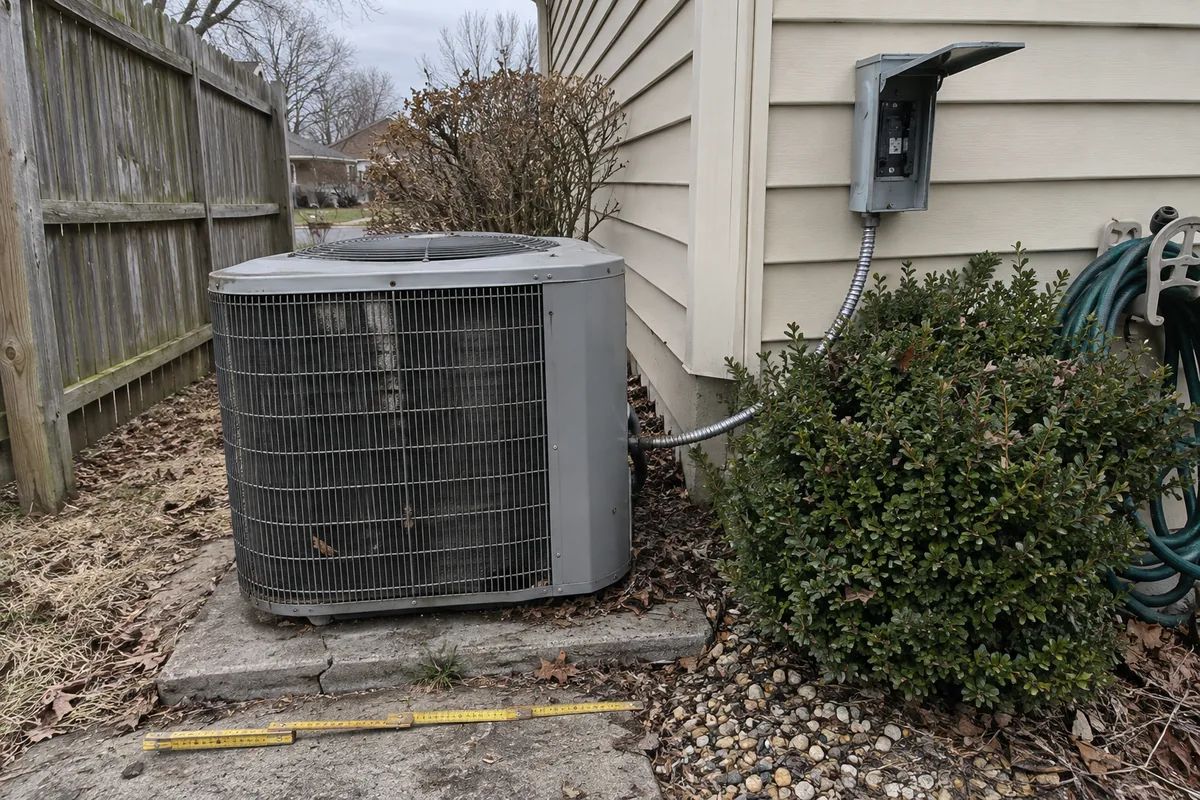
A condenser changeout can pass every check you can see and still fail on the space in front of the disconnect. The cabinet is new, the whip is new, the pad is level, and then somebody measures the three feet nobody measured.
Measure it before the quote goes out, not when the inspector is standing in the side yard.
What 440.14 has always required
NEC 440.14 requires the disconnecting means to be located within sight from, and readily accessible from, the air conditioning or refrigerating equipment.
“Within sight” has two halves and you need both: visible from the equipment, and no more than 50 feet away. A box 40 feet off around the corner of the house fails on visibility even though the distance is fine. Through the 2020 NEC that sat in an Article 100 definition, and the 2023 NEC moved it to a new Section 110.29. Same substance, new citation.
“Readily accessible” is still an Article 100 definition. It means reachable quickly for operation, renewal, or inspections without using tools other than keys, climbing over or under something, removing obstacles, or resorting to portable ladders.
Two more limits sit in the same section. The disconnect cannot be located on a panel designed to allow access to the equipment, and it cannot obscure the nameplate. Mounting it on or within the equipment is permitted if it clears everything else.
One exception is worth knowing: where an attachment plug and receptacle serve as the disconnecting means under 440.13, that location has to be accessible but not readily accessible. The other covers supervised industrial installations and does not reach residential work. The reason any of it matters is the tech at the unit who needs power off before opening it, the same territory as OSHA’s rules on energized electrical work.
The sentence the 2023 edition added
The 2023 NEC added one sentence to 440.14:
Disconnecting means shall meet the working space requirements of 110.26(A).
That sentence is the whole story. Editions before 2023 required within sight and readily accessible, and imposed no specific clearance around the box. Now three dimensions come with it.
Depth. Table 110.26(A)(1) sets it. Residential 240 volt single phase equipment sits in the 0 to 150 volts nominal to ground row, where Condition 1 is 3 feet. Condition 1 means exposed live parts on one side with nothing live or grounded on the other, which is what an exterior wall disconnect normally is. Condition 2 is 3 feet 6 inches and Condition 3 is 4 feet, so 3 feet is the floor, not every answer.
Width. 30 inches, or the width of the equipment if that is greater, and enough room for doors or hinged panels to swing 90 degrees.
Height. 6 feet 6 inches, measured from the grade, floor, or platform, or the height of the equipment, whichever is greater.
Changeouts are where this bites
On new construction the electrician sets the disconnect looking at an empty pad, so the clearance is obvious. On a changeout it was mounted to suit a unit that is not there anymore. The replacement cabinet is usually physically larger, so the new equipment takes a bite out of the 3 feet, and a condensate line, a gate that swings the wrong way, or shrubs the homeowner planted six summers ago take the rest. The install was fine the whole time. The replacement is what pulls it into current code, the same logic behind efficiency compliance turning on the day you install the equipment rather than the day it was built.
The attic version is the portable ladder. An air handler disconnect you can only reach off a stepladder runs straight into the words “resort to portable ladders” in the readily accessible definition. Treat it as one question with the attic and crawlspace access dimensions you are already measuring, not two.
The service receptacle nobody prices
NEC 210.63(A) requires a 125 volt, single phase, 15 or 20 ampere rated receptacle outlet at an accessible location for servicing heating, air conditioning, and refrigeration equipment.
It has to be on the same level as the equipment and within 25 feet of it, and it cannot be fed from the load side of the equipment’s branch circuit disconnecting means, for the obvious reason that the tech opens that disconnect first and still needs the receptacle to work. This one reaches one and two family dwellings, and the only carve out is for evaporative coolers.
NEC 210.8(E), new in the 2020 edition, then requires GFCI protection on those receptacles wherever they sit, including an attic. That is a separate rule from the outdoor outlet requirement in NEC 210.8(F) and the exception that just expired, and the two get confused constantly.
Check the edition before you rewrite the proposal
The NEC is a model code, not federal law. It binds you in the edition your jurisdiction adopted, with whatever amendments came with it. Under a pre-2023 edition, 440.14 does not carry the 110.26(A) sentence yet and you still owe within sight and readily accessible. It arrives on the next adoption cycle either way.
Four things worth doing this week:
- Call the electrical inspector and confirm the adopted edition and local amendments. It is the only call that settles this.
- Add disconnect clearance to the changeout survey. Depth, width, the 90 degree swing and the height, measured against the equipment you are actually proposing.
- Photograph the obstruction. Shrubs, gates and condensate lines are cheaper to argue about before the proposal than after.
- Confirm the 210.63 receptacle: same level, inside 25 feet, off the load side, GFCI protected.
The version that reaches your phone
None of this arrives as a code question. It arrives as a Thursday where an inspection sent the crew back to yesterday’s house to move a disconnect, the afternoon install is sliding, and the office phone is ringing with somebody whose AC quit.
That caller does not leave a voicemail. They call the next shop, and the job never shows up in your numbers because it never showed up at all. Dial 72 answers 24/7, sorts an emergency from a quote request on the first ring, books the routine ones into your calendar, and texts you the summary so nothing is lost while the crew is tied up. See how it works, or pricing if that Thursday currently goes to voicemail.
