
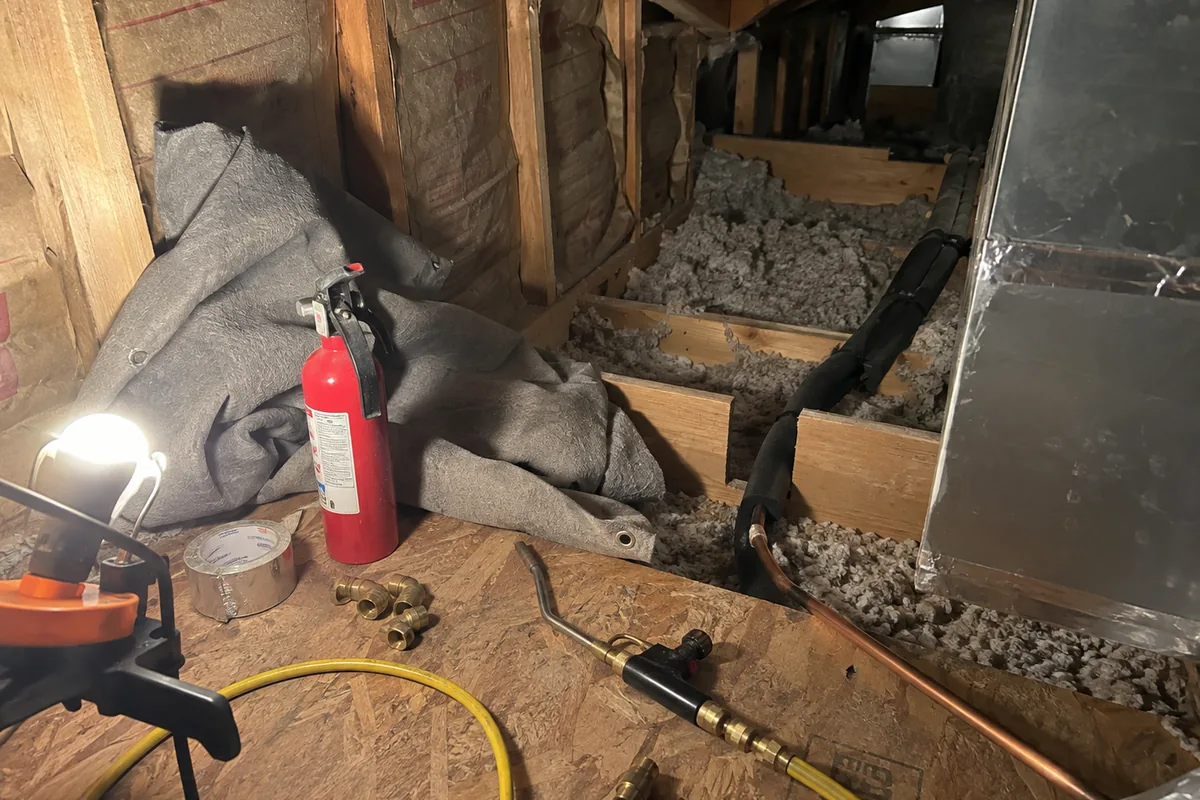
A tech brazes a line set connection in a knee wall attic during a changeout. Kraft faced batt insulation sits beside dry framing. Blown cellulose fills the joist bays. The joint is sound, the equipment runs, and the truck leaves. Nobody stays behind to find out whether heat or a spark started something smoldering out of sight.
A brazed refrigerant joint is hot work
NFPA 51B defines hot work to include welding, cutting, brazing, grinding, soldering, torch applied roofing, and any operation that produces an open flame, sparks, or enough heat to ignite combustibles. Torch brazing a refrigerant joint falls squarely inside that definition, including the joints you make when reusing a line set on a changeout.
The full title is Standard for Fire Prevention During Welding, Cutting, and Other Hot Work. The current edition is 2024, approved as an American National Standard on May 13, 2023.
Calling brazing hot work is the easy part. The harder question is which rule applies to the job.
Most residential changeouts fall on OSHA’s construction side
OSHA defines construction work as “work for construction, alteration, and/or repair, including painting and decorating.” Routine, scheduled maintenance such as filter changes, inspections and lubrication falls under general industry, 29 CFR 1910. Replacement and alteration work generally falls under construction, 29 CFR 1926.
There is no perfect dividing line. OSHA’s own interpretation letters acknowledge the gray area and say the answer turns on the scope of the work. Most changeouts, where equipment is replaced and refrigerant piping is brazed, land on the construction side.
That distinction matters. As with energized electrical work under OSHA, the rule you remember from the field may not be the rule governing the work in front of you. Other OSHA requirements keep applying at the same time, including the ones that follow you into attic work conditions.
The construction rule requires a watch but gives no time
The construction hot work rule is 29 CFR 1926.352, “Fire prevention,” in Subpart J, Welding and Cutting. It covers objects that are “welded, cut, or heated.”
When practical, the object must be moved to a designated safe location, and movable fire hazards must be relocated or protected. If the object cannot be moved and the hazards cannot be removed, you must use positive means to confine the heat, sparks and slag.
The rule prohibits welding, cutting or heating where flammable paints, other flammable compounds, or heavy dust concentrations create a hazard. Suitable fire extinguishing equipment must be immediately available in the work area and maintained in readiness for instant use. That means in the attic, crawlspace or utility room with the torch, not back in the truck.
When ordinary fire prevention precautions are not sufficient, additional personnel must guard against fire during and after the operation. For work on walls, floors and ceilings, the same precautions apply on the opposite side, because sparks and heat travel through.
In an enclosed space, the gas supply must be shut off outside the space when torches are unattended, and the torch and hose removed overnight or at shift change.
What 1926.352 does not give you is a distance or a duration. It says additional personnel, and it says after, and it stops there. Your shop has to supply the number.
The familiar 35 feet and half hour come from a different standard
The numbers most techs quote sit in the general industry standard, 29 CFR 1910.252. Where practicable, all combustibles must be relocated at least 35 feet, or 10.7 meters, from the work site.
That standard also addresses sparks dropping through floor openings onto readily combustible materials below, and sparks passing through cracks or holes in walls, open doorways, and open or broken windows. A fire watch must be maintained for at least a half hour after welding or cutting operations are complete, to detect and extinguish possible smoldering fires.
Fire watchers need extinguishing equipment available and must know the alarm procedure. They watch for fires in all exposed areas. They try to extinguish a fire only when it is obviously within the capacity of the equipment available, and otherwise they sound the alarm.
The general industry rule also calls for the area to be inspected by the individual responsible for authorizing the work. That person designates the precautions to be followed, preferably in the form of a written permit.
Those are specific instructions. They are also instructions from 1910.252, and the construction rule that likely covers your changeout does not repeat them.
NFPA 51B moved its number to an hour
NFPA 51B works from a 35 foot hot work area measured in every direction, not only across the floor. Combustibles inside that area have to be moved, and fixed items such as studs and structural framing have to be protected with fire resistant blankets or other approved barriers.
The 2014 edition required a fire watch during hot work plus an additional half hour. The 2019 edition raised the post work minimum to 1 hour, irrespective of the hot work operation, location, occupancy or construction type, and that hour carries into the current 2024 edition. The 2019 edition also added fire monitoring within the hot work area for up to 3 additional hours after the fire watch ends, as determined by the Permit Authorizing Individual.
So there are three different instructions in play. OSHA general industry says half an hour. NFPA 51B says an hour, plus up to three more hours of monitoring. The OSHA construction rule that most likely covers the job says neither.
In a house, 35 feet reaches through the assembly
Thirty five feet measured in all directions is not a bubble on the floor. In a typical house it takes in the room, the joist bay above or below it, and whatever sits past a wall or floor opening. That matters most in the places where attic and crawlspace access already limits what the tech can see and reach in the first place.
Section 1926.352 asks for precautions on the opposite side of walls, floors and ceilings. In practice that means checking the far side of the wall, checking below the floor penetration, and looking into the joist bay you just heated. Put the extinguisher in the work area. Have somebody stay after the flame goes out.
The question gets sharper on an A2L system, where the refrigerant is mildly flammable and an open flame is already something the shop is managing around.
A flame free joint takes the watch off that joint
Nobody is going to park a tech in a crawlspace for an hour after every connection. That does not turn a half remembered 30 minute rule into a shop policy.
Refrigerant press connect fittings are the option where a fire watch in that specific space is not practical. Manufacturers list them to UL 207, Refrigerant-Containing Components and Accessories, Nonelectrical, with a maximum rated pressure of 700 psi and a minimum burst pressure of 2,100 psi. The press tool makes the joint without a torch, so there is no flame, no hot work and no fire watch for that connection.
Write the rule down before the next changeout. Name who authorizes hot work. State what gets moved or covered, who stays and for how long, where the extinguisher goes, and who checks the opposite side of the wall, floor or ceiling. Then hold the crew to the written rule instead of to whichever number somebody remembers.
