TL;DR: For permits submitted on or after January 1, 2026, replacing a heat pump in an existing California single-family home requires refrigerant charge verification in all 16 climate zones. A straight air conditioner replacement in Climate Zone 7 still does not require that charge test.
Heat pump replacements now require charge verification in every California climate zone
The 2025 California Energy Code changed the answer for heat pump change-outs. Under Title 24, Part 6, Section 150.2(b)1F, a heat pump replacement now requires refrigerant charge verification in every California climate zone.
That includes coastal Climate Zone 7. A shop working from San Diego through Carlsbad now has to include the HERS process when the replacement equipment is a heat pump.
The rule applies to building permit applications submitted on or after January 1, 2026. A permit applied for in December 2025 remains under the 2022 Energy Code. The permit application date controls. The install date does not. The date the old equipment failed does not.
Section 150.2(b)1F covers more than a complete system replacement
The trigger is an alteration to an existing air conditioner or heat pump through installation or replacement of a refrigerant-containing system component. That includes the compressor, condensing coil, evaporator coil, refrigerant metering device, or refrigerant piping.
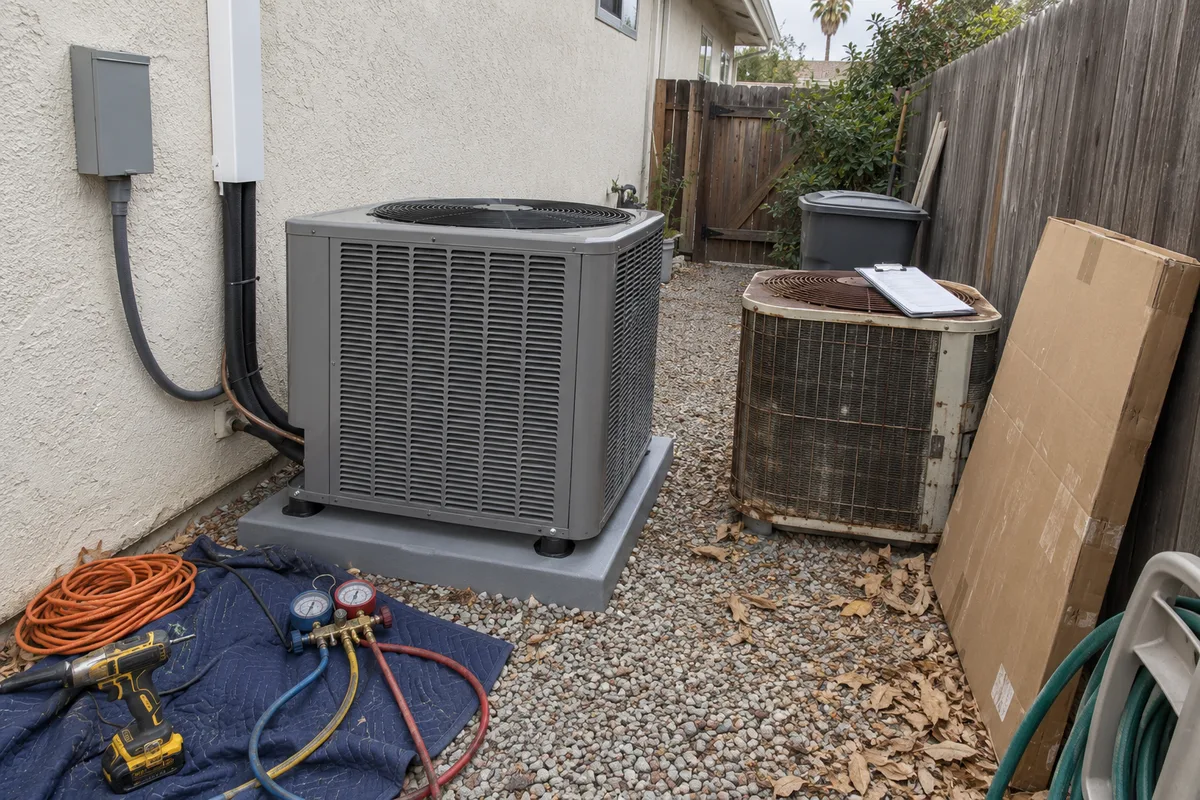
A condenser swap triggers it. A coil swap triggers it. A full split system change-out triggers it.
Once the section applies, the altered system must meet three requirements:
- Thermostats serving the system must be replaced with setback thermostats that meet Section 110.2(c).
- System airflow must be at least 300 cfm per ton of nominal cooling capacity, or 250 cfm per ton for a small duct high velocity system. Airflow must be field verified.
- Refrigerant charge must be verified for air-cooled air conditioners in Climate Zones 2 and 8 through 15, and for air-source heat pumps in every climate zone.
A factory pre-charged packaged system is the exception to the charge verification requirement. The manufacturer must have verified the charge before shipment, and the installer must certify on the Certificate of Installation that the system was factory pre-charged and not altered.
The 2025 code does not force a heat pump when a failed air conditioner is replaced in an existing home. A like equipment replacement follows the alteration rules in Section 150.2(b). It does not follow the new construction prescriptive heat pump baseline.
Climate Zone 7 is new territory for heat pump charge tests
Temecula, Hemet, and Escondido are in Climate Zone 10. Those shops have already needed charge verification on air conditioner change-outs because Climate Zone 10 is on the air conditioner list.
Carlsbad is in Climate Zone 7. San Diego is the representative city for Climate Zone 7. Before the 2025 edition, heat pumps shared the air conditioner list, so Climate Zone 7 coastal shops did not book a HERS rater for charge verification on a change-out.
That changes only when the equipment is a heat pump. A straight air conditioner replacement in Climate Zone 7 still does not trigger charge verification.
One company can serve both zones inside San Diego County. Check the address for every job. The CEC offers a climate zone lookup by address or ZIP. Do not treat the shop’s service area as the climate zone. This is one county, two climates on one phone line, and the zone is a per-job fact.

The HERS rater completes the charge verification record
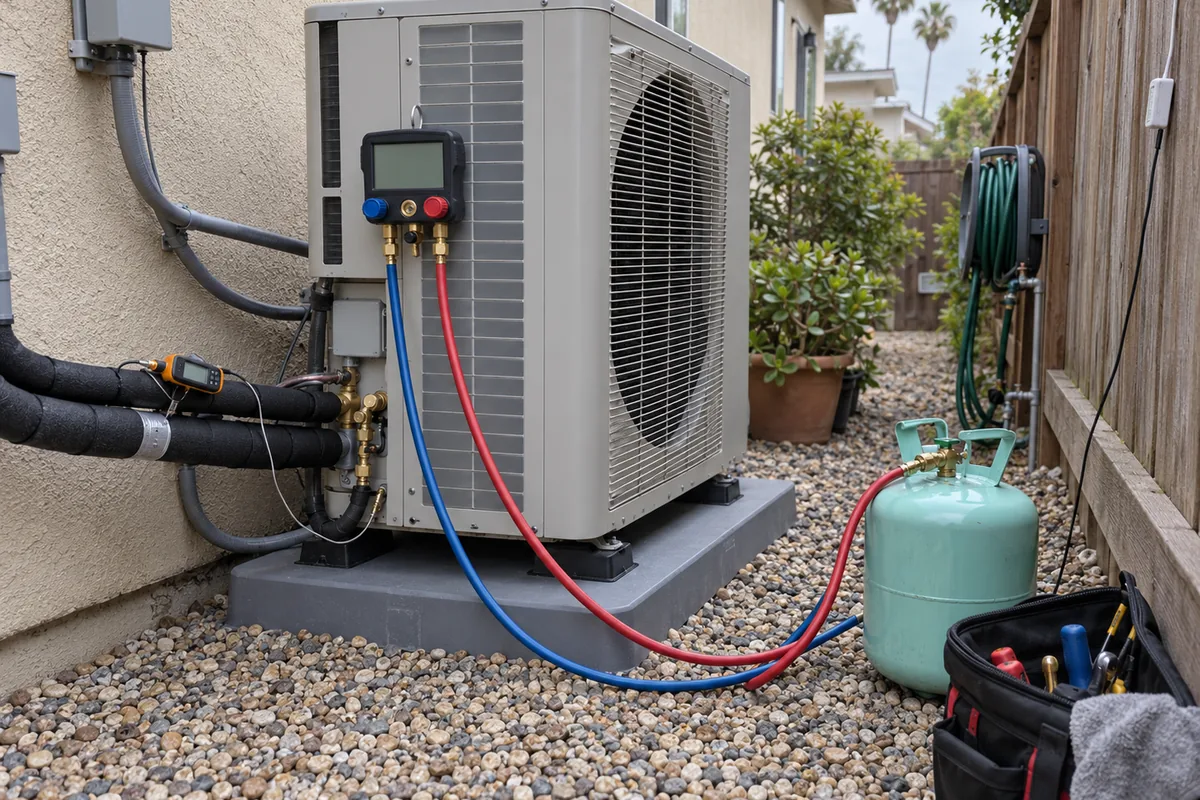
Refrigerant charge verification is a field-verified measure. The installing contractor completes the Certificate of Installation, called the CF2R. A third-party certified Home Energy Rating System rater performs the verification and completes the Certificate of Verification, called the CF3R.
The Certificate of Compliance, or CF1R, goes in with the permit.
The code allows the charge to be verified through the standard charge verification procedure or through a weigh-in charging procedure with its own documentation requirements. It also provides alternatives for cold outdoor conditions when the standard test cannot be run.
Duct sealing is a separate requirement under Section 150.2(b)1E. When equipment is installed or replaced, the connected duct system must be sealed and tested in every climate zone unless an exception applies. The rater usually handles that measure on the same visit. The test can use total leakage at or below 10 percent of system air handler airflow, leakage to outside at or below 7 percent, or accessible leak sealing followed by visual inspection and a smoke test when neither measured option is possible. The duct leakage test and its numbers should be part of the same scheduling conversation.
A fault indicator display no longer satisfies the 2025 rule
The CEC’s 2025 compliance manual says refrigerant charge verification is required for heat pumps in all climate zones and for air conditioners in Climate Zones 2 and 8 through 15 under Section 150.2(b)1F.
It also says fault indicator displays have been removed as an available method for refrigerant charge verification. A fault indicator display is the factory-installed charge diagnostic that some systems used to satisfy the measure in earlier code cycles. Under the 2025 code, it no longer counts.
Do not quote a fault indicator display as a reason the system can verify itself. The charge verification still needs the approved procedure, the contractor documentation, and the HERS verification unless the factory pre-charged packaged system exception applies. That also makes the line set you reused is a design decision question part of the equipment discussion when refrigerant piping is altered.
The same heat pump change-out carries other CF2R items
The installer must certify other mandatory heat pump items on the CF2R. If the heat pump has an installer-adjustable defrost delay timer, it must be set to 90 minutes or more, subject to the listed exceptions for Climate Zones 6 and 7 and certain small homes.
Supplementary electric resistance or gas heat may operate only below 35 degrees F, except during defrost or when the user selects emergency heat. The code lists exceptions for Climate Zones 7 and 15, room air conditioner heat pumps, and homes under 500 square feet.
A thermostat controlling supplementary heat must receive outdoor temperature from a sensor or internet weather service, display that temperature, show when supplementary or emergency heat is running, and lock out supplementary heat above 35 degrees F. These are installer-certified items. The HERS rater does not test them.
Book the rater before the crew closes the job
Dispatchers at shops serving both the coast and inland valleys describe the same failure pattern. The install crew closes its part of the job. The homeowner thinks the project is finished. The permit stays open for weeks because nobody booked the rater. The office hears about it only after final inspection fails or the homeowner calls because the permit never closed.
Dial 72 is an AI receptionist for HVAC shops. It answers 24/7, confirms the caller’s address on every call, texts a call summary to the office after each call, books jobs into the shop’s calendar, and flags replacement and install inquiries as high-value leads for the owner. Because the address is captured on the first call, the office knows whether the inquiry is in Climate Zone 7 or Climate Zone 10 before anyone quotes it. The rater and charge test can be priced into the job from the start instead of discovered at final inspection. See how it works and pricing.
For every new replacement inquiry, check the permit application date. Look up the climate zone for that address. Identify whether the equipment is a heat pump or an air conditioner. Book the HERS rater with the job when Section 150.2(b)1F applies. Stop treating a fault indicator display as self verification, and put the charge test in the change-out scope before the installer arrives.