
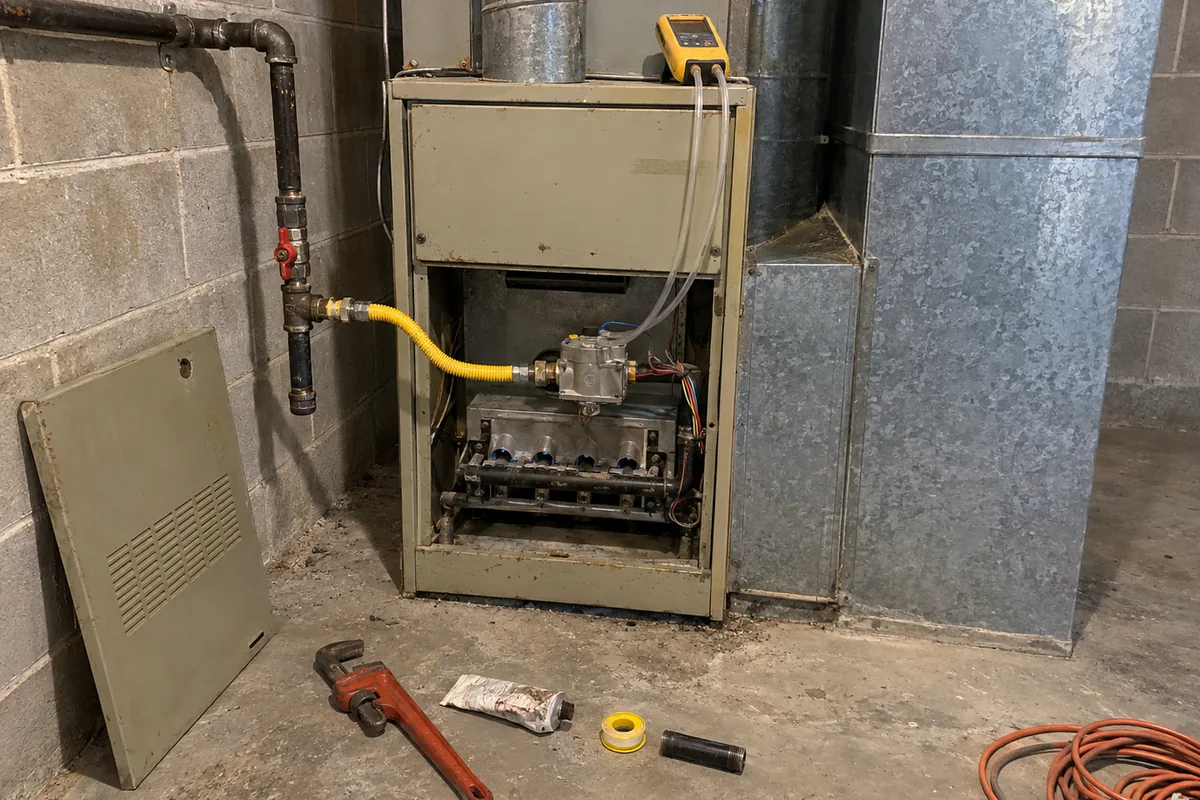
Gas piping is sized on the longest run in the system, not the run to the furnace. It is also sized on the total connected load of every gas appliance in the house, not only the appliance being replaced.
That is why a changeout can land on an undersized gas line even when the furnace input never changed. The house gained a tankless water heater, a range, or a dryer since the piping went in. The International Fuel Gas Code already tells you to check.
The line has to carry every appliance it serves
IFGC Section 401.3 says sizing has to be maintained when you modify or add to an existing piping system. Section 401.4 is more direct: where an additional appliance is to be served, the existing piping has to be checked for adequate capacity for all appliances served, and enlarged or supplemented if it is not. That is a required check, not a diagnostic step after the furnace is in.
Section 402.2 defines the load. It is the sum of the maximum input of the appliances served, and the total connected hourly load is the sizing basis, assuming all of them could run at full capacity at once. You may size on a diversity of load only where that diversity can be established. Assuming the furnace and the water heater never fire together does not establish it. Above 2,000 feet in elevation, the flow rate gets adjusted for altitude as well. Start from the input on the unit you picked, since equipment selection sets the input rate.
One pattern is worth naming. On a fresh install, second visit calls that sound like an equipment complaint deserve a gas supply check before anyone blames the unit. “The new furnace is not right” and “it locks out at night” describe a symptom, not a cause.
The longest run controls every section
Section 402.4.1 is the counterintuitive part. Under the longest length method, each section is sized using the longest length of piping from the point of delivery to the most remote outlet, plus the load on that section. A furnace 25 feet from the meter does not get sized off the 25 foot row. If a grill line or a dryer sits at the far end of the house, the furnace section gets sized on that longer row. Section 402.4.2 offers the branch length method instead: size the longest run first, then size each remaining branch off the length to the most remote outlet in that branch.
Section 402.3 allows three routes, and the second matters more than it looks: the code tables and equations, the tables in a listed piping system manufacturer’s instructions, or another approved engineering method. Section 402.4 states that the code’s tables apply to piping materials other than noncorrugated stainless steel tubing. CSST is sized from its own listed manufacturer tables, not off the steel pipe tables.
The pressure that counts is at the appliance inlet
Section 402.1 requires the piping to meet maximum demand and deliver gas to each appliance inlet at not less than the minimum pressure that appliance requires. The test point is the inlet, not the meter.
The failure does not look like a dead furnace. The appliance runs fine by itself and misbehaves when something else fires: low manifold pressure, poor flame, lockouts that will not reproduce on a warm afternoon when nothing else in the house is running. So measure. Read inlet pressure with the other gas appliances firing and compare it to the data plate minimum. That is a different question from the one a combustion analysis on a gas furnace answers. One tells you what the burner is doing, the other tells you whether the pipe can feed it.
Converting the nameplate into table units
The tables report cubic feet per hour and nameplates report Btu per hour, so divide the input by the heating value of the gas supplied. Natural gas is commonly figured at about 1,000 Btu per cubic foot, which makes a 100,000 Btu/h furnace roughly 100 CFH. The real heating value comes from the serving utility and can differ.
The table conditions matter as much as the pipe size. IFGC Table 402.4(2) covers Schedule 40 metallic pipe, natural gas, inlet pressure below 2 psi, a 0.5 inch water column pressure drop, and a specific gravity of 0.60. There, 3/4 inch pipe carries 104 CFH at 100 feet and 92 CFH at 125 feet. So that furnace fits at 100 feet with 4 CFH to spare and does not fit at 125. A 1/2 inch line falls from 118 CFH at 20 feet to 95 CFH at 30 feet, dropping under the same load somewhere in between.
The allowable pressure drop is an input you choose, not a property of the pipe. Same 3/4 inch pipe, same 100 feet: the 0.5 inch water column table lists 104 CFH, the 0.3 inch water column table lists 78. Two different answers.
The furnace stayed the same, the house did not
Take a typical appliance list, illustrative rather than measured: a 100,000 Btu/h furnace at about 100 CFH, a 199,000 Btu/h tankless at about 199, a 40,000 Btu/h range at 40, and a 30,000 Btu/h dryer at 30. Total connected load, 369 CFH. At 100 feet and a 0.5 inch water column drop, 1 inch pipe carries 195 CFH, which is short. At the same conditions 1-1/4 inch carries 400, which covers it.
The tankless is the usual source of that load creep, because its input often exceeds the furnace it now shares a line with and it went in years after the pipe was sized. A water heater change moves the venting picture too. The orphaned water heater is a separate problem, but it belongs on the same survey whenever the gas load changes.
Put the gas survey in front of the estimate
Record the longest run, the pipe material and size, and every gas appliance in the house before the estimate goes out. A reused line is not automatically adequate. The line set you reused is a design decision, and existing gas piping deserves the same review. The adopted code edition sets the section numbers and table set your inspector actually enforces, so confirm which code edition your jurisdiction enforces rather than assuming the newest one applies.
The detail that makes the survey cheap usually arrives on the phone. When a homeowner mentions the trouble started after a new water heater went in, that belongs with the technician before the truck rolls. Dial 72 triages the call and sends the shop a call summary by text, so a note like that reaches the tech in time for a manometer to be on board.
