
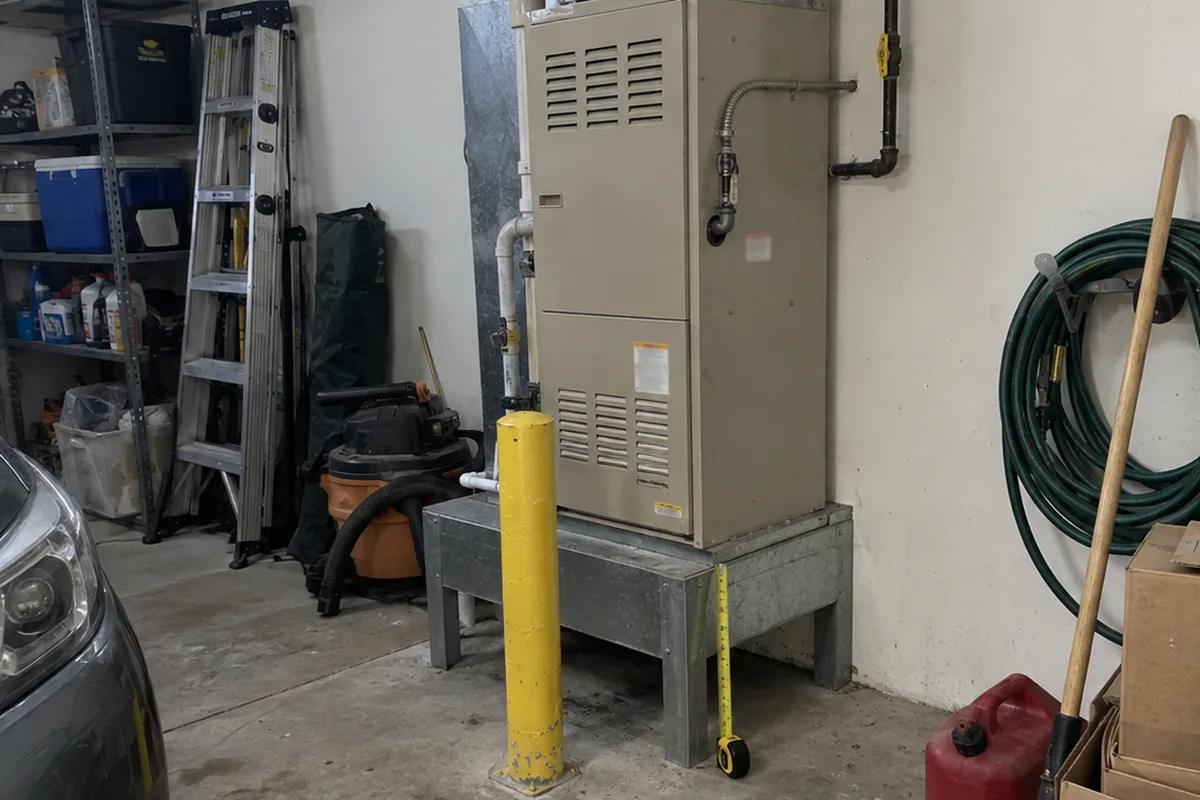
TL;DR: The 18 inch garage rule is measured from the floor to the furnace’s burners and ignition source, not to the bottom of the cabinet. A replacement also needs either 6 feet of height or approved vehicle-impact protection, so measure and price the stand and barrier before quoting.
Measure to the burners, not the furnace cabinet
A furnace that has sat in a garage for 25 years tells you nothing about whether the replacement can go back at the same height.
Section M1307.3 of the 2021 IRC requires an appliance with an ignition source to be installed so that the source is at least 18 inches, or 457 mm, above the garage floor. The rule is about the ignition source. It is not a rule that the bottom of the furnace cabinet must be 18 inches above the slab.
That distinction changes the quote. The burners and igniter may sit several inches above the bottom of the new furnace. The stand only needs to raise those components to the required height. Washington’s State Building Code Council interpretation 20-Mar01, addressing 2015 IRC M1307.3, reached that reading. It is a Washington interpretation, not a national ruling.
The practical measurement is from the slab to the location of the new model’s burners and igniter. Get that location from the installation manual before you select the stand.
The reason for the rule is simple. Gasoline, solvents, and other flammable vapors are heavier than air. They collect near the garage floor. The code keeps ignition sources above that layer.
The old furnace footprint does not answer the vehicle-impact question
The pattern on garage change-outs is familiar. The old furnace sits on a low platform or directly on the slab. The crew sets the new furnace in the same footprint because the plenum and gas line already line up. Nobody measures to the burners.
The inspector does at final. The stand, plenum and duct transition, gas drop, and possibly a bollard or other approved barrier become a second trip. None of it was in the price.
IRC Section M1307.3.1 says an appliance cannot be installed where it is subject to vehicle damage unless it is protected by approved barriers. The furnace can clear the 18 inch ignition-source rule and still fail the impact rule.
The 2021 IFGC adds a separate height rule in Section 305.5. Appliances in private garages must be installed with a minimum clearance of 6 feet, or 1829 mm, above the floor. That requirement does not apply when the appliance is protected from motor vehicle impact and installed under the 18 inch rule in Section 305.3.
For a floor-standing furnace, the field decision is usually clear: place it 6 feet above the floor, or provide approved vehicle protection and meet the 18 inch ignition-source elevation. A low stand by itself does not solve the vehicle problem.
An adjoining furnace room can still count as the garage
IFGC Section 305.3 applies the 18 inch rule to equipment and appliances with an ignition source in private garages and other listed hazardous locations. It also treats a room or space that is not part of the dwelling’s living space as part of the private garage when it communicates directly with that garage through openings.
That means a furnace room or storage room off the garage is not automatically outside the rule. If it has an opening into the garage, treat the location as garage for this purpose.
If the furnace is in an enclosed room, combustion air is a separate question. Use the requirements covered in this combustion air article. Other gas checks still belong on the change-out, including the items discussed in this CSST bonding article.
FVIR status must come from the appliance listing
The 18 inch elevation exception applies only to appliances listed as flammable vapor ignition resistant, or FVIR. Do not assume that a furnace qualifies. Check the specific appliance listing and installation instructions.
Lennox installation instructions for the ML180UHVK gas furnace, document 508547-01 dated 12/2025, list garages as an allowed location. The instructions require the burners and ignition source to be at least 18 inches above the floor in a residential garage. They also require the furnace to be located or protected against physical damage from vehicles.
IRC Section M1307.1 requires installation according to the listing and the manufacturer’s instructions. Where that code is adopted, the manual’s garage requirements are part of the installation requirements.
Garage ducts cannot open into the garage
IRC R302.5.2, using the 2015 IRC text confirmed in ICC interpretation RE 03-16, requires ducts in the garage and ducts penetrating the walls or ceilings separating the dwelling from the garage to be minimum No. 26 gage, or 0.48 mm, sheet steel or another approved material. The ducts must have no openings into the garage.
That means no supply register or return grille opening into the garage from a system serving the house. Flex duct through the garage separation is also a problem unless the jurisdiction approves it.
Return air from the garage is a separate prohibition under IRC M1602.2 for a system serving the house. That point is covered in our furnace closet return air article.
The section text cited here comes from the 2021 IRC and 2021 IFGC, with R302.5.2 from the 2015 IRC. Your enforceable requirement is the edition and amendments adopted by the jurisdiction. Check that before putting a section number in the proposal. This article explains why the adopted edition controls.
Put the garage questions in the first service call
Dial 72’s AI receptionist answers 24/7, triages calls by the shop’s rules, and texts the shop a summary after every call. You can tell it to ask where the furnace is located and flag replacement leads. A no-heat call about an old furnace in the garage can arrive as a text that says “garage” and is flagged as a likely replacement. The tech knows to bring a tape measure, the new model’s manual, and a plan for a stand. See how it works.
On the survey, measure from the slab to the burners and igniter of the new model according to its manual. Confirm 18 inches minimum unless that specific appliance is FVIR-listed. Decide whether the furnace will be 6 feet above the floor or protected from vehicle impact by an approved barrier. Check whether a room off the garage has an opening into it. Inspect garage ducts for No. 26 gage steel or approved material with no openings into the garage. Confirm there is no garage return for the house system.
Then put the stand and any barrier in the proposal before the replacement is sold.
