
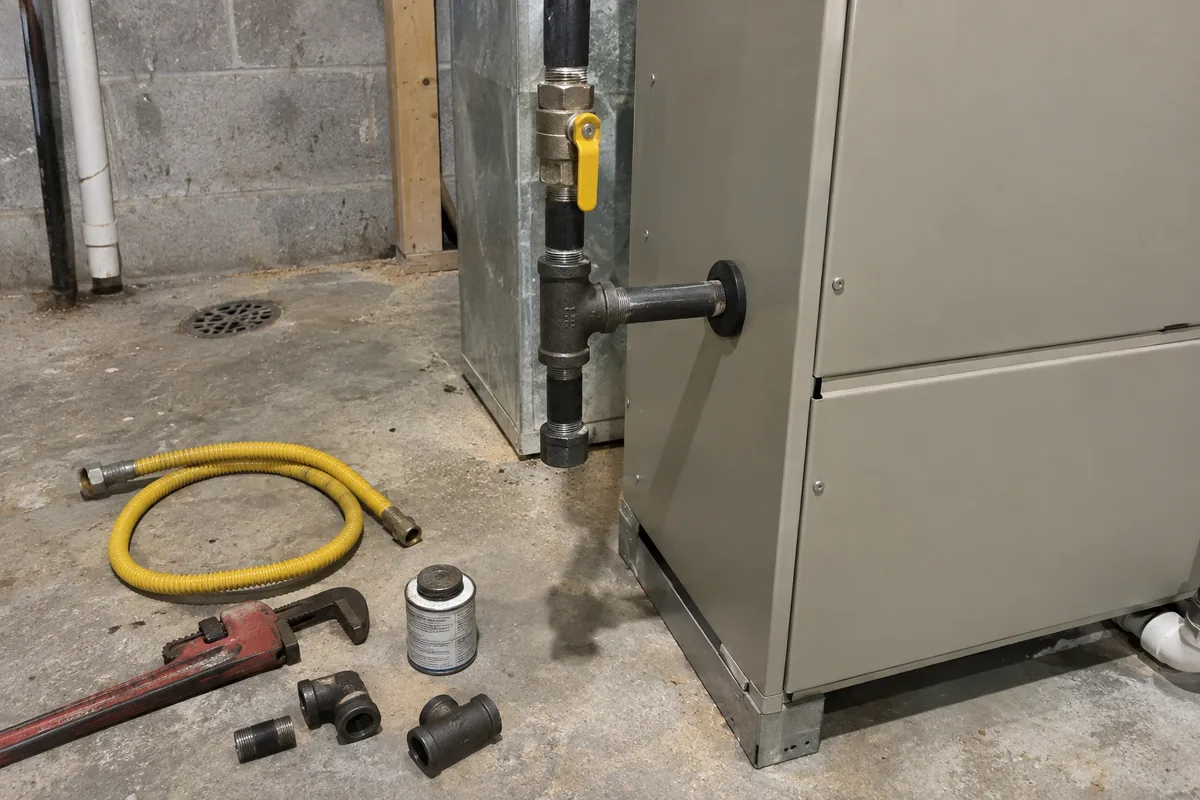
A furnace change-out has three short gas code sections an inspector can check at final: the sediment trap, the appliance shutoff valve, and the appliance connector.
In the International Fuel Gas Code, those sections are IFGC 408.4, 409.5.1, and 411.1.3. The International Residential Code repeats the same text in Chapter 24 under G2419.4, G2420.5, and G2422.1.2.
Section numbers and exact wording vary by edition and state amendment. The adopted edition in your jurisdiction is the one the inspector enforces. The adopted code edition guide covers that check.
The problem is not usually the new furnace. A new furnace often gets connected to the old gas connection as found. The old connection may never have been right in the first place.
The sediment trap must point straight down
IFGC 408.4 requires a sediment trap when one is not built into the appliance. It goes downstream of the appliance shutoff valve and as close to the appliance inlet as practical.
The standard arrangement is a tee with a capped nipple installed vertically in the bottommost opening. The nipple can be any length.
The capped nipple has to point straight down from the bottom of the tee. A tee with the cap installed on the side outlet does not match the code figure.
The requirement does not apply to illuminating appliances, ranges, clothes dryers, decorative vented appliances for vented fireplaces, gas fireplaces, or outdoor grills. Furnaces, boilers, and water heaters are not on that exempt list.
The shutoff valve belongs in the same room
IFGC 409.5.1 requires each appliance to have a shutoff valve in the same room as the appliance and within 6 feet of it. The valve has to be accessible.
It also has to be upstream of the union, connector, or disconnect device it serves. Reading from the supply toward the appliance, the order is shutoff valve, sediment trap, then appliance inlet.
A valve hidden behind the furnace or placed too far away is not fixed by installing a new furnace in front of it. If the existing valve does not meet the location and access rules, put the correction in the scope.
A furnace connector cannot be treated like spare flex
IFGC 411.1.3 requires appliance fuel connectors to be installed according to the connector manufacturer’s instructions.
The overall connector length cannot be more than 6 feet. The connector must have enough capacity for the total demand of the connected appliance. A shutoff valve at least the nominal size of the connector must be installed ahead of it.
The connector cannot be concealed within or extended through walls, floors, partitions, ceilings, or appliance housings. Rigid steel pipe connectors may extend through openings in appliance housings. Semirigid tubing and listed connectors may also pass through an appliance housing, cabinet, or casing opening when protected against damage.
That means a flex connector through the furnace cabinet is not automatically a violation. It is not automatically acceptable either. The question is whether it is protected at the opening. An unprotected flex connector rubbing against a sharp sheet metal knockout edge is exactly the condition this rule addresses.
The old connection often becomes your inspection problem
On change-out walk-throughs, shops describe the same pattern again and again. The old furnace is fed by a yellow flex connector run straight through a side knockout in the cabinet. The edge is bare metal. There is no grommet. There is either no sediment trap or a tee with the cap on the side outlet.
It passed for twenty years because nobody inspected it after the original installation. The new furnace’s final inspection is the first time anyone with authority looks at it. The tech who connected to it as found owns that condition now.
Gas pipe sizing is its own check on a replacement job. Use the gas pipe sizing guide as a separate scope item.
A furnace closet also requires combustion air arithmetic. That issue is covered in the combustion air guide.
Local checklists put these details on paper
The Village of Westmont, Illinois, HVAC Replacement Specifications, Requirements and Guidelines, revision 7/2024, requires the contractor and property owner to sign at permit. Its furnace section calls for the manufacturer’s installation instructions to be on site for the inspector. It also calls for a proper drip under Section 408.3 of the IFGC or a sediment trap under Section 408.4.
MyBuildingPermit.com, the eCityGov Alliance checklist for Washington State dated May 29, 2024, lists the same field checks. It calls for an accessible shutoff within 6 feet, in the same room, a connector not concealed within or passing through listed building components, a connector no longer than 6 feet and installed per the manufacturer’s instructions, and a connector sized for the appliance’s total demand.
The site walk is where this work gets priced
Dial 72’s AI receptionist flags replacement and install inquiries as high value leads for the owner. She asks when the owner can call back personally, such as when a homeowner with an older unit wants a quote on full replacement. She never quotes a price over the phone.
That is the right split for this work. A new shutoff, a correct sediment trap, and a connector that fits the rules cannot be priced over the phone. They have to be seen and priced during the site walk. The flagged lead is what gets the owner to that walk.
Add these three items to your change-out survey and estimate line items:
- A shutoff valve within 6 feet, in the same room, upstream of the connector.
- A sediment trap downstream of the valve, with the capped nipple vertical in the bottom of the tee.
- A connector no longer than 6 feet, sized for the furnace, and not run through the cabinet unless it is rigid steel or protected against damage.
Then photograph the finished connection for the job file. Replacement calls are worth winning on the quote, as covered in the replacement leads guide.
