
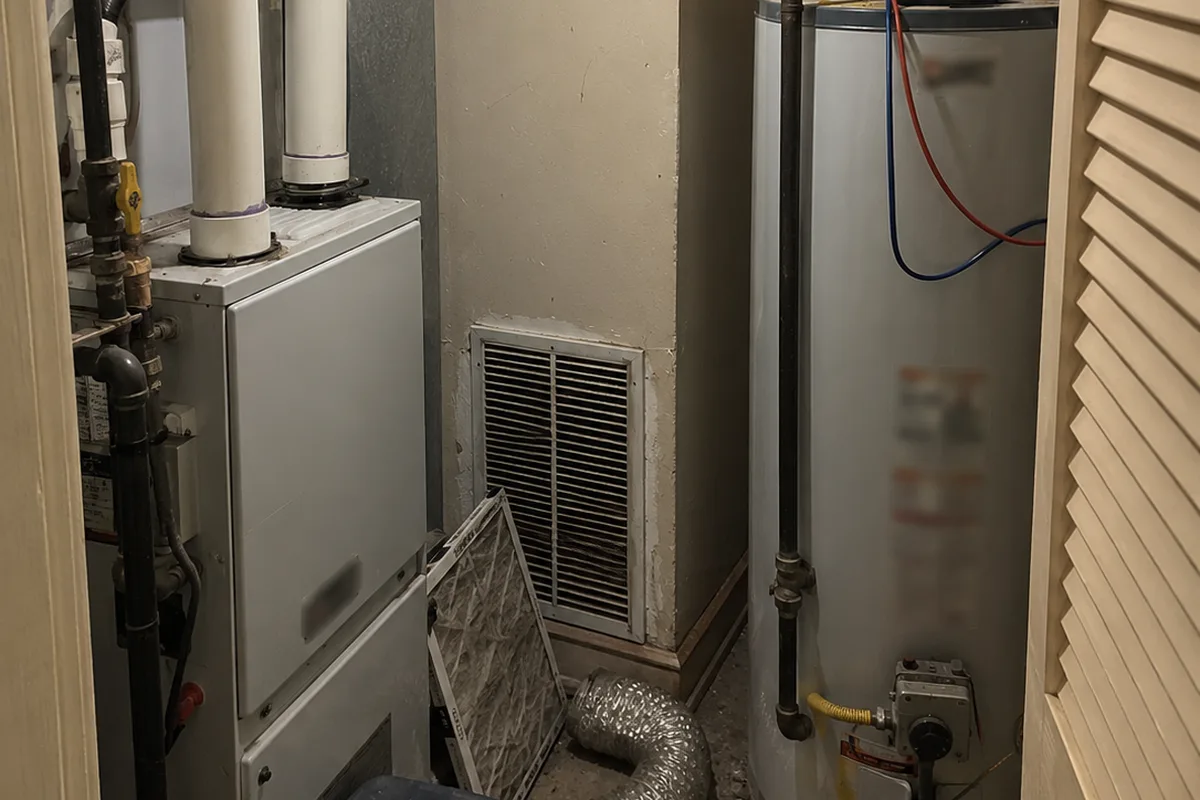
The return grille can make the new furnace change-out noncompliant
The 2024 International Residential Code section M1602.2 puts ten requirements on return air openings. The most consequential one for a furnace change-out is the rule for a mechanical room, boiler room, or furnace room with combustion appliances.
If return air is taken from one of those rooms, only sealed combustion appliances are permitted in that room. An atmospheric water heater with a draft hood sitting beside a furnace in a closet with a return grille is a code problem. Installing a new furnace does not fix it.
The return can depressurize the room and pull flue gas out of the water heater’s draft hood.
This is a common pattern on change-outs. A return grille was cut into the furnace closet wall or door because it was the shortest duct run when the house was built or when the last system was replaced. The grille sits a few feet from an atmospheric water heater. The new furnace is a sealed combustion 95 percent unit, so it is unaffected by that rule. The water heater beside it is the appliance the return can pull on.
The enforceable version is the code edition and amendments your jurisdiction actually adopted. Check that adopted code before quoting a section number to an inspector or homeowner.
The return location tells you which rule to check first
Look at the return grille before you quote the code or write the proposal. A furnace closet, hall closet, garage, kitchen, or crawl space connection each raises a different question under M1602.2.
A return opening cannot be less than 10 feet, measured in any direction, from an open combustion chamber or draft hood of another appliance in the same room or space. That distance applies even when the return is not in a furnace room. If a draft hood and return opening share a space, measure it.
Return air from a mechanical room, boiler room, or furnace room must serve only that room. It is allowed from that room without a dedicated supply duct, but the room’s combustion appliance rules still apply. Return air from other rooms cannot exceed the supply air delivered to those rooms.
A return taken from a closet has its own limit. It cannot exceed 30 cubic feet per minute and must serve only that closet. The closet door must be undercut at least 1.5 inches, or the closet must have a louvered door or transfer grille with at least 30 square inches of net free area.
The code also bars return air from a closet, toilet room, kitchen, garage, or unconditioned attic, with specific exceptions. A kitchen return is allowed when it serves only the kitchen and is at least 10 feet from the cooking appliances. A dedicated forced air system serving only a garage may take return air from the garage.
A system serving the house cannot use a garage return. A return connected straight from an unconditioned crawl space to the furnace return is also out. Transfer openings in the crawl space enclosure are not prohibited.
A furnace room door can show the pressure problem
When return air is taken from a mechanical room, boiler room, or furnace room, the pressure difference across that room’s door cannot exceed 0.01 inch water column, or 2.5 pascals. The code names the ways to address it: an undercut door, louvered door, transfer grille, or another means that meets the limit.
This is not a visual guess. Put a manometer across the closed door and take the reading.
If the room contains an atmospheric water heater, item 4 is the larger problem. The fixes are moving the return out of the room or changing the water heater to a sealed combustion unit.
Do not confuse this issue with combustion air sizing. The furnace closet combustion air arithmetic is a separate check. Do both when the equipment and return share a confined space.
The other return rules affect duct layout and equipment proposals
Return and transfer openings must be sized according to the equipment manufacturer’s installation instructions, ACCA Manual D, or the design of a registered design professional. The existing grille and duct are not automatically acceptable because they served the old furnace. Use the Manual D duct design reference when sizing is part of the change-out decision.
These rules can turn a simple reconnect into a return relocation. If the return is in a furnace room with a draft hood appliance, price the correction before the proposal goes out. If the return is tied directly to an unconditioned crawl space, show the required change in the scope. If the system serves the house and the return is in a garage, do not carry that arrangement forward.
A return problem can lead to a combustion complaint after the crew leaves. The combustion analysis guide covers measuring combustion rather than guessing. If the complaint includes a carbon monoxide alarm, the CO alarm rules belong in the service conversation too.
Bella can send a combustion complaint to the on-call tech
The call rarely says “return air.” It sounds like a CO alarm going off, a headache, or an exhaust smell near the furnace closet, often a few weeks after a change-out.
Dial 72’s AI receptionist, Bella, answers 24/7. She triages by the shop’s own rules and escalates emergencies to the on-call tech immediately. After every call, a summary is texted to the shop.
If your rules send CO alarm and exhaust smell calls to the on-call tech, Bella sends the call there. The texted summary tells the tech it is a combustion complaint at an address with recent work before anyone rolls.
See how Bella works.
Change the survey before you change the furnace
Do four things differently on every change-out:
- Photograph and note the return location during the survey.
- Check the furnace room for non sealed combustion appliances when the return is in that room.
- Carry a manometer and record the reading across the closed closet door.
- Price return relocation in the proposal instead of adding it after the inspection.
Also check the adopted code edition before citing M1602.2. The adopted code edition guide explains why the latest model code and the enforceable local code may not be the same.
