
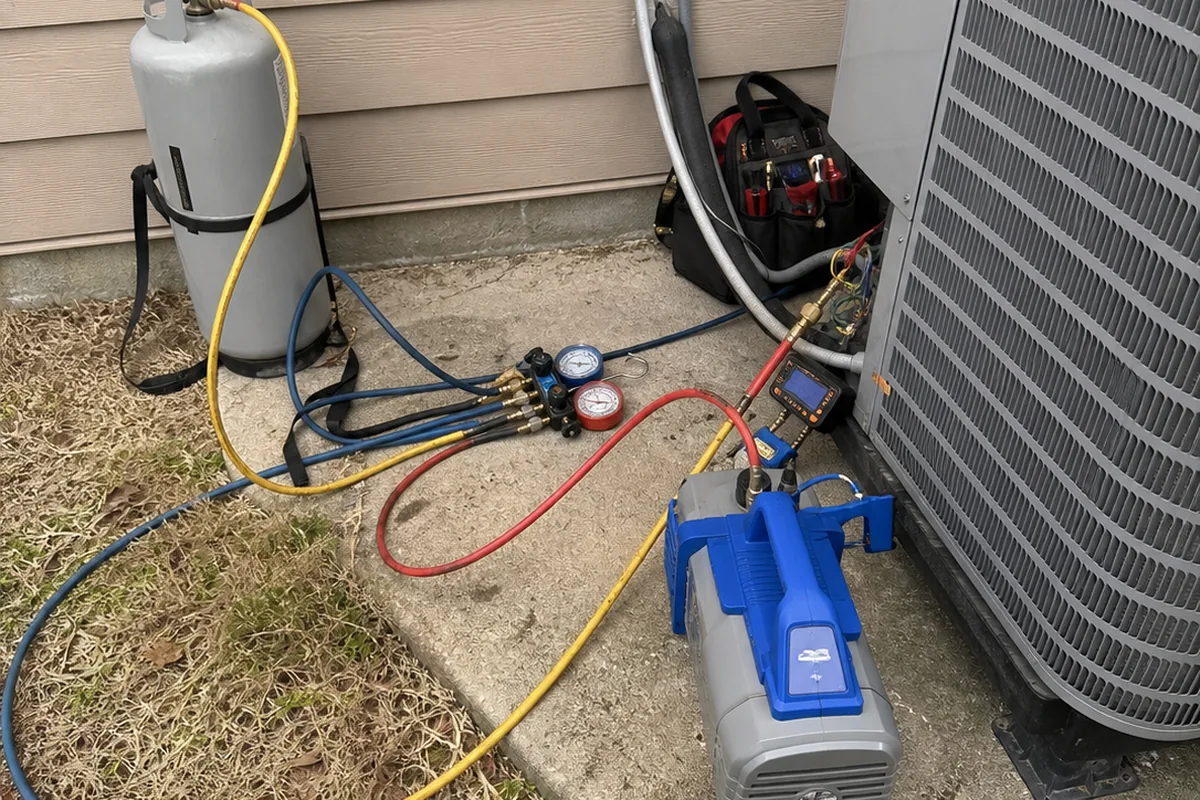
The EPA required evacuation level before opening a system depends on the appliance and the age of the recovery equipment, and it is not the same thing as a good vacuum before charging.
That distinction matters in the field. Refrigerant recovery before opening a system and deep evacuation before charging serve different purposes. One addresses lawful refrigerant handling. The other addresses moisture, air, and system cleanliness.
A shop should train, document, and verify them as separate procedures. Treating one gauge reading as proof of both creates a weak service process, even when the technician has met the federal requirement.
The regulation, and what it actually specifies
The federal recovery requirement comes from the United States Environmental Protection Agency under Section 608 of the Clean Air Act. It appears at 40 CFR 82.156, within subpart F.
The rule requires refrigerant to be evacuated before an appliance is opened for service, maintenance, repair, or disposal. For appliances other than small appliances, motor vehicle air conditioners, and MVAC-like appliances, EPA provides a table of required evacuation levels. Those levels are expressed in inches of mercury vacuum relative to a standard atmospheric pressure of 29.9 inches of mercury.
The applicable level varies by appliance type and size. It also depends on whether the recovery or recycling equipment was manufactured before or after November 15, 1993. That means a technician should identify both the appliance category and the relevant equipment age before selecting the required row.
Do not reduce that table to a single number printed on a truck wall. A remembered value can be correct for one combination and wrong for another. The defensible practice is to consult the current regulation for the appliance and recovery equipment in front of the technician.
Small appliances are handled differently. The rule permits recovery of 90 percent of the charge when the compressor is operating, recovery of 80 percent when the compressor is not operating, or evacuation to 4 inches of mercury vacuum.
These are federal requirements. Unlike an adopted building code, the federal rule does not change from one state or local jurisdiction to another. The specific required result still changes with the appliance and, where applicable, the age of the recovery or recycling equipment. Uniform federal authority does not make the table interchangeable across equipment.
Technicians who perform covered work also need the appropriate EPA Section 608 certification. Certification and evacuation procedure belong in the same compliance program, but one does not substitute for the other.
Why the legal floor is not a workmanship target
The regulatory evacuation level answers a narrow question: Has enough refrigerant been recovered for the appliance to be lawfully opened?
It does not answer whether the repaired system is dry, clean, tight, and ready to receive its charge. Removing refrigerant for recovery and evacuating a sealed system before charging are different stages of the job.
After a system has been opened, moisture and non-condensables may remain inside the piping and components. The workmanship evacuation is intended to remove those contaminants before charging. Its target and procedure should come from the equipment manufacturer’s installation instructions and the shop’s approved service process.
A technician can therefore meet the EPA recovery minimum and still have more work to do. Passing the legal threshold is permission to proceed with the repair. It is not proof that the subsequent evacuation is complete.
The instruments also tell different stories. A recovery machine, recovery cylinder, manifold, vacuum pump, and vacuum gauge each support a particular part of the process. A shop should not assume that a reading used to demonstrate lawful recovery also demonstrates the condition required for charging.
Avoid turning a familiar deep evacuation target into a universal rule. Training organizations teach evacuation methods, and manufacturers specify procedures for their equipment. Those instructions vary. The manufacturer’s current installation information should control the charging preparation for the system being serviced.
Where shops get caught out
The first failure point is terminology. Work orders may use “evacuate” to mean refrigerant recovery, deep evacuation, or both. When the record does not distinguish the stages, a supervisor cannot tell what was actually completed.
The second is relying on memory. The federal table varies by appliance and recovery equipment age. A technician who remembers one value without checking the classification may apply it to the wrong job.
The third is recording only the final vacuum result. A single entry does not necessarily show whether the refrigerant was properly recovered before the system was opened or whether the repaired circuit was later evacuated according to manufacturer instructions.
The fourth is treating equipment selection as a paperwork detail. Recovery equipment must be suitable for the refrigerant and work being performed. When a shop begins servicing systems using flammable refrigerants, its process should address recovery equipment certified for flammable refrigerant along with technician procedures and equipment identification.
The fifth is letting a successful recovery stand in for a complete commissioning process. Recovery compliance does not establish that the repair is leak free, that moisture and non-condensables have been removed, or that the system is ready for charging. Each conclusion needs its own procedure and evidence.
What to standardize
Start with precise language. Use “refrigerant recovery before opening” for the compliance step and “system evacuation before charging” for the workmanship step. Put those labels on work orders, checklists, and training materials.
Require technicians to identify the appliance category before recovery. The checklist should also capture the recovery or recycling equipment used and the information needed to determine which part of the current regulation applies.
Provide access to the current text of 40 CFR 82.156. A shop reference should direct technicians to the table instead of reproducing a partial version that may be misapplied or become outdated. The technician should verify the applicable row as part of job preparation.
Create a separate charging preparation procedure based on the equipment manufacturer’s installation instructions. That procedure should cover tool setup, measurement location, system isolation, and the evidence the shop expects before charging. It should not present an internal target as though EPA created it.
Keep the records separate enough to answer separate questions. The recovery record should support why the appliance could be opened lawfully. The evacuation record should support why the repaired system was considered ready to charge.
Finally, train supervisors to review the sequence, not just the last reading. A defensible file shows that the technician identified the appliance, applied the correct federal recovery requirement, completed the repair, and then followed the manufacturer’s evacuation instructions before charging.
Quick answers
Where does the EPA evacuation requirement live? It appears in the federal regulations at 40 CFR 82.156, within subpart F, under Section 608 of the Clean Air Act.
What is required for small appliances? Recover 90 percent of the charge with an operating compressor, recover 80 percent with a nonoperating compressor, or evacuate to 4 inches of mercury vacuum.
Is the required level the same for all appliances? No. The applicable requirement varies by appliance type and size and, for the table, by whether the recovery or recycling equipment was manufactured before or after November 15, 1993.
Does hitting the federal minimum mean the system is ready to charge? No. The minimum addresses lawful refrigerant recovery before opening, while charging preparation must follow good practice and the equipment manufacturer’s instructions.
Does the federal requirement vary by state? No. It is a federal regulation, although the applicable level varies by appliance and recovery equipment age.
