
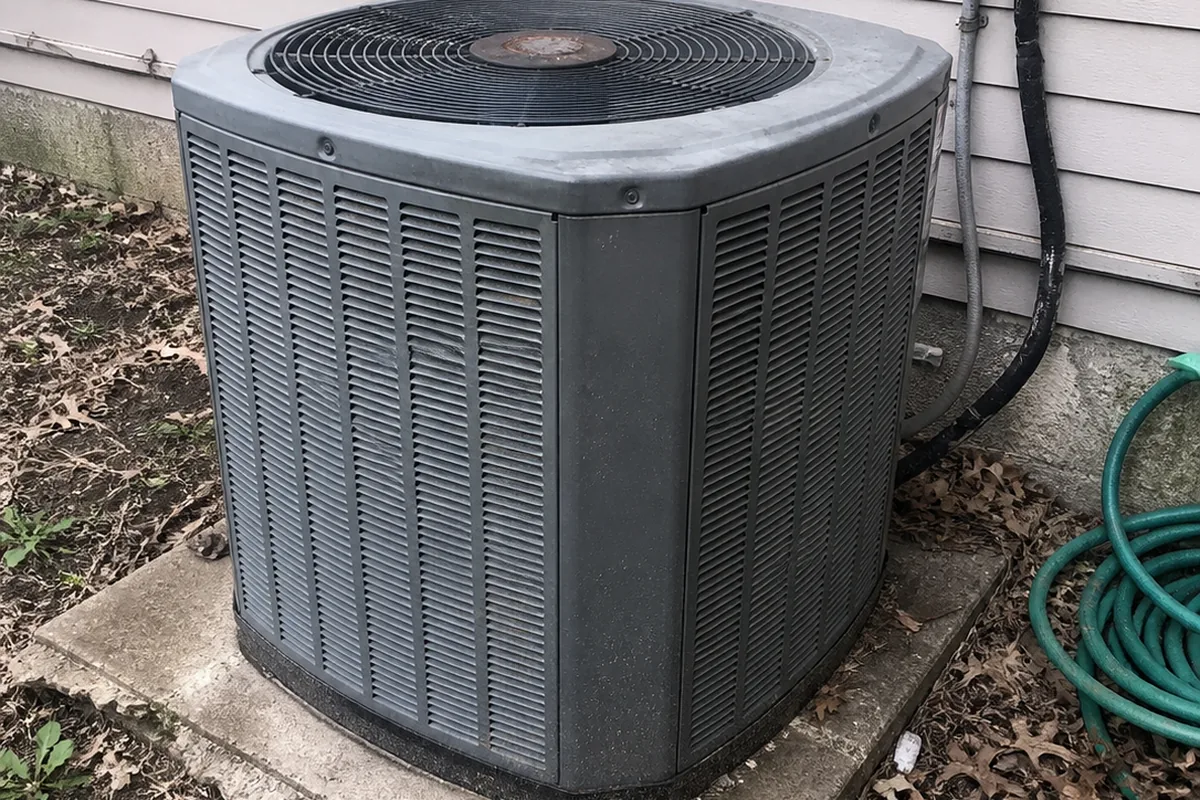
A homeowner reads your proposal, gets to the outdoor unit, and asks whether it is ENERGY STAR rated. For a straight-cool air conditioner, the honest answer changed this year, and it is not a “depends on the model” answer. There is no ENERGY STAR central air conditioner anymore.
Two separate things happened to ENERGY STAR in 2026. The EPA sunset the ENERGY STAR specification for central air conditioners effective February 1, 2026, so no central AC can carry the mark. And on August 28, 2026, EPA and the Department of Energy finalized a plan to move the entire ENERGY STAR program from EPA to DOE within twelve months. The first one affects what you can put in writing today. The second one affects the databases, partnership agreements, and rebate plumbing you rely on over the next year.
They get conflated constantly, including in trade coverage, so it is worth separating them.
The central air conditioner label is gone, and it went quietly
This one is finished, not pending. EPA’s Office of Air and Radiation sent a letter to central air conditioner manufacturers and interested parties dated December 2, 2024, signed by Ann Bailey, Director of ENERGY STAR Product Labeling, finalizing the sunset of the ENERGY STAR specification for Central Air Conditioners effective February 1, 2026.
The letter lays out the milestones that already passed:
- No new Partnership Agreements for the CAC program were accepted after July 15, 2025.
- No new CAC certifications were accepted after July 15, 2025.
- Certified central air conditioners and their brand owners were recognized at energystar.gov until February 1, 2026.
- Manufacturers and brand owners must stop using the ENERGY STAR name and mark in association with all central air conditioners manufactured, and services offered, on or after February 1, 2026.
That last bullet is the one contractors keep missing. It is not only about the equipment. It reaches “services offered,” which is the language that covers marketing. EPA did tell partners they could use up existing printed material rather than throw it away, which is why you still see the mark on brochures and box labels sitting in a warehouse. That is a waste-reduction allowance for material already printed. It is not permission to keep making the claim.
EPA’s stated reasoning is worth knowing because a customer may ask. In the same letter, the agency notes that some commenters were concerned continued ENERGY STAR endorsement of central air conditioners would impede residential heat pump adoption, while others opposed a sunset, citing consumers with no heating needs or who are not good heat pump candidates, and asked for a delay over market readiness, contractor training, and heat pump affordability. EPA weighed both and kept February 1, 2026.
For distinguishing an efficient model without the label, the letter points at two things that still exist: the Consortium for Energy Efficiency performance tiers, and the EnergyGuide label. Both are usable on a proposal. Neither is ENERGY STAR, and you should not describe them as if they were.
Air-source heat pumps were not touched. That category is still active on energystar.gov, with current requirements listed as effective January 1, 2023. If you are quoting a heat pump, the label question still has a real answer, and the certified product lists are still published.
The program itself is moving to DOE
On March 3, 2026, EPA and DOE signed the 2026 Memorandum of Agreement on the ENERGY STAR Program. It runs ten years and it makes DOE the lead federal agency for ENERGY STAR, in consultation with EPA and others. Both agencies act under section 131 of the Energy Policy Act of 2005, which is the statute that put a voluntary efficiency labeling program inside both agencies in the first place. It was signed by Aaron Szabo, EPA’s Assistant Administrator for the Office of Air and Radiation, and Audrey Robertson, DOE’s Assistant Secretary of Energy for Energy Efficiency and Renewable Energy.
The MOA required a detailed transition plan. That plan, the 2026 ENERGY STAR Program Transition Plan, was finalized on August 28, 2026. It commits both agencies to fully complete the transition no more than twelve months after finalization, and it splits the work into three streams.
Workstream 1, knowledge transfer and leadership. EPA hands DOE its documentation, standard operating procedures, contracts, partnership agreements, and the technical background and status of all ENERGY STAR specifications and the certification processes behind them. EPA staff train DOE staff. Programmatic leadership consolidates at DOE within one month of the plan being finalized, or by the trademark transfer date, whichever governs.
Workstream 2, the trademark and the agreements. The ENERGY STAR trademark, EPA-only partnership agreements, and agreements with foreign governments transfer through a separate Trademark and Agreement Transfer Plan that the two general counsels were to finalize by September 1, 2026. Control of the trademarks does not move until after that plan is done, and the actual transfer date gets set there. One footnote in the plan matters for anyone holding a partnership agreement: most existing agreements are already with both EPA and DOE, and only a small percentage are EPA-only and need modifying to add DOE.
Workstream 3, the IT systems. The plan is blunt that this takes the longest. The ENERGY STAR IT portfolio is described as a complex infrastructure of numerous tools, applications, and databases, and DOE has to stand up its own hosting that meets federal security and privacy requirements. Target for completion is before July 2027.
The plan states the goal as continuity with minimal disruption, and it puts a number on what is riding on that. In its own words, the agencies are committed to minimizing disruption to the 1,500 manufacturers, 1,200 retailers, 840 utilities, and $100 billion in private markets that depend on ENERGY STAR to save the equivalent of 13 percent of United States electricity use annually. Those figures are the transition plan’s, not an outside estimate.
Read that carefully, because it is a commitment about intent, not a guarantee about your specific rebate program. The MOA itself says plainly that it is not a binding document and creates no rights enforceable by anyone outside the two agencies. Nothing in either document changes a specification, revokes a certification, or invalidates a product listing. But 840 utilities pointing their program rules at a database that is being rehosted by a different agency is exactly the kind of thing that produces a stale qualifying-products list at the wrong moment.
Where this actually touches your shop
Your written claims. If your website, proposal template, truck wrap, or a canned line in your CRM says you install ENERGY STAR certified air conditioners, that is now inaccurate for central AC. This is the cheapest thing on this list to fix and the most likely to be sitting there untouched. Search your own site for the phrase.
Your rebate math. Utility and state programs commonly reference ENERGY STAR or CEE tiers to define what qualifies. Some of those programs already had to rewrite their central AC tiers around the February sunset. During the next twelve months of program transition, treat a rebate amount as something you confirm at the program’s own portal before it goes on a quote, not something you carry over from last season’s job. Quoting a rebate that does not come through is a collections problem and a reputation problem at the same time.
Federal tax credit questions. Customers still ask about the 25C credit, and the answer has changed. The IRS page for the Energy Efficient Home Improvement Credit states the credit is allowed for qualifying property placed in service on or after January 1, 2023, and before December 31, 2025. A system you energize in 2026 is outside that window. Point the customer at their tax professional rather than guessing, but do not let an old brochure make the promise for you.
New construction credentialing. If you do ENERGY STAR certified homes work, Track B of the Single-Family New Homes program requires the HVAC contractor to hold an EPA-recognized credential before assessing systems. The two national programs listed are ACCA’s Quality Assured Contractor Program and Advanced Energy’s contractor credentialing program. Those credential and partnership arrangements are part of what transfers, so keep your paperwork current and watch for a notice asking you to re-execute an agreement naming DOE.
Your bookmarks and any integration. If anyone at your shop pulls from the ENERGY STAR certified product data, whether that is a spreadsheet someone maintains or a proposal tool that calls the API, the hosting for those systems moves before July 2027. That is a long runway, but it is a real one. Know who at your company would notice if the feed went stale.
What to do this week
- Grep your own marketing. Website, proposal templates, email footers, printed leave-behinds. Any ENERGY STAR claim attached to a central air conditioner needs to come out or be rewritten around heat pumps, CEE tiers, or the EnergyGuide label.
- Retrain the phone answer. Whoever answers your calls will get “is it ENERGY STAR” from homeowners who saw it on a competitor’s site. The correct answer is short: central air conditioners no longer carry the label as of February 2026, heat pumps still do.
- Verify one live rebate. Pick a program you actually use and confirm today’s qualifying criteria at the source. If it still references a sunset central AC tier, you have found a problem before a customer did.
- Check the certified list at the source. For heat pumps, use the ENERGY STAR product finder rather than a manufacturer’s PDF, and note the date you checked on the job file.
- Do not oversell the transition. DOE taking over is administrative. It does not make anything you installed non-compliant, and telling a customer otherwise to close a replacement is the kind of claim that comes back.
The part that lands on your phone
Every one of these changes arrives at your business the same way, as a question on an inbound call. “My neighbor said there’s a rebate.” “Is this one ENERGY STAR?” “I read the tax credit went away, is that true?” They are not emergencies and they are not qualified leads yet, and they eat a dispatcher’s afternoon during the exact weeks you are trying to run install crews.
They also cannot go to voicemail. A homeowner comparison-shopping a replacement is calling three companies in one sitting. The one that picks up and captures the equipment, the age of the system, and a callback window is the one that gets the appointment, regardless of who had the better answer about a label.
That is the gap Dial 72 covers when the office is on another line or already closed for the day. Calls get answered, the details get written down, and your team follows up with the accurate answer instead of losing the lead to a busy signal. See how it works, or pricing if the after-hours version of this is currently going to voicemail.
Quick answers
Can a central air conditioner be ENERGY STAR certified in 2026? No. EPA finalized the sunset of the ENERGY STAR specification for central air conditioners effective February 1, 2026, and manufacturers must stop using the name and mark for central AC manufactured and services offered on or after that date.
Do heat pumps still carry ENERGY STAR? Yes. Air-source heat pumps remain an active ENERGY STAR product category, with current requirements listed as effective January 1, 2023.
Is ENERGY STAR being cancelled? No. It is moving. A March 3, 2026 memorandum of agreement made DOE the lead federal agency, and the transition plan finalized August 28, 2026 sets a twelve-month timeline to complete the handover, with IT systems targeted for completion before July 2027.
Does the move to DOE change any specification or certification? Not by itself. The transition documents cover leadership, trademarks, partnership agreements, and IT hosting. They do not revise product criteria or revoke listings.
What can I use instead of the ENERGY STAR label on an air conditioner quote? EPA’s own sunset letter points to Consortium for Energy Efficiency performance tiers and the EnergyGuide label. Use them by their real names, and do not present either as an ENERGY STAR equivalent.
Is the 25C tax credit still available? The IRS states the Energy Efficient Home Improvement Credit applies to qualifying property placed in service on or after January 1, 2023, and before December 31, 2025. Send the customer to their tax professional for their specific situation.
