
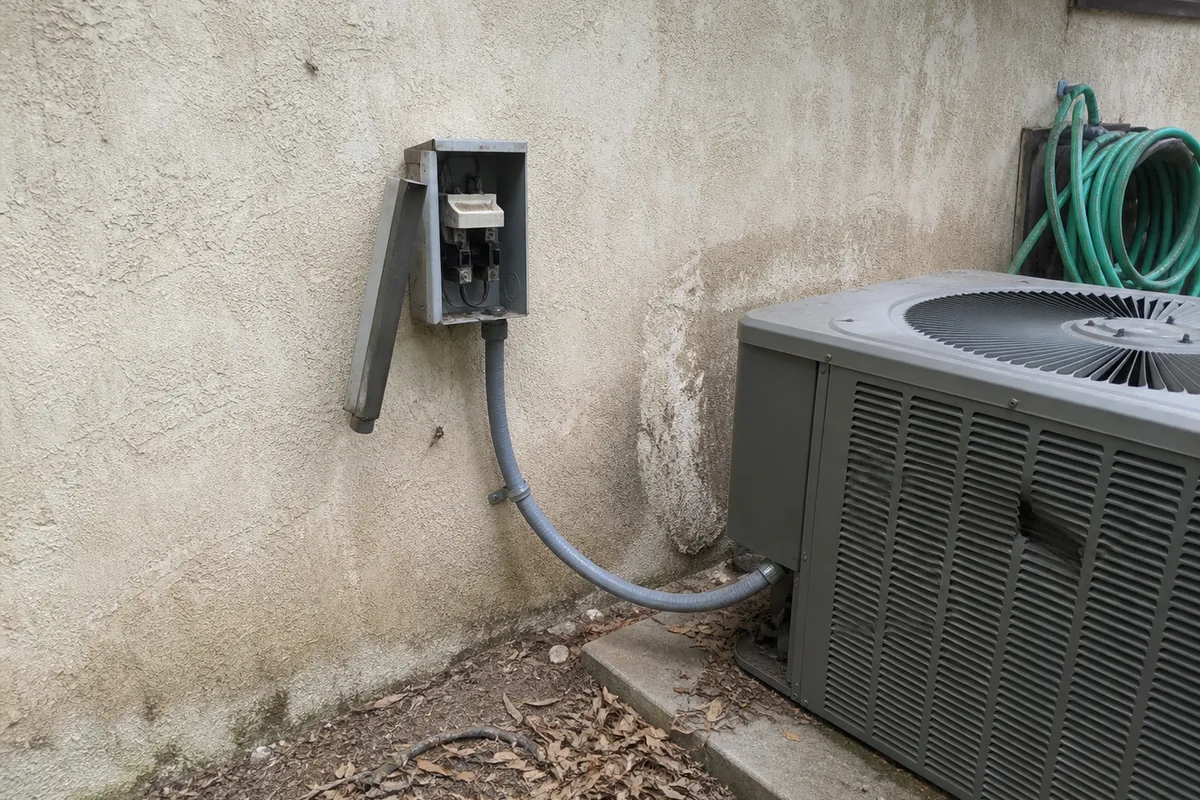
A tech pulls the disconnect at the condenser, opens the control panel, and starts pulling the spade terminals off a dual run capacitor with needle nose pliers. The unit is dead. The disconnect is on the ground. Nobody in that driveway thinks anything unusual is happening, because nothing unusual is.
The capacitor does not know the disconnect is out. It has been holding a charge since the compressor last stopped, and the discharge path a shop assumes is there is often not there in the way it is imagined.
Two things are true at the same time in residential HVAC, and shops usually only say one of them out loud. The first is that live parts have to be deenergized before you work on them. The second is that a huge share of the diagnostic work in this trade cannot be done that way, and that is legal. OSHA wrote both of those into the same paragraph.
The problem is not that shops break the rule. It is that most shops cannot say where the exception ends, which means they cannot tell a supervisor, an insurer, or a compliance officer why the thing their tech did was allowed.
The paragraph everything hangs on
The general industry electrical safety work practices live in 29 CFR 1910 Subpart S. The operative sentence is 1910.333(a)(1):
Live parts to which an employee may be exposed shall be deenergized before the employee works on or near them, unless the employer can demonstrate that deenergizing introduces additional or increased hazards or is infeasible due to equipment design or operational limitations.
Read the structure rather than the tone. The default is deenergized. There are exactly two doors out of it, and both of them are the employer’s to prove, not the tech’s to decide on the fly.
The regulation gives examples of each. Increased hazards means things like interruption of life support equipment, deactivation of emergency alarm systems, shutdown of hazardous location ventilation equipment, or removal of illumination for an area. None of that describes a house.
Infeasibility is the door residential HVAC actually walks through, and the named example is the one that matters:
testing of electric circuits that can only be performed with the circuit energized
That is the whole legal basis for how this trade diagnoses. Reading 240 volts across the line side of a contactor, checking control voltage at the transformer, watching whether the compressor draws locked rotor amps, verifying that a pressure switch is closing. None of those measurements exist with the power off. The rule anticipated that, and it does not ask you to pretend otherwise.
So the tech taking the voltage reading is fine. What the rule does not do is follow that tech to the next step.
Where the exception runs out
Testing is testing. Once the measurement is taken and the diagnosis is made, replacing the contactor is not testing. Landing a new capacitor is not testing. Changing a fan motor, repairing a burned lug, swapping a defrost board, none of that is a circuit that can only be checked energized. It is repair work, and the default in 1910.333(a)(1) applies to it in full.
This is the seam where field habit and the written rule separate, and it separates quietly. The tech is already in the panel. The meter is already out. The disconnect is fifteen feet away. Continuing straight into the repair with the unit live feels like one motion, not two decisions.
It is two decisions. The first one was covered by an exception the employer can defend. The second one is exposure to a hazard with no exception behind it.
There is a second, more useful way to describe it that lands better with techs than a regulatory citation does. The exception is about what the circuit requires, not about what is convenient. If the task can be done with the power off and still produce the same result, the power goes off. That test is easy to apply on a ladder, and it gives the same answer the regulation does.
The deenergizing procedure has a step your shop is skipping
When the power does go off, 1910.333(b)(2) sets out what deenergized means, and it is more than the absence of a humming compressor. The sequence is short enough to put on a truck card.
Determine the procedure first. Safe procedures for deenergizing get worked out before anything is opened, not improvised at the unit.
Open all sources. The circuits and equipment to be worked on get disconnected from all electric energy sources, and control circuit devices such as push buttons, selector switches, and interlocks may not be used as the sole means of deenergizing. Setting the thermostat to off is not deenergizing. Neither is flipping the service switch on the furnace, by itself.
Release stored energy. This is the one. The regulation says it directly:
Stored electric energy which might endanger personnel shall be released. Capacitors shall be discharged and high capacitance elements shall be short-circuited and grounded, if the stored electric energy might endanger personnel.
Capacitors are named in the text. Not implied, named. In a trade where nearly every outdoor unit and nearly every air handler has at least one capacitor sitting a few inches from where hands go, that is not an abstract requirement. It is a line written for exactly this equipment, and it is the step most often skipped because the unit already looks dead.
Apply locks and tags. Tags without locks are allowed only under a condition most shops do not realize is attached: a tag used without a lock has to be supplemented by at least one additional safety measure that provides a level of safety equivalent to a lock, and the regulation names removal of an isolating circuit element, blocking of a controlling switch, or opening of an extra disconnecting device as examples.
That last point is worth sitting with, because residential HVAC has a habit that lands close to it. A pull-out style disconnect that goes in the tech’s pocket is a removed isolating circuit element, which is one of the named supplemental measures. What it is not, on its own, is a tag. If your written program relies on the pull-out in the pocket, write down that this is what it is and what accompanies it, rather than leaving it as a habit that happens to be defensible.
Verify with a meter. A qualified person uses test equipment to test the circuit elements and equipment parts employees will be exposed to, and verifies they are deenergized. Verification is not looking at the disconnect. It is a reading. The same instrument discipline that turns a furnace visit into a defensible safety check applies here, for the same reason: a measurement you took is evidence, and a thing you assumed is not.
Your lockout binder probably does not cover this
Most shops with any safety program at all have something built around 1910.147, the lockout/tagout standard. It is the one everybody has heard of.
For the electrical hazard on a condenser, it is not the standard that applies. 1910.147(a)(1)(ii) lists what the lockout standard does not cover, and one item on that list is:
Exposure to electrical hazards from work on, near, or with conductors or equipment in electric-utilization installations, which is covered by subpart S of this part
Electric-utilization installations is the equipment on the load side of the service, which is to say all of it, from the point of view of a residential HVAC truck. Shock and arc exposure while working on that equipment routes to Subpart S and 1910.333, not to 1910.147.
That does not make the lockout binder useless. Mechanical hazards during service, a blower wheel that can start turning, a damper actuator with stored spring energy, still live in that world. But if a shop’s entire answer to “what is your electrical safety procedure” is a lockout program written to 1910.147, the answer is pointed at the wrong standard, and the specific requirement about discharging capacitors is not in it.
One more scoping note, and it matters more than it sounds. Subpart S of Part 1910 is general industry. Construction work has its own electrical requirements in Part 1926 Subpart K. Service and repair calls generally sit on the general industry side, while new installation work on a construction site generally does not. A shop that does both should know which of its work falls where rather than assuming one answer covers the truck and the new construction crew.
If you stay energized, the rule gets more demanding, not less
Techs sometimes read the testing exception as permission to relax. It is the opposite. The moment you are working on parts that have not been deenergized, two more sections switch on.
1910.333(c)(2) limits who can do it:
Only qualified persons may work on electric circuit parts or equipment that have not been deenergized. Such persons shall be capable of working safely on energized circuits and shall be familiar with the proper use of special precautionary techniques, personal protective equipment, insulating and shielding materials, and insulated tools.
Qualified is a status the employer confers and can show, through training and demonstrated ability on the specific equipment. It is not a synonym for experienced, and it is not a thing a tech assigns to himself in the driveway. A shop that lets apprentices take live readings unsupervised is on the wrong side of that sentence no matter how good the apprentice is.
Then 1910.335 adds equipment. Employees working in areas where there are potential electrical hazards shall be provided with, and shall use, electrical protective equipment appropriate for the specific parts of the body to be protected and for the work to be performed. Insulated tools are required where the tools might make contact with exposed energized conductors or circuit parts. Protective shields, barriers, or insulating materials are required to protect employees working near exposed energized parts that might be accidentally contacted.
Notice what 1910.335 does not say. It never tells you which glove, which face shield, or how far back to stand. It says appropriate. That word is where the second document comes in.
NFPA 70E is what makes “appropriate” a number
NFPA 70E, Standard for Electrical Safety in the Workplace, is the consensus standard that turns the general language in Subpart S into specific distances, PPE, and program requirements. The 2024 edition is current. It was originally developed at OSHA’s request, which is why the two documents fit together as neatly as they do.
70E is not itself law, and OSHA is direct about that. OSHA does not enforce 70E; it enforces its own standards. What OSHA does do is use 70E as evidence, both of hazard recognition and of the availability of feasible abatement, and specifically as a reference when considering citations under PPE requirements like 1910.335. Its own letters of interpretation say so. In practice that means a shop that ignores 70E is not violating 70E. It is failing to have an answer for what “appropriate” meant, at the exact moment somebody is asking.
Two sets of numbers from 70E do real work on a residential truck.
Shock approach boundaries. For alternating current in the 151 volt to 750 volt range, which covers 240 volt residential equipment, the limited approach boundary to an exposed fixed circuit part is 3 feet 6 inches and the restricted approach boundary is 1 foot 0 inch. Crossing the restricted boundary requires shock PPE and a documented plan. Those distances are the reason an open condenser control panel is not a place for a homeowner to stand and watch.
Arc flash for the equipment you actually open. 70E’s PPE category table for AC systems has a row that lands squarely on residential work: panelboards or other equipment rated 240 volts and below, with a maximum of 25 kA available fault current and a maximum 0.03 second (2 cycle) fault clearing time, at a minimum working distance of 18 inches, come out at arc flash PPE category 1, with an arc flash boundary of 19 inches.
Category 1 means arc rated clothing with a minimum arc rating of 4 cal/cm², an arc rated long sleeve shirt and pants or coverall, an arc rated face shield or flash suit hood, hard hat, safety glasses, hearing protection, heavy duty leather gloves, and leather footwear. That is a specific list, and it is a modest one. It is considerably closer to what a shop already owns than most people expect before they look it up.
Two cautions before that number goes on a truck card. The table method only applies when the equipment actually meets the stated parameters, and available fault current and clearing time are properties of the installation, not of your meter. And table and section numbers move between 70E editions, the same way they do in the fuel gas code. Work from the edition your program adopts rather than a number quoted in an article, including this one.
What to do this month
- Write down which door you go through. One page: the default is deenergized, testing that can only be done energized is the exception, and repair is not testing. If a supervisor cannot state that in a sentence, no tech is going to.
- Add capacitor discharge to the deenergizing sequence in writing. It is named in the regulation and it is the step that gets skipped. Specify the method, the tool, and the verification reading, not just the intention.
- Decide what “qualified” means in your shop and who has it. Training records, equipment covered, who signed off. A list that exists on paper before anyone asks for it is worth ten times a list assembled afterward.
- Check whether your safety binder is pointed at 1910.147 or 1910.333. If everything electrical is filed under lockout/tagout, the file is aimed at a standard that expressly excludes this exposure.
- Price the PPE against category 1 and see how close you already are. Arc rated shirt and pants, face shield, gloves, safety glasses, hearing protection. Compare it against what is on the truck now and buy the gap.
- Stop treating the pull-out in the pocket as the whole procedure. It is a legitimate supplemental measure. Write it into the program as one, alongside the tag it is supplementing.
The version of this that reaches your phone
None of this shows up on the phone as an electrical safety question. It shows up as a tech calling in from a driveway because the unit is dead, the homeowner is standing there, and he wants a second opinion before he opens anything. Or it shows up worse, as a call from a customer about an incident, where the only thing that matters is how fast somebody competent picks up and gets the details written down.
Both of those calls arrive while your office is already handling four others, or after hours when nobody is at the desk. A tech who cannot reach anybody makes the call himself, which is exactly the moment this article is about. That is the job Dial 72 does when your office cannot pick up, answering every call, getting the address and the situation down accurately, and routing the ones that need a human to a human. See how it works, or pricing if these calls are currently going to voicemail.
Quick answers
Is it legal to take a voltage reading on a live condenser? Yes, when the reading is one that can only be taken with the circuit energized. 1910.333(a)(1) names testing of electric circuits that can only be performed energized as an example of infeasibility, which is one of the two exceptions to the deenergized default. The employer has to be able to demonstrate it, and only qualified persons may do the work.
Does that exception cover replacing the capacitor once I have the reading? No. Testing is the exception. Replacing a component is repair, it can be done with the power off, and the deenergized default applies to it in full.
Is pulling the disconnect enough? It opens the source, which is one step of several. The procedure also requires releasing stored electric energy, and the regulation specifically says capacitors shall be discharged where the stored energy might endanger personnel, then applying locks or tags, then verifying deenergized condition with test equipment. A pulled disconnect on its own is none of those last three.
Our lockout program covers this, right? Probably not. 1910.147 expressly does not cover exposure to electrical hazards from work on or near conductors or equipment in electric-utilization installations, which routes to Subpart S instead. Mechanical hazards during service still belong to the lockout program.
Do we have to follow NFPA 70E? OSHA does not enforce 70E directly. It enforces its own standards and uses 70E as evidence of hazard recognition and of feasible means of abatement, including when considering PPE citations under 1910.335. Practically, 70E is where you get the specific PPE and boundary numbers that OSHA’s own text leaves as “appropriate.”
What PPE does residential 240 volt work actually call for? Under 70E’s PPE category table for AC systems, equipment rated 240 volts and below meeting the stated parameters falls at arc flash PPE category 1 with a 19 inch arc flash boundary, which is 4 cal/cm² minimum arc rated clothing plus face shield, hard hat, safety glasses, hearing protection, heavy duty leather gloves, and leather footwear. Confirm the parameters apply to the installation and work from your adopted edition.
Does any of this change with the GFCI requirements on outdoor units? They are separate questions. GFCI protection under NEC 210.8(F) is an installation requirement about the branch circuit. The rules here are work practice requirements about what your tech does at the equipment. A unit can be fully GFCI protected and the work practice obligations are unchanged.
Does this apply on new construction? Part 1910 Subpart S is general industry. Construction work has parallel electrical requirements in Part 1926 Subpart K. Service and repair calls generally sit on the general industry side. If your shop does both service and new install work, know which side each crew is on rather than assuming one program covers both.
