
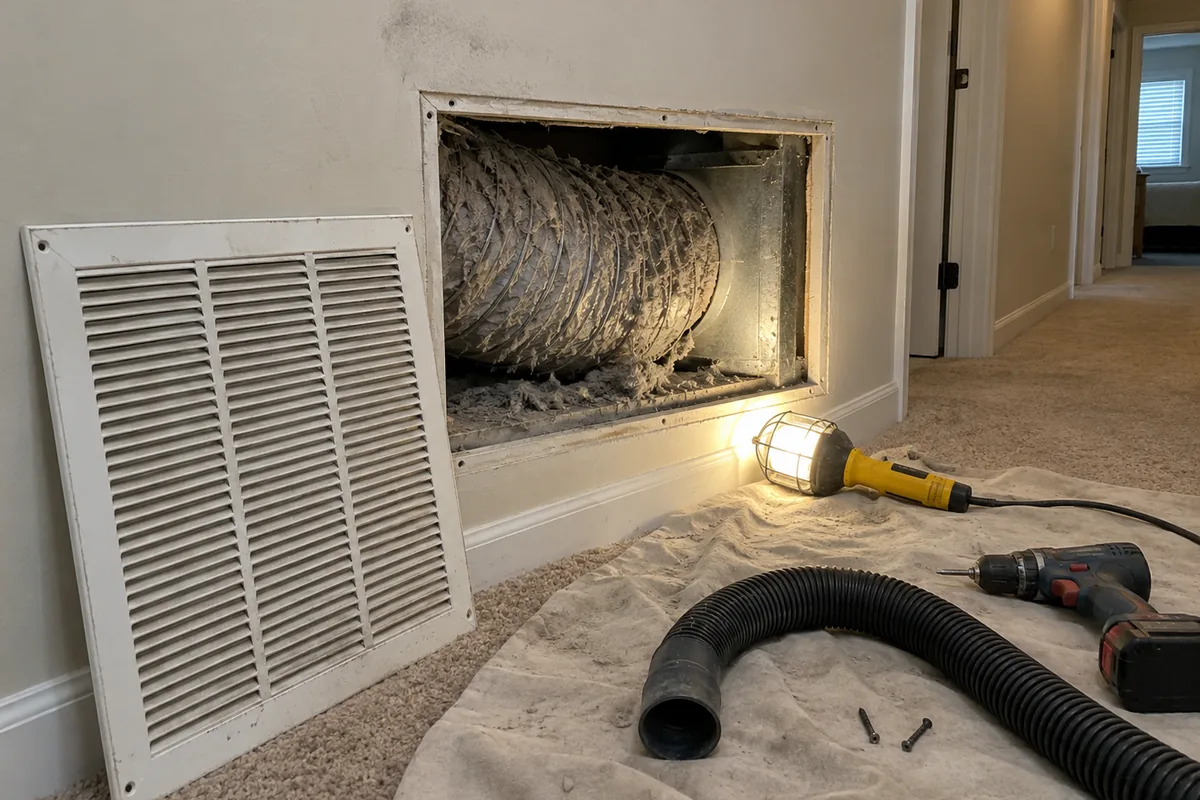
The phone rings and the caller asks for duct cleaning. That is the entire job description.
These calls cluster in the first genuinely cold week of the season, right after the furnace runs for the first time and the house smells like burning dust. The caller has already diagnosed the house and is calling to order a product, not to describe a symptom. Book it blind and you either send a tech to sell work the house does not need, or you wave off a home with real mold or vermin in the ductwork. Two free documents settle which one you have, and most shops have opened neither.
What EPA actually says, and the three claims it will not make
EPA’s homeowner guidance is blunt about frequency. “EPA does not recommend that air ducts be cleaned routinely, but only as needed.”
It names three conditions worth acting on. Substantial visible mold growth inside hard surface ducts, such as sheet metal, or on other components of the system. Ducts infested with vermin, meaning rodents or insects. And ducts clogged with excessive amounts of dust and debris, or particles actually being released into the home from the supply registers. That third one is a specific observation, not a general impression that the house is dusty.
The three claims EPA declines to support are just as useful, because they are the three your competitors advertise. EPA says “duct cleaning has never been shown to actually prevent health problems,” and that there is no evidence a light amount of household dust in the ducts poses any risk to health. It says “little evidence exists that cleaning only the ducts will improve the efficiency of the system,” while allowing that cleaning other components, such as cooling coils, may help. And it tells homeowners plainly not to hire duct cleaners who make sweeping claims about health benefits. If your phone script sells any of the three, EPA has handed your customer the rebuttal.
Two more items are worth knowing before a tech quotes anything. No chemical biocides are currently registered by EPA for use in internally insulated air duct systems. And where a provider says there is mold, EPA tells the homeowner to ask to be shown it, because a positive determination can be made only by an expert and may require laboratory analysis.
6 QR puts the decision before the cleaning
The standard is ANSI/ACCA 6 QR - 2015 (RA 2021), Restoring the Cleanliness of HVAC Systems. Like the rest of ACCA’s quality standards, it is a free download.
Its scope establishes “the minimum criteria for the cleaning of HVAC systems,” then adds the clause worth reading twice. It “is not intended to be recognized as the sole remedy for resolving all indoor air quality concerns.” The standard refuses to be sold as an air quality cure. Neither should you.
ACCA describes 6 QR as the nationally recognized minimum requirements to restore cleanliness in residential and commercial HVAC systems, in accordance with manufacturer or customer specified criteria. It defines minimum procedures to do four things: determine when airside surfaces should be cleaned and when they instead require repair or replacement, clean those surfaces, control the spread of contaminants released by the cleaning process itself, and verify the cleanliness of the system afterward.
The order is the whole argument. Deciding whether to clean at all is step one. The cleaning is step two. Verification is step four. A price quoted over the phone has skipped step one, which means it is not a 6 QR job no matter what the invoice says. ACCA also notes the standard gives direction on assessing the economic viability of replacing components or systems versus cleaning them, so replace it instead is a correct outcome, not a lost sale.
One housekeeping note. As ACCA’s Manager of Codes and Standards David Bixby has put it, an ANSI approved standard “must be reviewed every five years.” ACCA announced the 6 QR reaffirmation on March 5, 2021 and still lists that edition as of September 2026, which puts it in its review window now. Confirm the current designation before it goes into a written proposal.
Two standards, two products, two prices
Restoration is not maintenance. ANSI/ACCA 4 QM - 2019 (R2024) sets the minimum inspection tasks of a recurring visit, and that floor is its own separate subject. 6 QR is a restoration job carrying its own decision step, contamination controls and verification. A maintenance agreement does not contain a 6 QR cleaning, and a cleaning is not a substitute for a maintenance visit. Book both under one generic description and the tech arrives without a scope while the customer holds two different promises.
When the honest answer is replace, or fix the water first
EPA is direct that insulated air ducts whose insulation gets wet or moldy cannot be effectively cleaned and should be removed and replaced. That is the same call 6 QR builds into step one.
Mold also comes back if the cause stays. “If the conditions causing the mold growth in the first place are not corrected, mold growth will recur,” EPA says, and it calls controlling moisture the most effective way to prevent biological growth in air ducts. For a water source inside the system, the condensate side is where to look first, and what code requires there is worth standardizing before anyone quotes a cleaning as a moisture fix.
Dust runs on the same logic. What gets into the system matters more than scrubbing what already did, which is a filtration question, and the MERV 11 floor moved the design side of it. It is a leakage question too, because a return pulling attic or crawlspace air is an open intake, which is why the duct leakage number belongs in the same visit.
Four questions that belong on the phone, not on the truck
Four questions sort a possible 6 QR job from a non job before anyone drives anywhere. Is there visible mold inside the ducts or on another component. Any sign of rodents or insects in the ductwork. Is debris actually blowing out of the registers, or is the complaint dust on the furniture. Has the system or the space around it ever been wet, flooded, or run with a condensate problem.
Those are shop specific triage questions, which is the step Dial 72 covers. It answers 24/7 in under a second, asks by your shop’s own rules, and sends the answers in a call summary by text in English or Spanish, so the job books as an inspection when the facts support one and gets declined honestly when they do not, instead of landing on the board labeled only duct cleaning. Growth and Pro connect into Housecall Pro, Jobber and ServiceTitan, and Dial72 runs flat at $95, $295 and $495 a month with no per call and no per seat meter.
Sell the inspection, not a blind cleaning
The product on the phone is not a cleaning. It is a decision. You inspect, you confirm what the caller actually reported, and you come back with cleaning, repair, replacement, or the recommendation to leave the ducts alone.
That last answer costs you one job and earns the next three.
