
The first cold morning is when the phone starts. Somewhere in the next six weeks a homeowner with a working 80% furnace is going to ask your tech whether they should replace it now, because they read that gas furnaces are being banned, and they do not want to be stuck.
There is a real federal rule underneath that question. There is also a large gap between what the rule does and what the homeowner thinks it does, and the gap runs in a direction that costs you jobs if you do not close it on the driveway.
What the rule actually says
The Department of Energy published amended energy conservation standards for consumer furnaces on December 18, 2023, at 88 FR 87502, docket EERE-2014-BT-STD-0031. The rule took effect February 16, 2024.
It sets one number for two product classes:
- Non-weatherized gas furnaces: 95.0% AFUE
- Mobile home gas furnaces: 95.0% AFUE
The compliance language is the part worth reading twice. The standard applies to units manufactured in, or imported into, the United States starting on December 18, 2028.
That threshold is above what a non-condensing furnace can reach, which is why the trade press calls it a condensing mandate. It is an accurate description of the effect. It is not a description of the scope, and the scope is where the customer conversation goes wrong.
It is a manufacture date, not an install date
This is the single fact that answers most of the questions you will get this fall.
Federal appliance standards attach to when a unit is built or brought into the country. They do not restrict installing a unit that was lawfully manufactured before the date, and they do not reach equipment already in a house. A furnace built on December 17, 2028 remains legal to sell and legal to install after the date passes, for as long as it exists.
There is one well known exception in consumer HVACR, and it is not this rule. HARDI, the HVACR distributors’ association, points out in its energy efficiency standards briefing that the regional standards for consumer split system air conditioners use the date of installation to determine compliance in the southeast and southwest regions. That is the outlier contractors already know from the SEER2 transition. Furnaces do not work that way.
So the honest answer to “should I replace my furnace before the ban” is no, not for that reason. Replace it because the heat exchanger is cracked, because the thing is 24 years old and short cycling, or because the operating cost math works. Not because a 2028 manufacture date is going to make it illegal. If you let a homeowner buy on a false urgency, you own the conversation when they find out.
What the rule does not cover
DOE ran a separate rulemaking on the rest of the furnace market and reached the opposite conclusion. In a final rule published October 18, 2024 at 89 FR 84028, docket EERE-2021-BT-STD-0031, DOE determined that standards for electric furnaces, non-weatherized oil-fired furnaces, mobile home oil-fired furnaces, weatherized oil-fired furnaces, and weatherized gas furnaces do not need to be amended.
Weatherized gas furnaces are the ones sitting outdoors, which in residential work usually means the gas section of a packaged rooftop or a packaged unit on a pad. Those are untouched by the 2023 rule. So are oil furnaces and electric furnaces.
If you work in a market that is heavy on packaged equipment, a meaningful share of your gas heat is outside the scope entirely. Knowing that before a customer asks is cheaper than looking it up afterward.
The rule is not settled
Here is where the story stopped being simple.
The D.C. Circuit upheld the 2023 standards on November 4, 2025 in American Gas Association v. Department of Energy, No. 22-1030. That looked like the end of it.
It was not. On June 8, 2026, the Supreme Court granted, vacated, and remanded that decision, sending it back to the D.C. Circuit for reconsideration in light of the position the Solicitor General had taken. In an April 2026 brief the government agreed with the challengers that DOE’s 2021 interpretive rule and the 2023 standards rested on too narrow a reading of “performance characteristic” under the Energy Policy and Conservation Act, and said DOE was considering a new rulemaking to correct it. The case is back at the D.C. Circuit now, undecided.
Separately, on February 19, 2026, DOE received a petition from the American Gas Association, the American Public Gas Association, and the National Propane Gas Association asking it to amend the compliance dates for the consumer furnace rule and the commercial water heating rule, pushing them to at least January 1, 2030. DOE published notice of the petition on April 27, 2026 at 91 FR 22477, docket EERE-2026-BT-STD-0001, and took comment through May 27, 2026. ACCA asked contractors to weigh in. DOE has not announced a decision.
DOE has shown it will use enforcement discretion when a compliance date collides with live litigation. On April 24, 2026 it issued an enforcement policy statement on commercial water heaters saying it would not seek civil penalties over the amended thermal efficiency standards for covered units manufactured on or after October 6, 2026 but before October 6, 2027, with clarifications following on May 5, 2026. That is a real signal about how the agency is thinking. It is also a commercial water heater document, not a furnace document, and nobody should read it as one.
The state of play, stated plainly: the furnace standard is on the books with a December 18, 2028 manufacture date, the court that upheld it has been told to look again, DOE is sitting on a petition to move the date, and none of that has changed anything yet. Plan for the rule as written and stay ready for it to move.
The part that actually costs money on the job
For a residential shop, the interesting problem is not the 2028 date. It is that a condensing changeout is a different job from a like-for-like 80% swap, and the difference lands in the quote whether the rule exists or not.
A 95% furnace does not vent up the old chimney. It needs plastic venting for intake and exhaust, terminated to the manufacturer’s clearances, which means a wall or roof penetration and a route through finished space that may not exist yet. It produces condensate, which means a drain path and, depending on the jurisdiction and the drain material, neutralization. In a basement with no gravity drain you are adding a pump.
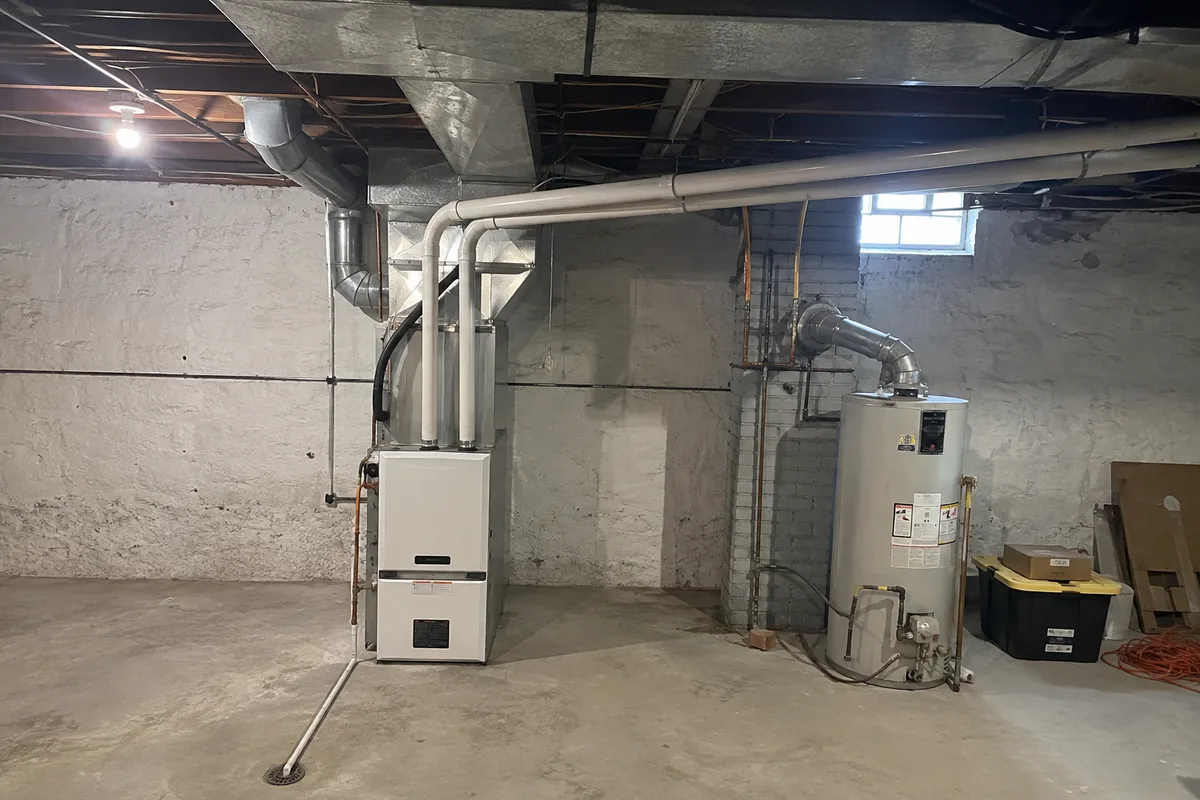
Then there is the one that quietly causes callbacks: the orphaned water heater. A common configuration in older housing stock is an 80% furnace and an atmospheric gas water heater sharing one masonry chimney, with the flue sized for both. Take the furnace off that chimney and the water heater is left alone on a vent that is now far too large for it. Oak Ridge National Laboratory documented the consequence in its condensing furnace venting work: the chimney no longer gets hot enough fast enough, draft can be insufficient under some ambient and wind conditions, and flue gases can spill out of the draft hood into the basement. That is a combustion safety problem, not a comfort complaint.
The fix is a resized vent, usually a properly sized liner, and it is a line item. Shops that price it after the fact eat it. Shops that price it up front look expensive next to the shop that did not include it, right up until the inspection.
None of this is new. All of it becomes more common as the market moves toward condensing equipment, whichever way the 2028 date lands.
What to do this month
- Fix your answer to the ban question. One sentence, same from every tech: the standard applies to furnaces built starting December 2028, it does not make any existing furnace illegal, and it does not stop you from installing one that was already made.
- Know which of your gas heat is even in scope. Non-weatherized and mobile home gas furnaces are covered. Weatherized gas, oil, and electric furnaces were reviewed separately and left alone.
- Quote the condensing changeout as the job it is. Vent route, terminations, condensate handling, and the chimney the water heater is about to be alone on. Walk the vent path before you write the number.
- Check the water heater on every changeout off a shared chimney. If it is orphaned, the liner belongs in the proposal, not in a phone call afterward.
- Do not build inventory strategy on a date that is in litigation. The compliance date is more than two years out and is being reconsidered in two places at once. There is time.
The version of this that reaches your phone
None of the above arrives as a policy question. It arrives as a homeowner on the first cold Saturday whose furnace will not light, who has half a headline in their head about furnaces being banned, and who is calling three shops in a row until somebody picks up.
That call needs two things captured before anyone dispatches: what the equipment is actually doing, and whether this is a no heat emergency or a replacement conversation. Those go to different trucks and different parts. A voicemail that says “call me back” gets you neither, and by the time you call back the second shop already answered. That is the job Dial 72 does when your office cannot pick up. See how it works, or pricing if the after-hours version of that Saturday is currently going to voicemail.
Quick answers
Are gas furnaces being banned? No. DOE set a minimum efficiency of 95% AFUE for non-weatherized and mobile home gas furnaces manufactured starting December 18, 2028. Gas furnaces remain legal to build, sell, install, and operate. The standard removes non-condensing models from future production, not gas heat.
Does my customer need to replace their furnace before 2028? No. The rule does not reach equipment already installed and sets no deadline for existing units. Recommend replacement on condition, age, and operating cost, not on this date.
Can we still install an 80% furnace after December 18, 2028? If it was lawfully manufactured or imported before that date, yes. The compliance date attaches to manufacture and import, not to installation. Consumer split system air conditioners in the southeast and southwest are the exception that uses installation date, and that is a different rule.
Which furnaces are covered? Non-weatherized gas furnaces and mobile home gas furnaces. In its October 18, 2024 final rule DOE determined that electric, non-weatherized oil-fired, mobile home oil-fired, weatherized oil-fired, and weatherized gas furnaces did not need amended standards.
Could the date change? It could. The Supreme Court sent the D.C. Circuit’s decision upholding the rule back for reconsideration on June 8, 2026, and a petition asking DOE to move the compliance date to at least January 1, 2030 is pending after a comment period that closed May 27, 2026. Neither has produced a change to the rule as of today.
What should we actually be preparing for? More condensing changeouts, which means vent routing, condensate handling, and orphaned water heater liners priced into the job rather than discovered on it.
