
The R-410A jug rule starts January 1, 2028
As of January 1, 2028, a disposable cylinder containing R-410A must go for further processing when it is done being used and headed out of the shop.
The rule is 40 CFR 84.116, Requirements for disposable cylinders. It is part of EPA’s Emissions Reduction and Reclamation program under subsection (h) of the American Innovation and Manufacturing Act. EPA finalized that program in a rule published in fall 2024.
The trigger has three parts:
- The cylinder contains a regulated substance, such as R-410A.
- It was used to service, repair, or install refrigerant-containing equipment.
- Nobody intends to use it for future servicing, repair, or installation.
That is the moment most technicians call the jug empty. The cylinder still has a heel, meaning refrigerant left inside it.
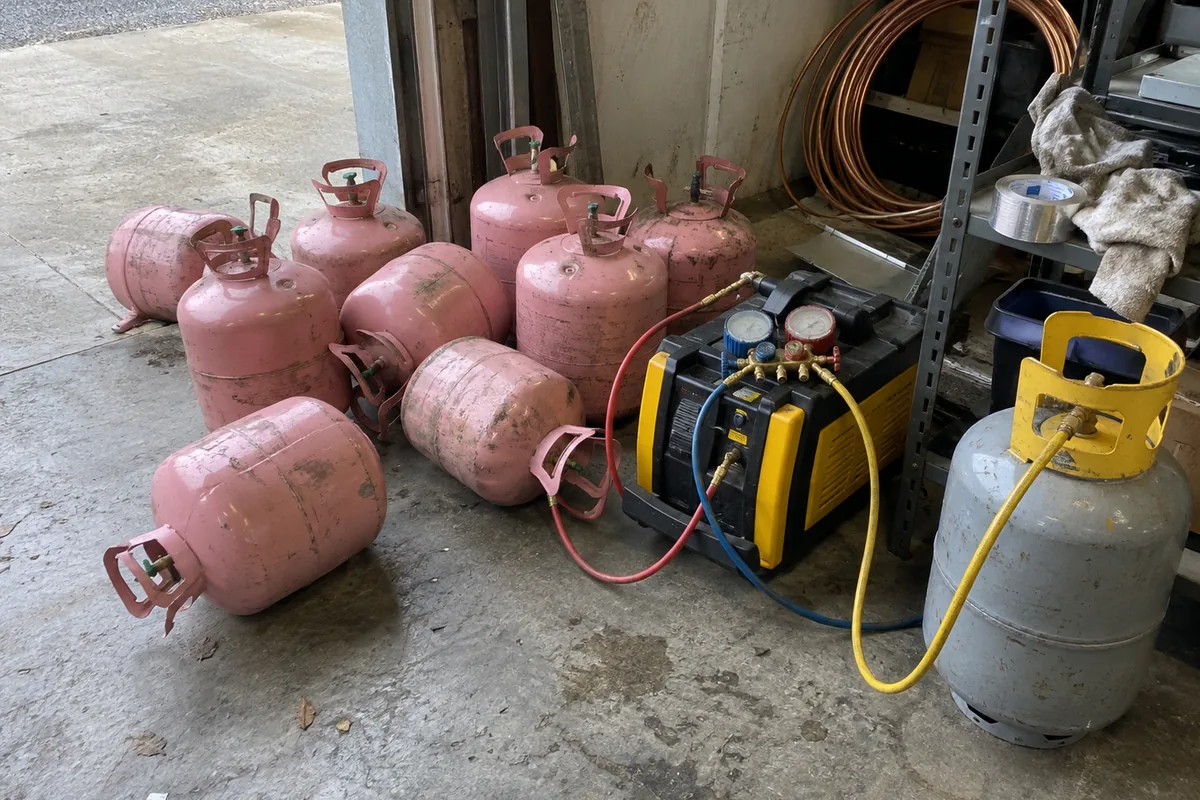
Walk into the back corner of most residential shops, or look in the bed of a service truck, and there is a pile of pink R-410A jugs that are “empty” by the tech’s definition. The gauge stopped moving mid-charge, so the jug went into the pile and a new one came off the shelf. Nobody weighs them. When the pile gets big enough, someone hauls it to scrap in one trip. That pile is exactly what 84.116 is written about. Under the rule, each jug is a cylinder with a heel.
Four places can receive the cylinder
Under 84.116(b), the cylinder can go to an EPA-certified reclaimer certified under 40 CFR 82.164. It can also go to a fire suppressant recycler, but that option applies to fire suppression cylinders.
The other two options are a final processor, such as a landfill operator or scrap metal recycler, that can remove the heel, or a refrigerant supplier that can remove it. Suppliers include distributors and wholesalers.
The receiving entity must remove all remaining contents before discarding the cylinder. Any heel removed by a final processor or supplier must go to a certified reclaimer.
That gives your shop a decision to make before the deadline. You can send the empties back to the supply house or distributor, but you need to confirm that the counter will actually take them and can remove the heels. Do not assume that every branch handles the cylinders the same way.
You can also have technicians handle the heel before the cylinder reaches the scrap yard.
The technician route requires 15 in-Hg and a signed statement
A disposable cylinder may go directly to a final processor when the heel was removed by a certified technician, meaning a Clean Air Act Section 608 certified technician. The heel must be evacuated to a vacuum of 15 inches of mercury, written as 15 in-Hg, before the cylinder is discarded.
The technician must provide a signed certification statement. That statement must say the heel was evacuated to 15 in-Hg. It must include the technician’s name and address, the date or dates the cylinders were evacuated, and the technician’s signature.
The signed statement must go to the final processor at the time the cylinder is discarded. The scrap yard or landfill must keep it for three years. That gives the final processor a reason to start asking for the paper.
The measurement is familiar. Technicians already use inches of mercury for the Section 608 evacuation levels required before opening an appliance. The Section 608 evacuation minimums explain those levels. For this cylinder rule, the required number is 15 in-Hg.
A simple shop form can carry the required information:
- Technician name and address
- Date the cylinder was evacuated
- Statement that the heel was evacuated to 15 in-Hg
- Technician signature
Keep the form with the load going to the scrap yard. The cylinder transport rules still matter when cylinders are hauled in the van.
The residential split system is mostly outside the rest of ER&R
This disposable cylinder provision is the part of the ER&R program that reaches the daily routine of a residential service technician.
EPA’s leak repair requirements have a January 1, 2026 compliance date, but they apply to appliances with a full charge of 15 pounds or more. EPA’s footnote says appliances in the residential and light commercial air conditioning and heat pump sector are not included in those leak repair provisions.
The requirement to service with reclaimed HFCs starts January 1, 2029. It applies to supermarket systems, refrigerated transport, and automatic commercial ice makers, not residential air conditioning. The reclaimed refrigerant purity standard, no more than 15 percent virgin HFC by weight, is aimed at reclaimers. You can read more about recovered R-410A and that standard in recovery, recycling and reclaim.
EPA’s May 2026 actions revised compliance dates in the 2023 Technology Transitions rule and proposed an ER&R change limited to exempting road refrigerated transport appliances from leak repair. Nothing in that proposal touches the disposable cylinder provision. As of the current eCFR text checked in September 2026, 84.116 reads as described here, with the January 1, 2028 date. It is on the books as written.
The existing exemption covers small cans holding no more than two pounds of refrigerant that qualify under 40 CFR 82.154(c)(1)(ix). That is mostly an auto-AC small-can issue. A 25 pound R-410A jug is not a small can.
Put one person in charge before the pile grows
You have roughly 15 months. Set the shop habit now instead of waiting for December 2027.
Choose the route. Either confirm that your supplier will receive the cylinders and remove the heels, or train the technicians to pull each finished jug to 15 in-Hg with the recovery machine into a recovery cylinder. Keep the signed statement form in the truck or shop where the technician can complete it before the cylinder joins the scrap load.
Do not let “the rule’s not until 2028” mean nobody owns the task. Put one person’s name on it. That person checks the supplier route, keeps the forms available, and makes sure the scrap load leaves with the required statement.
The heel is recoverable refrigerant. Recovered R-410A has real value now. Disposable cylinders are DOT specification 39 cylinders, so they are non-reusable and non-refillable. The goal is not to refill them. The goal is to remove the heel and send the cylinder through the correct route.
Dial 72’s AI receptionist answers every call 24/7, texts the owner a call summary after every call, and books routine work straight into the calendar. A new end-of-job step like pulling a jug to 15 in-Hg and filling out a form gets skipped when the technician is also answering the phone between jobs. Taking the phone off the tech’s hands makes room for that compliance habit. See pricing.
Common questions about the 2028 cylinder rule
Does this apply to every R-410A jug?
It applies when the jug contains a regulated substance, was used in servicing, repair, or installation, and nobody intends to use it in future work.
Can I take the cylinder straight to a scrap yard?
Yes, if a certified technician removed the heel to 15 in-Hg, completed and signed the required statement, and hands it to the final processor when discarding the cylinder.
How long does the scrap yard keep the statement?
The final processor must keep it for three years.
Can I send the jug to my distributor instead?
Yes, if the refrigerant supplier can remove the heel. Confirm that the supplier will accept the cylinder before making that your shop’s route.
