
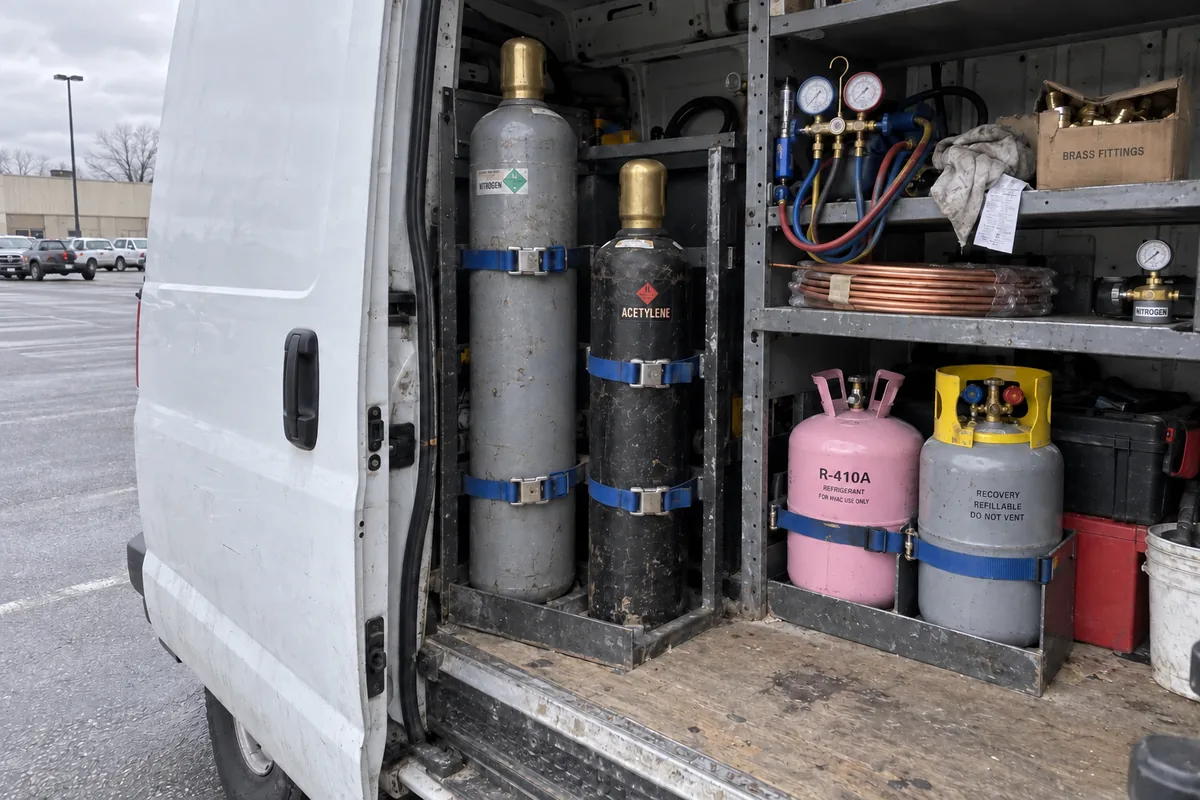
A service van loaded with nitrogen, acetylene, oxygen, refrigerant and a recovery cylinder is operating under 49 CFR 173.6, the Materials of Trade exception. Most shops have never heard it named. Every shop relies on it every day.
The companion piece on PHMSA’s A2L equipment transport rule covered the charged equipment side and said plainly that the cylinders riding in the same van are governed by something else entirely. This is that something else.
The exception works like this. When a material is transported by motor vehicle in conformance with the section, it is not subject to any other requirements of the hazardous materials regulations. No shipping papers, no placards, no hazmat registration. The category an HVAC contractor uses is a hazardous material carried by a private motor carrier in direct support of a principal business that is other than transportation by motor vehicle. A contracting company hauling its own cylinders to its own jobs fits that squarely.
It does not cover hazardous waste, and it does not cover material that is self-reactive or poisonous by inhalation. Neither of those is a problem on a residential truck.
A2L and R-410A share the same 220 pound cylinder limit
Here is the part worth knowing first. The per-cylinder limit did not change when refrigerant went from R-410A to A2L.
Section 173.6(a)(2) allows a Division 2.1 or Division 2.2 material in a cylinder with a gross weight not over 100 kg, which is 220 pounds. Division 2.1 is flammable gas. Division 2.2 is non-flammable, non-toxic gas. Both appear in the same sentence at the same number. Flammability does not move it.
That matters because the jug did move. Under the hazardous materials table, R-410A is UN3163, proper shipping name “Liquefied gas, n.o.s.”, Division 2.2. R-454B is UN3161, “Liquefied gas, flammable, n.o.s.”, Class 2.1. When your inventory turned over, the refrigerant in the van reclassified from non-flammable gas to flammable gas, and the exception covering it did not change by a pound.
The rest of the rack sorts the same way. Nitrogen is UN1066, Division 2.2. Acetylene, dissolved is UN1001, Division 2.1. Oxygen, compressed is UN1072, Division 2.2 with a 5.1 oxidizer subsidiary hazard, and that subsidiary hazard does not disqualify it here. The no-subsidiary-hazard restriction in that paragraph applies only to the permanently mounted ASME tank option, not to cylinders.
Contrast that with the equipment side, which genuinely did need fixing. PHMSA issued two final rules published August 4, 2026, effective August 19 and September 3, 2026, extending refrigerating machine exceptions that had covered only A1 refrigerant so they reach A2Ls as well. The cylinder rule needed no rulemaking because it already said 2.1 or 2.2. The shop readiness piece on the A2L changeover covers what else moved when that classification did.
One trap in the number itself. Gross weight is the cylinder as it sits, steel and contents together, not the net charge printed on the label. The tare weight is stamped on the cylinder shoulder. Read it.
The whole truck has a 440 pound ceiling
The per-cylinder limit is rarely what a shop bumps into. The whole-vehicle limit is.
Section 173.6(d) is one sentence: “The aggregate gross weight of all materials of trade on a motor vehicle may not exceed 200 kg (440 pounds).”
That is a total for everything on the truck, not a limit per cylinder and not a limit per gas. Every cylinder counts, and so does every other material of trade riding along, which on a working HVAC truck is more than just the gas rack.
A large nitrogen cylinder, an acetylene bottle, a charging jug and a recovery cylinder that is half full get to 440 faster than people expect, because the steel counts against you and a recovery cylinder full of takeout is heavy. Cylinder tare weights vary by manufacturer and size, so there is no shortcut here and no table that answers it for your fleet. Add up one truck, once, using the stamped tare on each cylinder plus what is actually in it.
Going over does not make the load illegal by itself. It means the load is no longer covered by the exception, and the full hazardous materials regulations apply to it instead. That is the regime a residential shop is not set up for, and finding out about it at a roadside inspection is the expensive way.
The conditions that quietly break the exception
The exception is not a free pass on how the cylinders ride.
Packagings must be leak tight for liquids and gases, sift proof for solids, securely closed, secured against shifting and protected against damage. Outer packagings are not required where receptacles are secured against shifting in cages, carts, bins, boxes or compartments, or by other means, which is what a proper cylinder rack is doing.
For gas in a cylinder, the rule says the cylinder must conform to the packaging, qualification, maintenance and use requirements of the subchapter, except that outer packagings are not required. Manifolding is authorized provided all valves are tightly closed.
The word to notice is qualification. It pulls the whole requalification schedule into the exception, which means a cylinder past its date is not a covered cylinder.
Most DOT specification cylinders requalify on a five year interval. That includes DOT 4B, 4BA, 4BW and 4E, the family that covers refrigerant recovery cylinders, and DOT 3A and 3AA, the high pressure steel used for nitrogen. There is a longer option: a DOT 3A, 3AA, 3B, 4B, 4BA, 4BW or 4E cylinder protected by an external corrosion resistant coating and used exclusively for non-corrosive gas commercially free from corroding components may be requalified by volumetric expansion testing every 12 years instead of 5. Acetylene is its own case. DOT 8 and 8AL cylinders run on 10 or 20 year intervals and are requalified on shell and porous filler under CGA Pamphlet C-13, not by the ordinary hydrostatic route.
The date is stamped on the cylinder. Walking the truck and reading them takes ten minutes and it is the single cheapest compliance check on this list.
Two more conditions travel with the exception. A non-bulk packaging must be marked with a common name or proper shipping name identifying what it contains, and a DOT specification cylinder, except specification 39, must be marked and labeled as the subchapter prescribes. And the operator of the vehicle must be informed of the presence of the hazardous material and of the requirements of this section. That last one is an actual obligation, not a formality. The tech driving the van has to be told, not assumed to know.
The disposable jug is the one with a prison term printed on it
Disposable refrigerant cylinders are DOT specification 39 cylinders, non-reusable and non-refillable. They are the ones carved out of the marking sentence above, because they are not marked the way a refillable specification cylinder is.
For DOT-39 cylinders manufactured on or after October 1, 1996, 49 CFR 178.65(i) requires the cylinder to be marked: “Federal law forbids transportation if refilled-penalty up to $500,000 fine and 5 years imprisonment (49 U.S.C. 5124).” The other required markings are DOT-39, NRC, the service pressure, the test pressure, the manufacturer’s registration number and a lot number or date of manufacture.
A DOT-39 jug never has a requalification date because it is never refilled. Putting a refilled one in a truck is not a paperwork problem, and the penalty is printed on the cylinder in the shop’s own supply room.
Recovery belongs in a refillable recovery cylinder, and that cylinder carries a requalification date like everything else. What comes back in it is also worth real money now, which the piece on recovery, recycling and reclaim goes through.
OSHA has its own rules for the same cylinders
DOT governs the transport. OSHA governs the work, and several of its rules land on the same cylinders in the same truck.
Under 29 CFR 1926.350, valve protection caps must be in place and secured. Cylinders transported by powered vehicles must be secured in a vertical position, and compressed gas cylinders must be secured upright at all times except for short periods while actually being hoisted or carried. Unless cylinders are firmly secured on a special carrier intended for the purpose, regulators must be removed and valve protection caps put in place before cylinders are moved. When work is finished, when cylinders are empty, or whenever cylinders are moved, the valve must be closed.
One line in that standard is worth reading twice if anyone has ever proposed building a tidy sealed cylinder box onto a van body: cylinders shall not be kept in unventilated enclosures such as lockers and cupboards.
The standard also requires oxygen cylinders in storage to be separated from fuel gas cylinders or combustible materials, especially oil or grease, by a minimum of 20 feet, or by a noncombustible barrier at least 5 feet high with a fire-resistance rating of at least one-half hour. That is written for cylinders in storage, and an oxy-acetylene rig sharing a van is a well known practical tension in the trade that the rule does not resolve for you. What it gives you is a real number to hold against how your rig rides and how it sits at the shop overnight. The torch end of that same work, including the fire watch that has no number attached to it, is covered in the piece on hot work and brazing.
What to do this week
- Read the stamps. Tare weight and requalification date, on every cylinder on every truck. Anything past date is outside the exception starting now.
- Add up one truck. Stamped tare plus contents, everything that counts as a material of trade, against the 440 pound aggregate. Do it once properly instead of estimating forever.
- Confirm nobody refills disposables. DOT-39 jugs are single use, and the reason is printed on them.
- Tell the drivers. Informing the operator of what is aboard and what 173.6 requires is a condition of the exception, and it is free.
- Look at how the rack is built. Upright, secured against shifting, caps on, valves closed, and not sealed into an unventilated box.
The version that reaches your phone
None of this shows up as a regulatory question. It shows up as a Tuesday where a tech is at the supply house sorting out what goes in the truck, the install crew is behind, and the office phone is ringing with a customer who wants to know when somebody is coming.
A caller who gets voicemail during that hour usually does not leave a message. They call the next company on the list, and the job never registers as lost because it never registered at all. Capturing what the equipment is doing and whether this is an emergency or a quote, on the first ring, is the whole difference. That is the job Dial 72 does when your office cannot pick up. See how it works, or pricing if that Tuesday is currently going to voicemail.
