
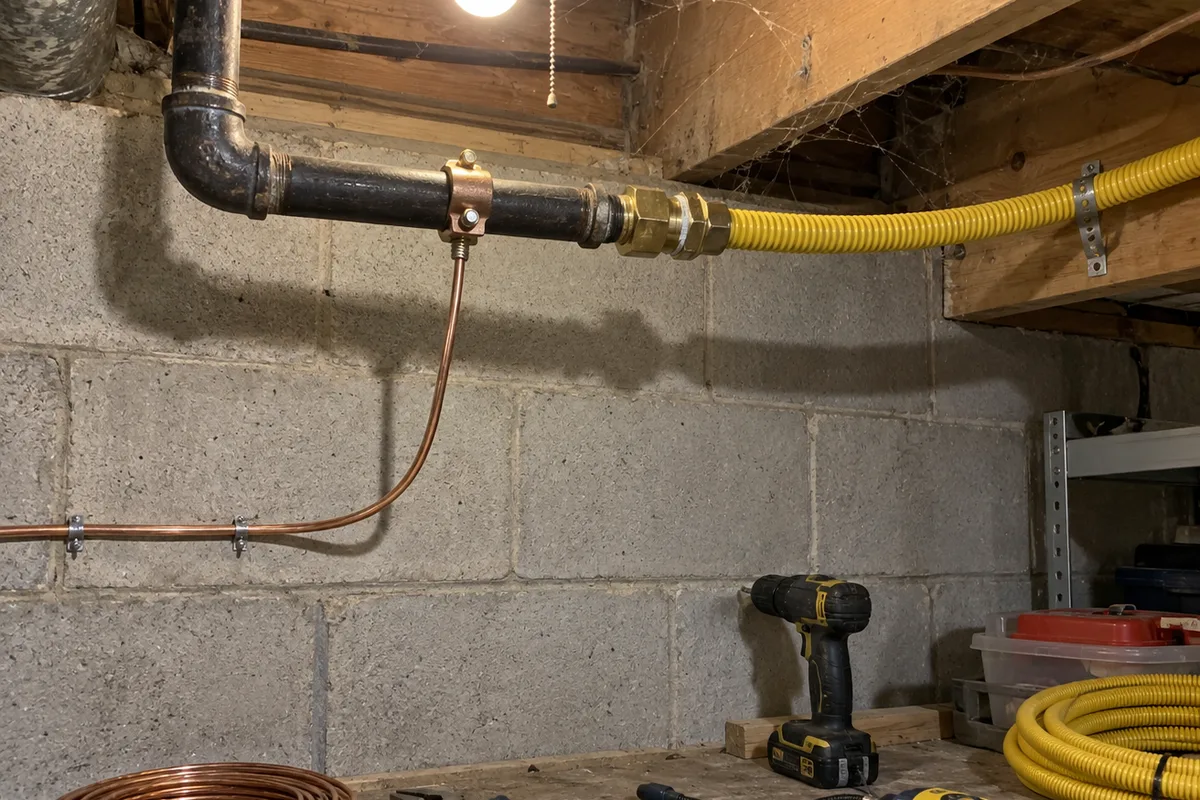
TL;DR: One segment of yellow CSST anywhere in the gas piping system triggers a bonding rule for the whole system: a copper bonding jumper no smaller than 6 AWG, no longer than 75 feet, connected to the electrical service grounding electrode system. The furnace’s equipment grounding conductor does not satisfy that rule.
One yellow CSST segment changes the bonding requirement
A single segment of yellow CSST anywhere in the gas piping system puts the whole system under the yellow CSST rule. The furnace’s ground wire does not count.
That is the check to make during a gas furnace change-out. Do not stop when you see the furnace connected to a grounded circuit. Look at the gas piping beyond the furnace.
The rules are in IFGC Section 310, Electrical Bonding. The same structure appears in IRC Section G2411. The enforceable section depends on the code edition and amendments adopted by the jurisdiction, not simply the newest model code. Check the adopted edition before quoting a section number to an inspector or homeowner. This article explains why the adopted edition controls.
Steel pipe, yellow CSST, and black CSST have different rules
For above-ground gas piping other than CSST, IFGC 310.1 and IRC G2411.1 require electrical continuity and bonding to an effective ground-fault current path when the piping is likely to become energized.
The code considers non-CSST piping bonded when it is connected to an appliance connected to the equipment grounding conductor of the circuit supplying that appliance. In plain terms, black steel pipe connected to a grounded furnace generally meets the bonding requirement through the furnace circuit.
Yellow CSST means CSST that is not listed with an arc-resistant jacket or coating system under ANSI LC1/CSA 6.26. Under IFGC 310.2 and IRC G2411.2, a CSST system, or any gas piping system containing one or more CSST segments, must be bonded to the electrical service grounding electrode system or, where provided, the lightning protection grounding electrode system.
That requires a separate bonding jumper. The furnace equipment grounding conductor is not a substitute.
Black CSST is different only when it is listed as arc resistant under ANSI LC1/CSA 6.26. IFGC 310.3 and IRC G2411.3 allow arc-resistant CSST to be considered bonded when it is connected to one or more appliances connected to the equipment grounding conductor of the supplying circuit. Black CSST connected to a grounded furnace generally does not need the separate 6 AWG jumper.
That relief disappears if the system contains even one segment of yellow CSST. It also disappears if no appliance on the system has an equipment grounding conductor. An all-black CSST system with one old yellow run to a range or dryer falls back under the yellow CSST rule for the entire system.
Do not confuse the flexible stainless appliance connector between the shutoff valve and the furnace with CSST. It is a separate listed product. The shutoff, connector, and sediment trap have their own change-out requirements covered here. CSST sizing is a separate question based on the manufacturer’s tables, covered here.
A compliant yellow CSST bond has four specific details
IFGC 310.2.1 requires the bonding jumper to connect to a metallic pipe, pipe fitting, or CSST fitting. Do not clamp onto the corrugated tubing itself.
ICC CodeNotes identifies acceptable attachment locations such as rigid pipe, a malleable iron fitting, a manifold, or a brass CSST fitting. The attachment surface must be clean and free of paint and other coatings.
The jumper must be no smaller than 6 AWG copper wire or equivalent under IFGC 310.2.2. Its length between the gas piping connection and the grounding electrode system connection cannot exceed 75 feet under IFGC 310.2.3.
The bonding device must be listed for the application under UL 467, as required by IFGC 310.2.5. Look for a clamp or other listed device made for this bonding connection. Do not treat an improvised clamp as acceptable because it is holding tight.
Only one attachment point is required, regardless of how long or complex the gas piping system is, according to ICC CodeNotes. The grounding side connects to a grounding electrode, the grounding electrode conductor, or the service enclosure.
Bonding the pipe does not turn it into a grounding electrode
Bonding and grounding are not the same job.
NEC 250.104(B) requires metal piping likely to become energized, including gas piping, to be bonded. That creates a path for fault current. It does not make the gas pipe part of the grounding electrode system.
NEC 250.52(B)(1) prohibits metal underground gas piping from being used as a grounding electrode. Connect the yellow CSST bonding jumper to the permitted grounding location, not to the gas pipe as if the pipe itself were the electrode.
If the crew is working near service equipment to check where the bond terminates, use the applicable electrical safety procedures. The OSHA issue is separate from the gas piping rule. See the related electrical work guidance here.
The hidden yellow run is the pattern that catches crews
A pattern that shows up on change-outs involves a house that was re-piped or added onto over the years. The original gas line is black steel. Later, a range, dryer, fireplace insert, or attic furnace run gets installed with yellow CSST. Nobody runs a bond.
The tech sees steel at the meter and assumes steel throughout. The yellow segment is up in the attic, behind the dryer, or beyond the visible furnace connection.
On the survey, check the CSST jacket color at the furnace and anywhere visible in the basement, attic, or crawl space. Look for a clamp on rigid pipe or a fitting near where the gas enters, often near the meter side. Follow the copper conductor and estimate its path to the service grounding point. The 75 foot limit still applies.
If the bond is missing, note it, photograph it, and put it in the proposal or hand it to whoever is licensed to install it in that jurisdiction. That may be a gas fitter, electrician, or HVAC contractor, depending on local licensing. Do not close the job silently.
A gas smell call should reach the on-call tech immediately
A “smell gas” call, or a call about gas odor after a lightning storm, is the kind of call your shop rules should mark as an emergency.
Dial 72’s AI receptionist, Bella, answers 24/7, triages calls by your rules, escalates emergencies to the on-call tech immediately, and texts the shop a summary after every call. The summary arrives before anyone rolls. See how it works.
Put this check on every gas change-out
Before closing a furnace change-out, do these five things:
- Identify whether the visible gas piping is steel, yellow CSST, or black CSST listed as arc resistant.
- Check for yellow CSST anywhere visible in the system, not only at the furnace.
- If yellow CSST exists, look for a 6 AWG or larger bonding jumper, a listed UL 467 connection, a clean attachment to rigid pipe or a fitting, and a path no longer than 75 feet to the grounding electrode system.
- Never clamp to the corrugated tubing.
- Photograph and document any missing bond, then assign the correction to the properly licensed party.
The furnace ground wire can cover the steel pipe case and generally covers an all-black, arc-resistant CSST system with grounded appliances. It does not cover a system containing yellow CSST.
