
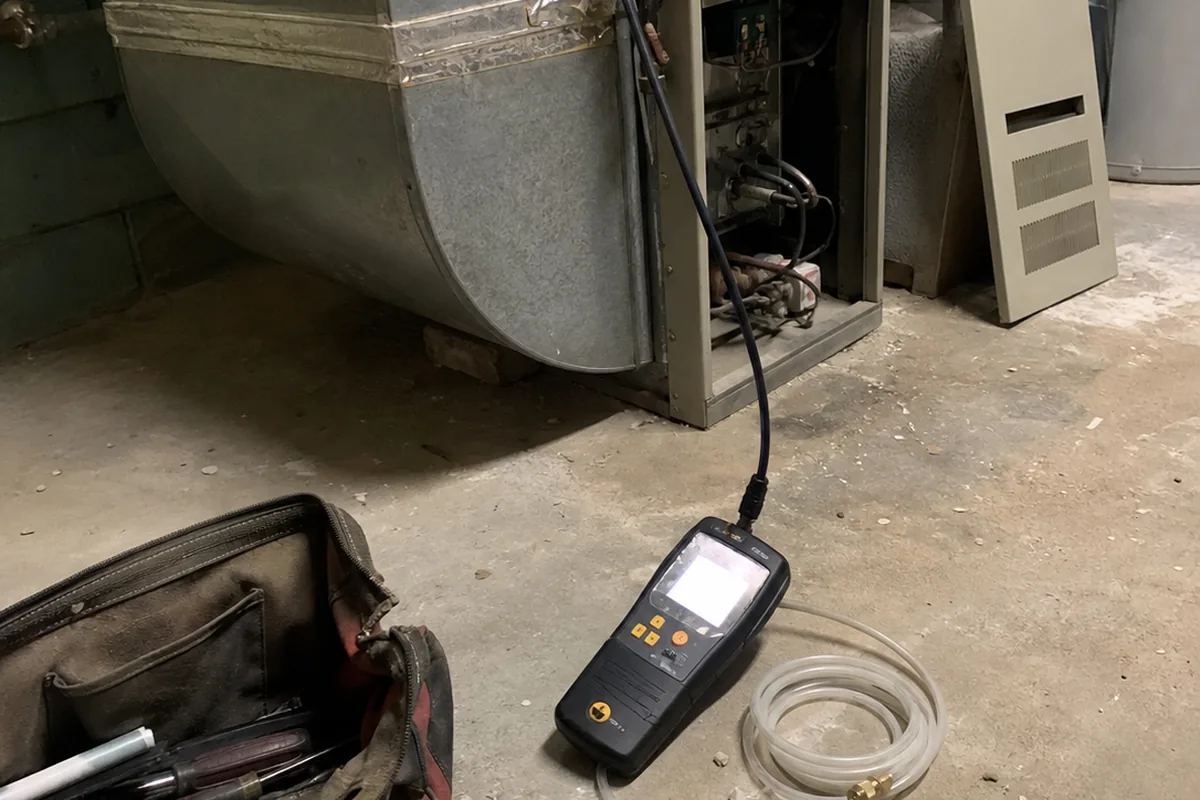
Combustion analysis is the measurement of what a fuel-burning appliance is actually producing at the flue, rather than what it looks like from the outside. A technician inserts a calibrated analyzer probe into the vent and reads oxygen, carbon monoxide in parts per million, stack temperature, and the calculated efficiency that follows from those. It’s the difference between “the heat exchanger looked okay” and a recorded set of numbers showing how the appliance actually ran on the day someone was standing in front of it.
Heading into fall, that distinction is worth thinking about before the first no-heat rush, not during it.
Why the stakes on this one are different
Most of what goes wrong on an HVAC call is a comfort problem or a money problem. Combustion is the category where it can be neither. The CDC reports that each year in the United States, unintentional carbon monoxide poisoning not linked to fires kills more than 400 people, sends more than 100,000 to an emergency department, and hospitalizes more than 14,000. Not all of that traces to furnaces, and plenty of it involves generators, vehicles, and other appliances. But CO poisoning reporting skews toward the winter months, which is exactly when a heating contractor is in people’s houses.
That’s the context for why the trade treats this test differently from checking a filter.
What the readings actually mean
The reading most people focus on is CO, measured in parts per million, and ideally reported “air-free” so the number isn’t diluted by excess air in the sample and made to look better than it is.
The number that gets quoted most often in this conversation is 400 ppm air-free, and it’s worth being precise about where it actually comes from, because it’s routinely repeated as though it were a field-service pass/fail line. It isn’t. It originates in the ANSI gas-appliance standards, including ANSI Z21.47 for gas-fired central furnaces, as a maximum an appliance may produce under prescribed laboratory test conditions, including tests run with the vent deliberately blocked. The CPSC discusses it in exactly those terms. It’s a certification limit for how equipment must behave on a test stand, not a code ceiling that a technician measures a working appliance against in a basement.
So what should a tech expect to see in the field? Lower, and stable. Training programs teach working expectations well below that certification figure, on the reasoning that a properly operating appliance has no business approaching a limit set by a blocked-vent test. Specific target ranges vary by training program, appliance type, and draft configuration, and none of them is a universal industry pass/fail threshold. Treat any single number you’ve heard repeated on a jobsite as a prompt to check the guidance you actually train against, not as settled consensus.
The more useful signal is often not the absolute number but its behavior. CO that climbs steadily or swings erratically during operation, at almost any level, points at something actively wrong with combustion, draft, or the heat exchanger, and it deserves investigation rather than a note on the invoice. A stable low number and an unstable low number are not the same finding.
Oxygen and stack temperature matter for the same reason. They’re what let a tech tell the difference between an appliance that’s genuinely combusting cleanly and one whose CO number happens to look acceptable because it’s pulling in dilution air somewhere it shouldn’t be.
Where the standard actually lives
For shops that want a defensible written basis for what a maintenance visit includes, the reference is ANSI/ACCA 4 QM, Maintenance of Residential HVAC Systems, most recently reaffirmed as the 2019 (R2024) edition. It’s ACCA’s ANSI-recognized consensus standard, and it works as equipment-specific checklists of minimum inspections, performance tests, and measurements, with recommended corrective actions when something is found. Its gas-appliance checklists cover the combustion side directly, including heat exchanger inspection for cracks, perforations, bulges, corrosion, and erratic flame behavior during blower operation.
Worth being precise about what that standard is and isn’t. ACCA 4 QM is a voluntary consensus standard, not a code that automatically applies everywhere. It carries weight because it’s ANSI-recognized and because it’s the trade’s own written answer to “what does a real maintenance visit consist of,” which is exactly the question a shop wants an external answer to rather than one it invented.
For hands-on training specifically on combustion and CO, the National Comfort Institute is the organization most of the trade points toward, and their material goes considerably deeper than a code minimum.
The business case, separate from the safety case
It’s the honest justification for what a real tune-up costs. A maintenance visit that includes recorded combustion readings is a materially different product from one that doesn’t, and it’s a difference a customer can understand without any technical background: one of them produced numbers, the other produced an opinion. Shops competing against a $59 “tune-up” that’s really a filter swap have a hard time explaining the gap in the abstract. A printed set of readings makes the gap concrete.
Recorded numbers are the record. If a CO question ever comes up on a house months later, the shop that has dated combustion readings from its last visit is in a completely different position than the shop whose file says “checked, OK.” That’s true whether the readings were clean or whether they flagged something the customer declined to repair, which is arguably the more important case to have documented.
It surfaces the things nobody wants to find late. Combustion readings can flag conditions a visual pass misses, and they can do it in October rather than January. Worth being careful about how much any one test claims, though. A CO reading that shifts when the blower energizes is a real signal, but it isn’t proof of a cracked heat exchanger. The National Comfort Institute has documented multiple scenarios on natural draft and 80% induced draft furnaces that can produce that same change, and a combustion analyzer measures what’s in the sample without identifying where it came from. Combustion analysis and physical heat exchanger inspection are complementary tests, and a finding on one is the reason to do the other, not a substitute for it.
If a shop isn’t doing this yet
The practical barrier is usually not the concept, it’s making it routine: having enough calibrated analyzers that every truck running gas calls has one, keeping the calibration current so the readings mean something, and building the readings into the paperwork the customer actually receives instead of leaving them in a tech’s head. An analyzer that lives in the shop or reads off-calibration is a line item, not a practice.
Quick answers
What does a combustion analyzer measure on a furnace? Oxygen, carbon monoxide in parts per million, and stack temperature at the flue, from which efficiency and air-free CO are calculated.
Where does the 400 ppm air-free figure come from? The ANSI gas-appliance standards, including ANSI Z21.47 for gas-fired central furnaces, as a maximum under prescribed laboratory test conditions rather than a field pass/fail limit. It is not an NFPA 54 field-service ceiling. Field expectations taught by training programs are lower and vary by program and appliance type, and rising or unstable CO at any level warrants investigation.
Is combustion analysis required by code on every maintenance visit? Generally no. ANSI/ACCA 4 QM is a voluntary consensus standard rather than a universally adopted code requirement, though some jurisdictions, manufacturers, and program requirements reference testing of this kind.
Does combustion analysis detect a cracked heat exchanger? Not by itself. It can reveal symptoms, such as a CO change when the blower energizes, that justify further investigation, but those symptoms have multiple possible causes and an analyzer does not identify the source of the CO it measures. Combustion analysis and physical heat exchanger inspection are complementary, and neither replaces the other.
