
A2L is a refrigerant safety classification from ASHRAE Standard 34, the standard that assigns every refrigerant a toxicity and flammability class. The “A” means lower toxicity. The “2L” means lower flammability: refrigerants that do exhibit flame propagation, but with a lower flammability limit above 0.10 kg/m³, a heat of combustion below 19,000 kJ/kg, and a burning velocity no greater than 10 cm/s. R-410A is classified A1, meaning it does not propagate flame under the Standard 34 test conditions. R-454B is A2L. That is the actual distinction, and it’s more defensible than the trade shorthand of calling one “non-flammable” and the other “flammable.”
Why the market moved, and what that does and doesn’t mandate
Worth being precise about causation here, because it gets stated backwards constantly. The federal transition was not a mandate to use A2L refrigerants. It was driven by EPA’s global warming potential limits under the AIM Act, which for residential and light-commercial air conditioning and heat pumps generally set a 700 GWP ceiling. A2L refrigerants happen to be a primary way manufacturers comply with that ceiling.
So R-454B is one of the main refrigerants adopted for new residential equipment, used by many manufacturers, rather than a refrigerant EPA required. R-32 is another EPA-accepted A2L option, and ASHRAE’s residential standard addresses a broader set including R-452B, R-454A, and R-454C. If you’re planning tooling and training, plan for the class, not for one product number.
The lower-GWP transition pushed the market toward these refrigerants. Their A2L classification is what drives many of the new safety, equipment, and handling requirements that follow.
What changed physically, before any paperwork
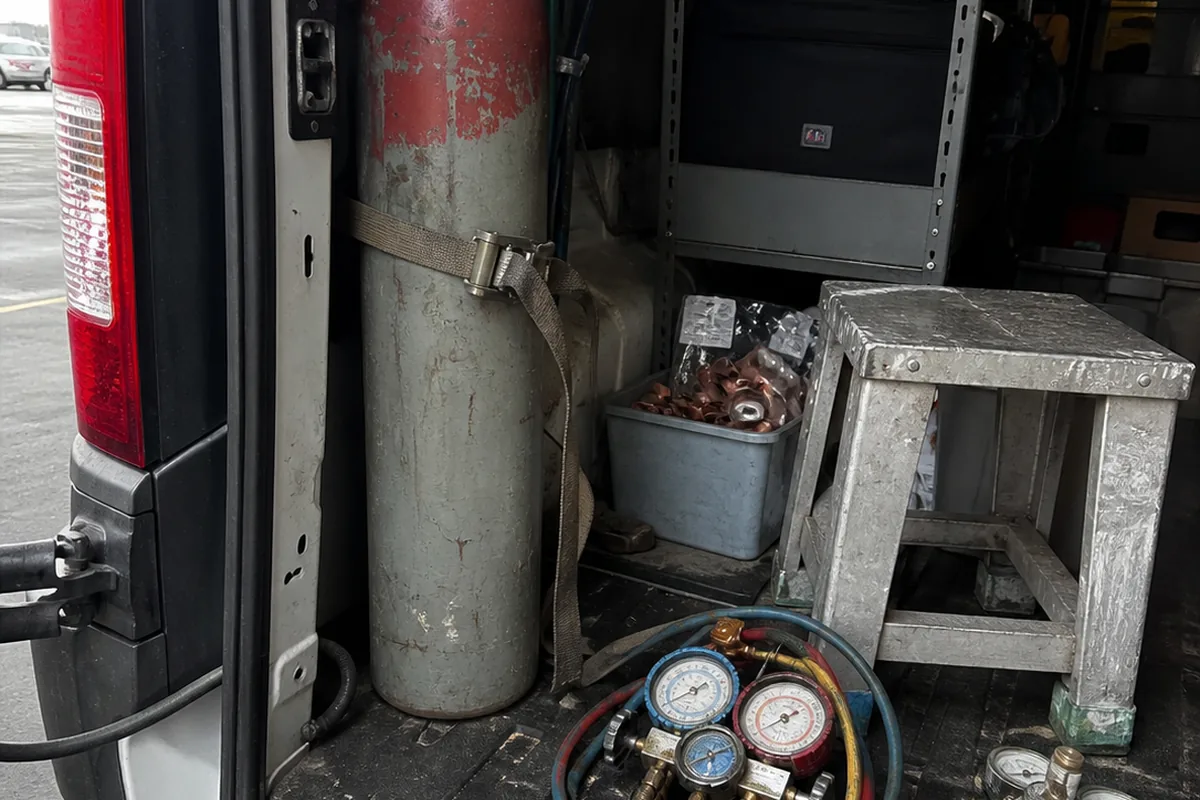
The cylinders don’t match your old connections. A2L cylinders use a left-hand thread on the cylinder valve, a deliberate design choice so A2L refrigerant cannot be cross-connected to equipment and tooling intended for other classes. The connection practice comes out of the Compressed Gas Association’s CGA V-1 standard for valve outlet connections. Confirm the exact fitting for a given cylinder against your supplier’s or the cylinder manufacturer’s documentation rather than assuming one adapter covers everything on your shelf.
The practical version: your existing hose sets do not thread onto these cylinders. Adapters and A2L-specific hose sets exist, and this is a real line item once you multiply it across every truck.
Do not identify a cylinder by its color. This is worth stating plainly because the old habit runs deep. AHRI moved away from refrigerant-specific cylinder colors in its container color guideline. Containers now use a uniform RAL 7044 body color, and a red band on the shoulder or top designates a refrigerant that is flammable or could become flammable. That red band tells you a flammability class, not which refrigerant is inside. AHRI is explicit that the container label and package markings are the primary means of positively identifying the refrigerant, and that the color guideline is not a substitute for reading them. A shop still training people to sort cylinders by color is training a habit the guideline was rewritten to eliminate.
Which standard actually covers which thing
This is where most A2L explainers, including an earlier draft of this one, get sloppy. Three different categories, three different answers.
The installed appliance: UL/CSA 60335-2-40. This is the safety standard for the equipment itself, air conditioners, heat pumps, and dehumidifiers, covering things like refrigerant charge limits, leak mitigation, and ignition risk within the appliance. It is an appliance standard. It is not the governing standard for the tools in your van.
Recovery equipment: EPA certification. Recovery and recovery/recycling equipment is certified under EPA’s rules at 40 CFR 82.158. Equipment manufactured or imported on or after January 1, 2017 is certified under appendix B3 for non-flammable refrigerants, based on AHRI Standard 740-2016, or under appendix B4 for flammable refrigerants, which is based on both AHRI Standard 740-2016 and UL 1963, Supplement SB, the requirements for recovery/recycling equipment intended for use with a flammable refrigerant. EPA has approved AHRI and UL to certify this equipment. So the question to ask a distributor is not “is this A2L rated” in the abstract, it’s whether the machine is EPA-certified for flammable refrigerant use.
Vacuum pumps, gauges, hoses, and leak detectors: check the tool, per the tool maker. There is no single standard that blankets all of these for A2L service. Verify suitability for the specific refrigerant you’re working with and follow the equipment manufacturer’s instructions. On detection specifically, a detector that reliably finds R-410A is not automatically appropriate for finding R-454B, so confirm rather than assume.
Transport and storage, without a magic number
Transport classification is a separate system from ASHRAE’s. DOT and PHMSA classify hazardous materials using their own flammability criteria, not ASHRAE’s letter-and-number scheme. Division 2.1 is DOT’s flammable gas division, and the major A2Ls in use here can fall into it, where R-410A and R-22 sit in Division 2.2 as non-flammable gases. But “A2L” and “Division 2.1” are two different classification systems, and it’s a mistake to treat one as automatically implying the other. What matters for your trucks is the DOT classification of the specific material you’re carrying.
Be careful with specifics here, and this is where trade-blog content will steer you wrong. Marking, labeling, shipping documentation, quantity thresholds, and placarding requirements live in the federal hazardous materials regulations at 49 CFR, and what applies depends on the material, the packaging, the quantity, and the circumstances of transport. Read the actual requirement for how your trucks are loaded, or have whoever handles your compliance do it, rather than adopting a weight threshold you saw quoted in an article. Including this one.
Storage depends on workplace rules and adopted local codes. General compressed-gas handling and storage requirements can apply under OSHA, whose compressed-gas standard at 29 CFR 1910.101(b) requires in-plant handling, storage, and use of compressed gases in cylinders to conform to the incorporated Compressed Gas Association safe-handling requirements. Separately, A2L-specific storage quantities, ventilation, and building requirements depend heavily on the fire and mechanical codes adopted in your jurisdiction, and those vary. The general principles are consistent: upright storage, away from ignition sources and incompatible materials, with attention to whether a space is ventilated. The enforceable numbers are local, so check them rather than inferring them.
The residential standard, and what an inspector actually enforces
For residential work, the relevant document is ANSI/ASHRAE Standard 15.2-2024, Safety Standard for Refrigeration Systems in Residential Applications, which supersedes the 2022 edition and was updated to align with the current UL/CSA 60335-2-40 requirements.
One important caveat, because this is easy to get wrong in the other direction: an inspector principally enforces the mechanical and building code your jurisdiction has adopted, not whichever edition of an ASHRAE standard a contractor happens to own. Adopted code frequently lags the newest standard edition. Standard 15.2 is highly relevant and worth knowing, but it isn’t a substitute for the adopted code, and it isn’t a trump card in a permit conversation.
The certification question, answered plainly
EPA Section 608 certification remains the federal technician-certification requirement for servicing covered stationary refrigeration and air-conditioning equipment. It’s structured around the type of appliance being serviced rather than the specific refrigerant, and EPA has stated that technicians already certified do not need to be recertified because of the HFC transition.
A2L-specific safety training is a separate matter: widely offered and widely recommended, particularly for safe transport, charging, and recovery. Some manufacturer and distributor programs make it a condition of program participation or dealer standing. Whether any of it is mandatory for you depends on your manufacturers and your state or local authority, so confirm it directly with them rather than assuming in either direction. ACCA and AHRI both publish A2L safety and transition material, and most manufacturer programs have their own.
Why this is an owner’s problem, not just a tech’s
Every item above is a purchase, a training hour, or a liability question, which makes it a planning problem rather than a technical curiosity.
It’s capital spread across trucks, not one tool. Hose sets, adapters, EPA-certified recovery equipment for flammable refrigerant, and appropriate detection gear, multiplied by the number of trucks running refrigerant calls. Discovering on a Saturday that the cylinder won’t thread onto the hose is the expensive version of learning this.
Mixed fleets are the actual difficulty. Shops are servicing R-410A systems that will be in the field for years while installing A2L equipment now. That means two sets of consumables, two sets of expectations, and techs who have to keep it straight in a hot attic. Labeling gear clearly and standardizing what lives on which truck is unglamorous and prevents the mistake that matters.
Documentation is the same lesson as everything else. As with the AHRI matched-system number and recorded combustion readings, a shop that can say what it installed to, and show that its people were trained, is in a different position than one that can only say the job went fine. That difference shows up exactly once, and only when something has gone wrong.
The same “which era is this system” question shows up on the phone before a truck ever rolls. A homeowner asking whether their system takes “the old refrigerant or the new kind” is really asking whether this is a same-day recharge or a conversation that ends in a replacement quote, and how that call gets routed depends on whether the office catches the distinction in real time or a tech discovers it in the driveway with the wrong cylinder on the truck. Dial 72 flags calls like that as a possible replacement lead rather than a routine repair, and passes the caller’s own description along in the text summary the office gets, which matters more now that a straightforward-sounding call can turn into a legacy-refrigerant sourcing problem nobody wants to find out about on site.
None of this is an argument that A2L refrigerants are dangerous. They’re lower flammability under specific conditions, and the equipment standards are written around that. It’s an argument that “the refrigerant changed” was never the whole change, and the rest of it lands on the shop.
For the regulatory timeline behind the switch, including the installation-deadline rule that moved in 2026, see our breakdown of the R-410A rule change.
Quick answers
What does A2L mean? It’s an ASHRAE Standard 34 safety classification: lower toxicity (“A”) and lower flammability (“2L”), meaning a refrigerant that exhibits flame propagation but has an LFL above 0.10 kg/m³, heat of combustion below 19,000 kJ/kg, and burning velocity no greater than 10 cm/s. R-454B and R-32 are A2L. R-410A is A1.
Did EPA require R-454B? No. EPA set global warming potential limits under the AIM Act, generally 700 GWP for residential and light-commercial air conditioning and heat pumps. A2L refrigerants are a primary way manufacturers comply, and R-454B is one of several options rather than a mandated product.
Can I identify an A2L cylinder by color? No. AHRI’s container color guideline moved away from refrigerant-specific colors to a uniform RAL 7044 body color, with a red band on the shoulder or top indicating a flammable refrigerant. The label and package markings are the primary means of identifying which refrigerant is inside.
Do I need new recovery equipment for R-454B? Recovery equipment must be EPA-certified for flammable refrigerant use. Under 40 CFR 82.158, equipment made or imported on or after January 1, 2017 is certified under appendix B4 for flammable refrigerants, based on AHRI 740-2016 and UL 1963 Supplement SB. UL/CSA 60335-2-40 is the standard for the installed appliance, not for your service tools.
Is EPA 608 certification still enough? Section 608 remains the federal technician-certification requirement for covered stationary equipment, it’s based on appliance type rather than refrigerant, and EPA has said already-certified technicians don’t need recertification for the HFC transition. Whether additional A2L training is mandatory for you depends on your manufacturers and local authority.
Which standard covers A2L in a house? ANSI/ASHRAE Standard 15.2-2024, Safety Standard for Refrigeration Systems in Residential Applications, which supersedes the 2022 edition. The enforceable requirement is whatever your jurisdiction’s adopted code incorporates, which may lag the current edition.
