
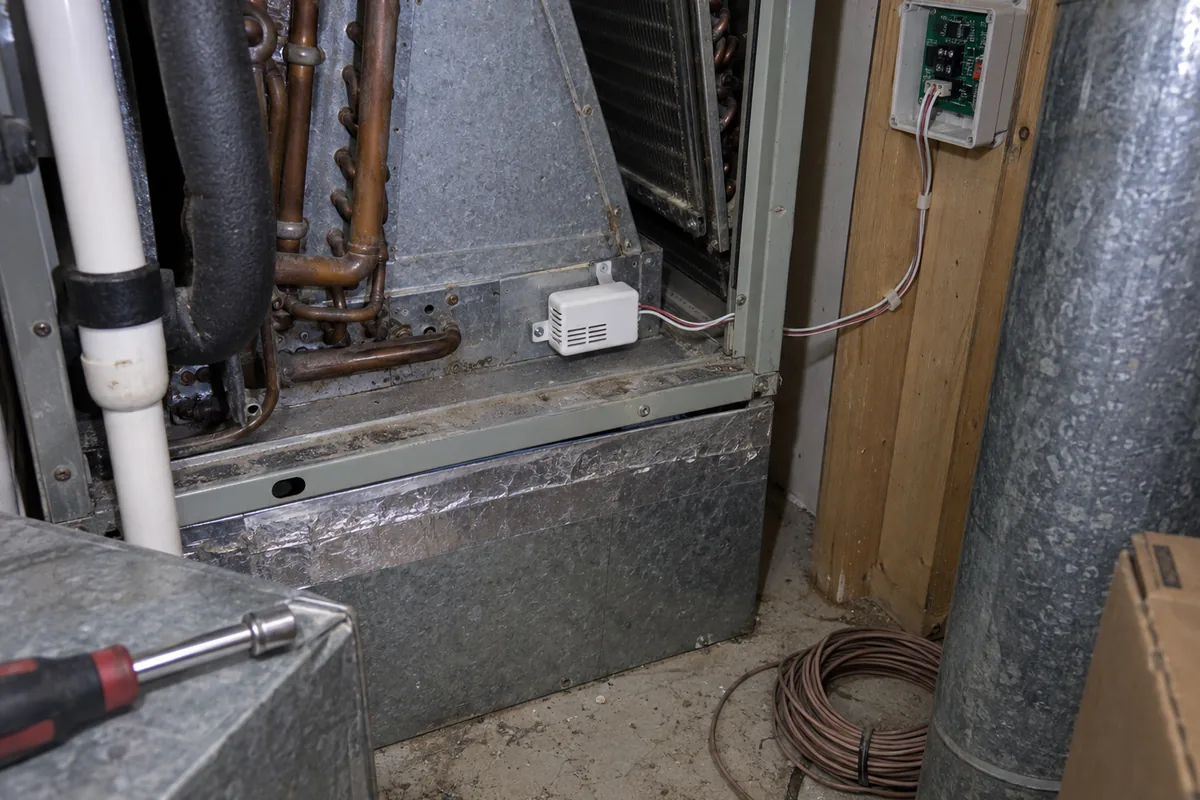
The call comes in on a Thursday in August. The homeowner says the air conditioning stopped cooling, but the fan will not shut off, and it has been running all night. They have already turned the thermostat off. It did not help.
The tech gets there and finds exactly that. No compressor, no cooling, indoor blower running continuously, thermostat unresponsive. He puts a sniffer on the coil and around the line set connections and finds nothing. Pressures look normal. The equipment is four months old.
Nothing about that is a contradiction, and nothing about it is a mystery.
On A2L equipment, a refrigerant detection system can take control of the system away from the thermostat, shut off the compressor and any ignition source, and run the indoor blower to dilute the space. That is mitigation mode, and it is the equipment doing precisely what it was listed to do. The part that catches shops out is that on a fail-safe design, a sensor fault or a control fault triggers the same response as a real leak, and so can something in the room that is not refrigerant at all. So “the system locked out” is the start of a diagnosis, not the end of one. There are at least three different causes behind that one symptom, and they have three different fixes.
What the detection system is actually required to do
This is worth getting exact, because the requirements explain the behavior you are looking at on the driveway.
UL Solutions describes an integral refrigerant detection system as “a system that uses one or more stationary sensors to detect the presence of a refrigerant leak at a specified concentration and automatically initiates one or more mitigating actions.” The trigger point is not a full flammable mixture. It is a quarter of the way there. UL 60335-2-40 requires a system response when the detection system “senses a concentration of refrigerant gas that is 25% of the lower flammability limit (LFL).”
The timing is tight and the reset is deliberately slow. The RDS must call for mitigation within 15 seconds of detecting that concentration, and UL states that “this signal must continue for a minimum of five minutes before resetting.”
The mitigating actions themselves come off a defined list. UL names activating the indoor air circulating fan, signaling zoning systems to fully open all zone dampers, shutting off the compressor unless pump down control is specified, de-energizing ignition sources such as heating elements and air cleaners, closing shut off valves to stop refrigerant flow, triggering audible or visible alarms, and initiating mechanical ventilation. Read that list against the symptom in the opening paragraph. Blower on, compressor off, thermostat not in charge. That is the list, running.
UL’s guidance to code officials is that an RDS is generally expected on equipment above roughly a 2 pound charge for nonfixed factory sealed equipment, or above roughly 4 pounds for other types. That is the practical reason this is now a residential problem and not a commercial one.
Where the requirement comes from, so you can answer the inspector
Two documents carry it, and they are not the same document.
The residential safety standard is ASHRAE 15.2. It requires an integral refrigerant detection system on A2L systems carrying more than the m1 charge limit. That is the standard that says a detection system has to exist.
The product standard is UL 60335-2-40, and that is the one that says what the detection system has to do. Its Fourth Edition published December 15, 2022, with certification requirement decisions issued in March 2023 and clarified that October, and it became mandatory for new product certifications on January 1, 2025. UL 1995, the standard a lot of older equipment was listed to, is no longer maintained past that date.
On the code side, the 2024 International Mechanical Code approves A2L refrigerants for comfort cooling and requires equipment using Group A2L refrigerant to comply with UL 484, UL/CSA 60335-2-40, or UL/CSA 60335-2-89. The code language is consistent with the safety standards but it is not word for word identical to them, which is the usual reason a field argument happens.
As always, adopted code is what gets enforced, not the newest published edition. Confirm what your jurisdiction has actually adopted rather than quoting an edition year at an inspector. The broader map of which standard answers which A2L question is in our earlier piece on A2L shop readiness.
Fail-safe is the part nobody explains to the tech
Here is the sentence that resolves the opening scene.
UL 60335-2-40 requires that “refrigerant detection systems, by design, shall employ electrical or electronic circuitry that is intended to fail-safe and engage an appropriate system response.” Fail-safe means the safe failure direction. A detection system that quietly goes blind is the dangerous outcome, so when it cannot see, it assumes the worst and mitigates.
The practical consequence: a system in mitigation mode has not necessarily detected refrigerant. It may have lost the sensor.
Manufacturer documentation says this plainly. Daikin’s published installation instructions for its Non-A2L Furnace Integration Kit, the accessory that lets an existing non R-32 furnace stay in place when the coil and outdoor unit are replaced with R-32 models, describe the operating principle in three steps. At a safe concentration the kit passes all thermostat signals through untouched. And then, in their words, when R-32 concentration is above a certain level “or the R-32 sensor or the integration kit encounters a fault,” the kit energizes the G terminal with 24VAC, disconnects the R signal to the thermostat, disconnects ClimateTalk communication where applicable, and terminates all cooling and heating operation while keeping the main blower running to dissipate any refrigerant gas.
Leak or fault, same output. The equipment cannot tell you which one it was by behavior alone. It tells you with a status code.
That document is one manufacturer describing one accessory, and the numbers and flash patterns below are theirs. They are here to show the shape of the diagnostic, not to be applied to a different brand’s board. Your equipment’s instructions govern your job.
Reading the codes instead of guessing
On that kit, a single red LED carries the whole story, and the patterns are worth internalizing because the shape repeats across the industry even when the specifics do not.
- Slow flash, 2 seconds on and 2 seconds off. Normal operation, no faults.
- Fast flash. An R-32 leak alarm is currently being detected. The controls and sensor are working correctly. Go find the leak.
- Steady on, not flashing. Delay mode. The alarm cleared and the unit is holding in mitigation for its 5 minute period before returning to normal.
- 2 flashes, then off for 5 seconds. Control board internal fault.
- 3 flashes, then off for 5 seconds. Sensor communication fault. The board cannot talk to the sensor.
- 4 flashes, then off for 5 seconds. Sensor fault. Communication is fine and the sensor is reporting an internal problem about itself.
Two of those six say “leak.” Three of them say “the detection system has a problem.” The symptom at the thermostat is the same in all five non-normal cases, which is exactly why a shop that treats a lockout as automatically a leak call ends up doing a two hour leak search on a system that needed a 20 dollar part and a code read.
The published ladder for separating a board problem from a sensor problem is mechanical. Unplug the sensor and plug it back in, then cycle power. If it returns to normal operation or delay mode, there is no further issue. If not, unplug the sensor, leave it unplugged, and cycle power again. If the control still shows a control board internal fault with the sensor absent, the fault is on the board and the control gets replaced. If it now shows a sensor communication fault, the sensor is implicated.
One honest note in that same table is worth quoting for what it tells you about scope. On a sensor communication fault, the manufacturer says the problem could be the sensor, the sensor harness, or something internal to the control, and that “the field will not be able to measure anything to reliably fix this error assuming the connector is properly secured to the control. Replacing both is the only option.” That is not a diagnosis you are going to out-clever with a meter. Price the visit accordingly and stock both parts.
The five minutes that survives a power cycle
This one produces bad conclusions, so it deserves its own heading.
After the sensor stops detecting refrigerant, that kit holds the system in mitigation for an additional 5 minutes. During that window the LED goes from fast flashing to steady on. Only after it expires does the system return to normal operation.
And critically, the manual warns that once the system enters leak mitigation mode it may stay there for approximately 5 minutes “even if the board loses power (i.e. power cycled).”
So the classic field test proves nothing. A tech kills power, restores it, watches the system come straight back up in mitigation, and concludes there is a live leak. There may not be. He may simply be inside the hold-off window. Wait it out, watch the LED, and read the pattern before you decide what you are looking at.
The same manual notes the other half of that trap: if the sensor is not connected before the board is powered up, the system will enter leak mitigation mode. Their instruction is direct, connect the sensor before powering up. A first-time startup that goes straight into mitigation is very often an install sequence problem, not equipment failure.
The third cause: it detected something that was not refrigerant
The sensor can be working perfectly, be perfectly connected, and still be wrong about what it smelled.
Writing for HVAC School in August 2025, JD Kelly laid out the mechanism. The two common sensing technologies are thermal conductivity, which measures how the air mixture conducts heat, and metal oxide semiconductor, which measures resistance change when gas molecules react with a heated metal oxide film. Neither one is specific to refrigerant. As that article puts it, hydrocarbons and solvents “have different thermal conductivity properties than clean air” and can “react with the metal oxide film in MOS sensors, altering their electrical resistance in a way that is indistinguishable from a refrigerant detection.”
The example named there is construction adhesive, specifically Geocel 2300, whose own manufacturer data describes it as intended for exterior use because of the odor emitted during cure. The general category is volatile organic compounds: solvents, adhesives, curing spray foam, fresh paint, and household chemicals used near an indoor unit.
That gives you a question to ask before you open anything, and it is a question the office can ask on the phone. What changed in that room, that closet, or that attic in the last few days. New flooring, a bathroom remodel, foam in the rim joist, somebody sealing duct with the closet door shut. If the answer is yes and the sensor sits low in the coil cabinet a few feet away, off-gassing belongs at the top of your list, ahead of assuming a leak in a four month old system.
The recommended response is to investigate the environment before condemning parts, ventilate the space, and confirm the sensor’s reading with a handheld leak detector rather than trusting or replacing on faith. Note the order there. You are not overruling the sensor, you are corroborating it. On a real leak, the sniffer agrees.
Longer term this is also a spec conversation. Choosing low VOC or indoor air quality compliant products for work near an indoor unit is cheaper than the callback, and a 60 second conversation with the homeowner about hairspray, paint, and cleaners near the air handler prevents a real percentage of these.
What you do not do, and the one narrow exception
Bypassing the sensor is not on the menu. The HVAC School piece says it directly: do not bypass these A2L sensors, even when it seems like the only way to get the system running. Daikin’s kit manual opens with a boxed warning that reads, in full, “Do not bypass safety devices.” You are defeating a listed safety function on flammable refrigerant equipment, in someone’s house, in writing, on your invoice.
There is exactly one adjacent thing that gets confused for bypassing, and it is worth naming so nobody stretches it. Some furnaces ship A2L ready with the R-32 function available in the control. If such a furnace is installed with R-410A equipment, meaning there is no A2L refrigerant anywhere in that system, the A2L function can be disabled in the furnace control menu, after which the control ignores A2L functions.
That is not your changeout. On an R-32 or R-454B system the refrigerant is in the building and the detection system is part of the listing. And note what the same manufacturer requires when the mandatory verification test cannot be made to pass: if it cannot be resolved with technical support, the installer must replace the furnace or modular blower with a compatible one. Replace the equipment, not the safety function.
The commissioning test most shops are skipping
Everything above gets easier if the system was verified at install, and this step is quietly mandatory.
That manual states in capitals that running the system test is mandatory for all installations and that the HVAC system must not complete commissioning until the listed installation steps have been successfully completed. There is a built-in way to do it without releasing refrigerant. Press the push button on the control twice within 5 seconds and the board enters system verification mode, a simulated leak alarm that runs for up to 5 minutes, with the red LED flashing fast.
What you are watching for during that simulation, on their published timings:
- Gas heat or electric heat turns off within 30 seconds.
- A non-communicating outdoor unit turns off within 2 minutes. A communicating outdoor unit may take up to 12 minutes.
- The indoor blower starts within 30 seconds and keeps running. It is normal for it to ramp up or down.
- On a communicating thermostat, a loss of communications error on the screen during the test is expected, because the kit is deliberately cutting that communication.
If gas or electric heat is still running after 2 minutes, or the communicating outdoor unit is still running after 12, the manufacturer’s instruction is to stop, recheck the wiring diagram, and not continue until it is resolved. Then repeat the test in each mode you have not yet tested, cooling, heating, emergency heat, constant fan, and idle.
Two setup details that cause failed tests and get blamed on the kit. Furnace control firmware has minimum versions before the kit is installed, and on that product line the published floors are software version 11 or greater for a two stage furnace, 8 or greater for a modulating furnace, and 10 or greater for an ultra low NOx furnace, updated with the manufacturer’s phone application. And on ComfortNet systems the existing 4 pin green connector has to be swapped for the included 5 pin connector that adds the G terminal, because G is how mitigation runs the blower.
Where you mount it decides what next year’s service call costs
Two physical requirements from the same manual pay for themselves.
The control is to be installed externally to the cased coil and the furnace, never mounted on either, and it must always be accessible and serviceable. A wall near the unit, a wood beam, or the return duct are all called out as acceptable. A board buried behind ductwork is a board nobody can read a flash code off of at 9pm.
And after the sensor is connected, the manual is emphatic that the sensor must be kept in its original location and correctly mounted in its bracket. Sensor placement is not decoration. Inspectors are told to confirm sensor placement against the manufacturer’s instructions, typically near the indoor coil and toward the bottom, because these refrigerants are heavier than air. A sensor zip tied somewhere convenient is a detection system that will find the leak late.
It is the same principle as the rest of a good changeout. The manufacturer already made the design decision and wrote it down, exactly as with the line set you reused, and the mechanical code is what makes those instructions enforceable rather than advisory.
Sensors do not last forever, and the standard accounts for that
One more thing to put on the ten year conversation.
UL 60335-2-40’s Annex LL.7 drift testing requires that “over the refrigerant sensor life, the refrigerant detection system shall consistently initiate a system response within 60 seconds” when exposed to 25% of LFL, and a separate annex sets out the evidence a manufacturer must provide for a claimed sensor life span. Sensor life is a published, bounded number, not an assumption.
The practical reading for a shop: A2L sensors are a wear item with a manufacturer-stated life, and on some equipment the end of that life is going to present as a fault code and a system in mitigation, in August, on a system that is otherwise fine. Find the stated life for the lines you sell and put it in the same mental bucket as anode rods and capacitors, something you expect rather than something that surprises you.
What to actually change on Monday
- Teach every tech the flash codes before the next lockout, not during it. Print the status table for the equipment you actually sell and put it in the van. Two of the codes mean leak. The rest mean the detection system needs attention.
- Add “what changed in that room recently” to the phone script. New flooring, paint, adhesive, foam, a remodel. It costs 10 seconds and it reframes a whole class of these calls before a truck rolls.
- Stop treating a power cycle as a test. The hold-off can survive it. Wait the 5 minutes and read the LED.
- Run the verification test at every install and write down that you did. It is mandatory, it takes minutes, it uses a button instead of refrigerant, and it is the documentation that protects you when the system mitigates six months later.
- Connect the sensor before you power up the board, and leave it in its bracket in the location the manual specifies.
- Stock the sensor and the control together for the platforms you install most. On at least one published fault the manufacturer’s own answer is to replace both.
- Never bypass it. If the system cannot pass verification, that is an equipment or wiring problem to resolve, not a safety device to defeat.
The version of this that reaches your phone
The homeowner does not call and say the refrigerant detection system entered mitigation mode following a sensor communication fault.
They call and say the AC is broken and the fan will not shut off and it has been running since last night and it is 96 degrees. They are worried about the electric bill and they are worried the new system they just bought from you is a lemon. That call comes in hot, and often it comes in after hours, because a blower that will not stop is the kind of thing people notice at 11pm.
Whoever answers needs to get three things down and get them to the right person: that it is a recent install, that the blower is running with no cooling, and whether anything was painted, glued, foamed, or remodeled near the indoor unit in the last week. That last question, asked on the phone, can turn a leak search into a code read.
That is the job Dial 72 does when your office is already on another line or the crew is still on a roof. See how it works, or pricing if that call is currently going to a machine.
Quick answers
My A2L system is locked out and the blower will not stop. Is that a leak? Not necessarily. That behavior is mitigation mode, and refrigerant detection systems are required to fail-safe, so a sensor fault or a control fault produces the same response as a real leak. Some sensors will also respond to off-gassing from adhesives, paint, or curing foam. Read the status code before you decide.
What concentration sets it off? UL 60335-2-40 requires a system response when the detection system senses 25% of the refrigerant’s lower flammability limit. The system must call for mitigation within 15 seconds, and the signal must continue for at least 5 minutes before resetting.
What does mitigation mode actually do? Depending on the equipment, it runs the indoor blower, shuts off the compressor, de-energizes ignition sources such as gas heat and electric heat, opens zone dampers, and can trigger alarms or ventilation. On one published integration kit it also disconnects the R signal to the thermostat, which is why the thermostat appears dead.
I cycled power and it came right back into mitigation. Does that confirm a leak? No. At least one manufacturer states the unit may remain in mitigation for approximately 5 minutes even if the board loses power. Wait the window out and watch the indicator before concluding anything.
Can I bypass or disable the sensor to get cooling back on? No. Manufacturer documentation says not to bypass safety devices and trade guidance says the same. The one narrow exception is an A2L capable furnace installed with R-410A equipment, where no A2L refrigerant is present in the system and the A2L function can be disabled in the control. That does not apply to an R-32 or R-454B system.
Do I need a detection system on a residential changeout? If the system uses an A2L refrigerant and carries more than the charge limit in the residential safety standard, yes. ASHRAE 15.2 requires an integral refrigerant detection system above the m1 limit, and UL’s guidance to inspectors points at roughly 2 pounds for nonfixed factory sealed equipment and roughly 4 pounds for other types. Confirm against your equipment’s instructions and your adopted code.
Can I keep the existing furnace when I put in an R-32 coil and condenser? On some product lines, with the manufacturer’s integration kit, yes. Daikin’s instructions state that if either the indoor coil or the outdoor unit needs replacing then both must be upgraded to R-32 models, while a furnace or modular blower that is still operational does not have to be replaced. The kit plus the sensor becomes the leak detection system, the mandatory verification test has to pass, and firmware minimums apply.
Do A2L sensors expire? They have a manufacturer-stated life. UL 60335-2-40 includes drift testing requiring consistent response within 60 seconds at 25% of LFL across the sensor’s life, and requires evidence supporting whatever life span is claimed. Treat the sensor as a wear item and find the stated figure for the equipment you sell.
