
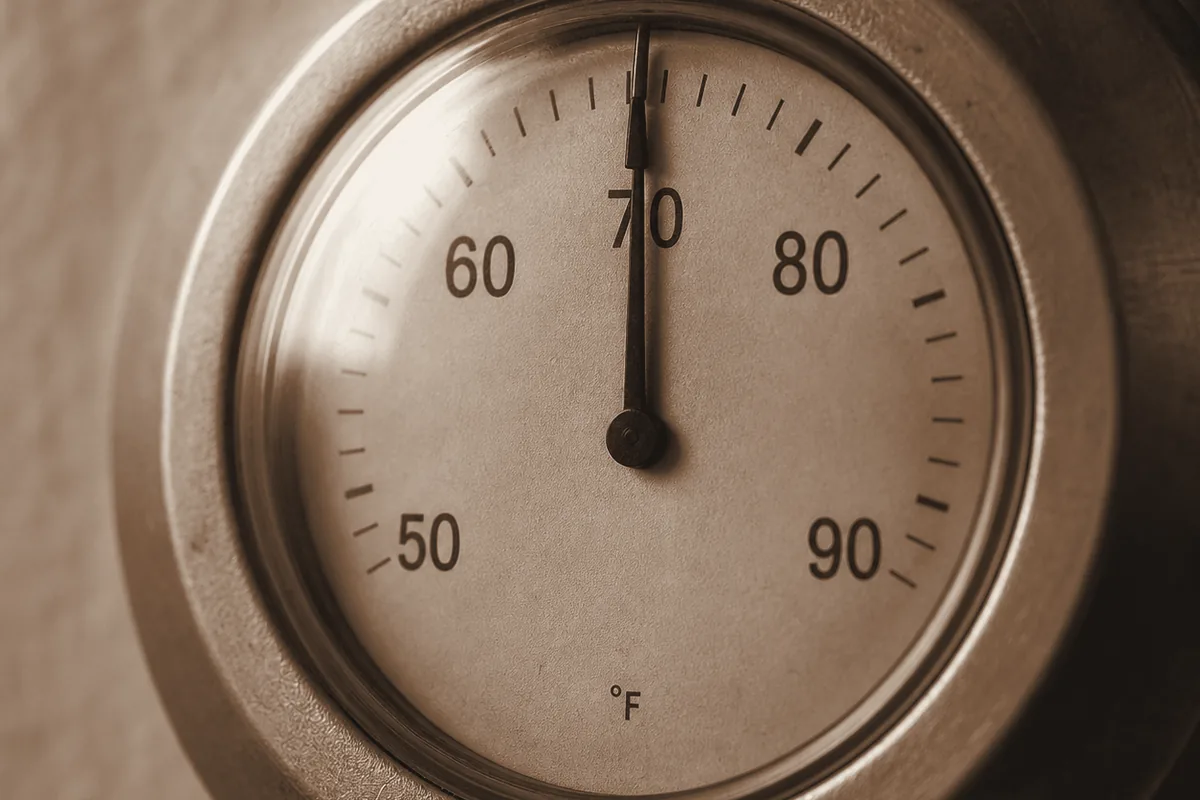
Walk into any home in America and look at the thermostat. Odds are it’s set somewhere between 68 and 76, and odds are the people who live there have argued about it. But when the argument finally ends, when everyone grudgingly agrees on a number they can live with, it lands in the same place so often that the trade has a shorthand for it: set it to 72.
So where did the magic number come from? And why does an entire industry orbit around it?
The science part (there actually is one)
Comfort isn’t one number. It’s a zone. ASHRAE, the standards body the HVAC world runs on, defines thermal comfort as the condition where roughly 80% of occupants are satisfied, and the acceptable indoor range it describes generally spans the high 60s to the mid 70s depending on season, humidity, clothing, and activity.
Look at the middle of that zone. In cooling season, with typical indoor humidity and summer clothes, the center of the comfort range lands almost exactly where every homeowner’s finger stops on the dial: right around 72°F.
It’s not arbitrary. The human body at rest, lightly dressed, sheds heat at a comfortable rate into 72-degree air. Colder, and you start losing heat faster than you produce it, so you feel chilly. Warmer, and your body has to work to dump the excess, so you feel stuffy. 72 is the temperature where most bodies, most of the time, stop noticing the air at all.
That’s the real definition of comfort: the temperature you don’t think about.
Why the fights are always over two degrees
Every tech has stood in a kitchen refereeing the same argument: one person wants 70, the other wants 74. Nobody fights about 60 versus 85, those are settled questions. The battles happen in the narrow band around 72, because that’s where individual differences actually matter.
Metabolism, age, body size, what you’re wearing, whether you just carried groceries in from the car, all of it shifts your personal comfort point a degree or two. Women often run a couple degrees colder than men in the same room (office HVAC studies have made this famous). Older folks feel cold sooner. Kids run hot.
So 72 isn’t the temperature everyone loves. It’s the temperature everyone can live with, the treaty line. Which is exactly why it became the default: it’s not the peak of anyone’s comfort, it’s the center of everyone’s.
Humidity: the part homeowners never factor in
Here’s the piece of the puzzle the trade knows and customers don’t: 72 only feels like 72 at reasonable humidity.
At 50% relative humidity, 72 is that perfect nothing-temperature. Push the humidity to 70% and the same 72 feels sticky and warm, because sweat stops evaporating efficiently. Drop it to 20% in winter and 72 feels cool and scratchy, because moisture is evaporating off your skin faster than it should.
This is why “it’s set to 72 but it doesn’t feel right” is one of the most common service calls in the book, and why a good tech checks more than the setpoint. The number on the wall is a promise. The equipment behind the wall is what keeps it.
The number the whole trade exists to deliver
Strip the industry down to its purpose and it’s this: machines that hold a house at the number its people picked. Everything else, tonnage calculations, refrigerant lines, heat exchangers, duct design, is in service of that little number on the wall staying true.
Which means every service call is really the same call. The furnace quit in a January freeze and it’s 45 in the living room. The AC died in a heat wave and it’s 85 upstairs at bedtime. A newborn’s room won’t hold temperature. In every case, a house drifted away from 72, and someone in it grabbed a phone.
And here’s the part that decides who gets the job: what happens when they dial. If your line rings out to voicemail, most of those callers never try again. They go straight to the next shop on Google. The house still gets back to 72. It just gets there on a competitor’s invoice.
Why we named the company after it
That’s the whole story behind our name. Dial 72 is what happens when both meanings of “dial” point at the same promise: the thermostat setting everyone’s trying to get back to, and the phone call that starts the trip.
When a customer dials, Bella answers, in under a second, at 2 p.m. or 2 a.m. She sorts the true emergency from the tune-up, books the job into your calendar, and texts you the details. The house gets back to 72, and the job stays on your books instead of your competitor’s.
72 is where comfort lives. We just make sure the call that gets a house back there always gets answered. See how it works, or check pricing: flat rate, steady as the setpoint.
